TURNAs-2026: Turkish Navy Puts 41 Unmanned Systems to the Test

The Turkish Naval Forces Command opened one of its largest unmanned-systems exercises to date this week, putting 41 drone and autonomous systems from 17 domestic manufacturers through live drills alongside 18 crewed ships and 11 aircraft in the Gulf of Antalya and the eastern Mediterranean.
The drill, designated TURNAs-2026 (İnsansız Deniz Sistemleri Tatbikatı, or Unmanned Maritime Systems Exercise), began on October 21 according to an announcement from Türkiye’s Ministry of National Defence (MSB), relayed the same day by Anadolu Agency. It groups unmanned surface, underwater, air and amphibious platforms already in Turkish Naval Forces service alongside prototypes and recent designs from the country’s defence industry.
What Took Part
According to the MSB statement, the exercise combines a multipurpose amphibious ship, a frigate, a corvette, a fast attack boat, a submarine, a mine countermeasures vessel, a test and training ship, an amphibious landing ship and auxiliary vessels from the fleet, operating alongside unmanned surface vehicles, kamikaze unmanned surface vessels, a maritime patrol aircraft, SH-70 Seahawk helicopters, unmanned aerial vehicles and Turkish Coast Guard boats.
The numbers given by the ministry put the crewed side at 18 ships and 11 aircraft, against 9 unmanned aerial vehicles, 7 unmanned underwater vehicles and 9 unmanned surface vehicles. Neither the MSB nor AA named every system or company involved, and as of this report Ankara had not issued a closing statement or result summary; the drill’s precise end date has not been confirmed.
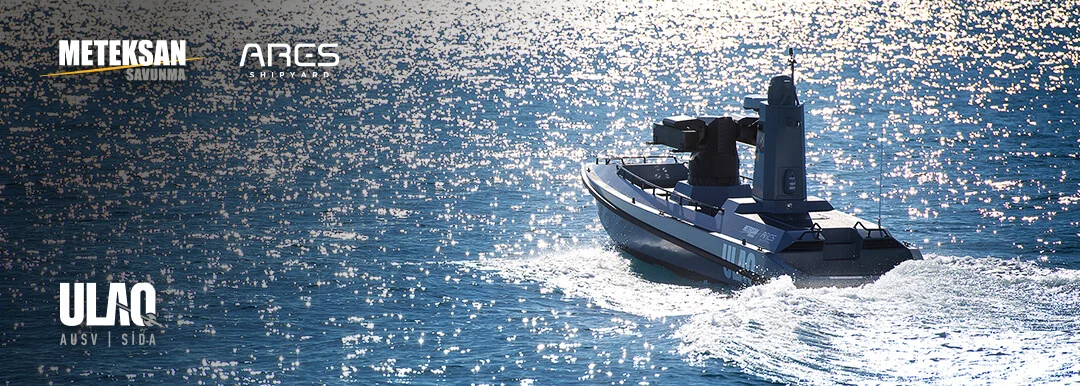
The broad categories match a product line Turkish industry has built up over the past five years largely for export as much as for the Turkish Navy itself. Armed unmanned surface vessels such as Meteksan and ARES Shipyard’s ULAQ, already sold to Qatar, and MKE’s kamikaze PİRANA, which has been fired in earlier fleet exercises under Bayraktar TB3 control from TCG Anadolu, sit in the same product segment as Dearsan’s SALVO, which Azerbaijan is now co-producing. A broader look at how these designs diverge is in our survey of Türkiye’s unmanned boat fleet. STM’s NETA family of autonomous underwater vehicles, aimed chiefly at mine detection, is the newest addition to that lineup, and Turkish defence trade outlets reported that a NETA 300 unit took part in TURNAs-2026 on a mine-countermeasures run — a claim that has not yet been confirmed by STM or the Navy directly.
Why an Unmanned-Only Drill
Running a dedicated unmanned-systems exercise, rather than folding drone elements into a conventional drill such as Mavi Vatan or Denizkurdu, signals that the Naval Forces Command now treats autonomous maritime platforms as a distinct warfare area requiring its own integration work: command and control across air, surface and subsurface drones operating together, rather than single-platform demonstrations. HAVELSAN has been building toward exactly that kind of cross-domain tasking, having already linked an unmanned surface vessel and a kamikaze UAV under one command system in a separate October demonstration.
For a non-Turkish audience, the exercise is a data point in a wider argument the Turkish defence industry has been making since the Black Sea war exposed how cheaply built sea drones can threaten much larger, much more expensive warships. Ukraine’s Sea Baby and Magura attack boats forced the Russian Black Sea Fleet to pull back from Crimean anchorages without Kyiv possessing a comparable surface navy. The US Navy’s Task Force 59 and NATO’s Baltic and Black Sea maritime autonomy efforts are built on the same premise. Türkiye, which already exports some of the hardware involved — ULAQ to Qatar, SALVO technology to Azerbaijan — is positioning itself as a supplier for navies that want unmanned capability without the cost or diplomatic friction of a manned naval buildup.
What’s Still Unconfirmed
Several specific test results attributed to TURNAs-2026 have circulated in Turkish defence trade media over the past two days, including a claimed SİPER Block-2 firing in which the interceptor reportedly switched target mid-flight, and a reported engagement in which MKE’s naval TOLGA system firing from the patrol vessel TCG Beykoz hit both an aerial and a surface target. None of these have yet been confirmed by ASELSAN, Roketsan, MKE, the SSB or the MSB, and this report treats them as unverified pending an official statement. Readers should note the distinction between the confirmed exercise itself — whose scale and composition come directly from the Ministry of National Defence — and the individual weapons-test claims layered on top of it by secondary reporting.
SİPER, Türkiye’s indigenous long-range air defence system, cleared a live-fire test at Sinop involving senior officials just four days before TURNAs-2026 began, so a further test so soon would not be out of step with the programme’s current testing tempo — but it would need separate verification before being reported as fact.
The Bigger Picture
TURNAs-2026 lands in a year where Türkiye’s defence and aerospace exports have already passed $6.9 billion for January through September, up 16 percent year on year, and where the Presidency of Defence Industries (SSB) has said it expects total new contracts signed in 2026 to reach roughly $20 billion. Turkish officials put that contract figure at $15 billion as of mid-October. Unmanned maritime systems are a small slice of that total next to fighter jets and air defence missiles, but they are also one of the segments where Turkish firms face the least established international competition, and where a credible, war-tested track record from exercises like TURNAs-2026 can translate directly into export contracts — much as it already has for ULAQ and SALVO.
Defence Türkiye will update this report if the Ministry of National Defence or the companies involved release confirmed results from the exercise.