How TEKNOFEST Is Feeding a Younger Generation Into Turkish Defence

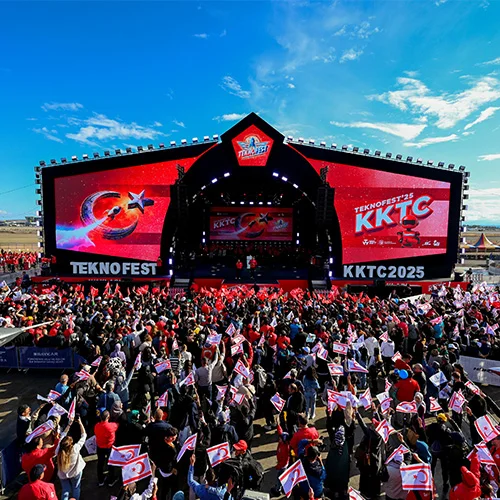
For a few days each autumn, a former airport turns into a recruiting ground the defence industry could never buy. TEKNOFEST, the aerospace and technology festival run by the T3 Foundation, now draws students by the hundreds of thousands, and the companies that sponsor it have said openly that they are watching who wins.
The festival is a youth competition that happens to share a stage with fighter jets and armed drones. Whether it is also reshaping who works in Turkish defence is a fair question, and the answer so far is a mix of documented numbers and company claims that are harder to measure.
What is TEKNOFEST and who runs it?
TEKNOFEST was launched in 2018 under the leadership of the Türkiye Technology Team Foundation (T3 Foundation) and the Ministry of Industry and Technology. The T3 Foundation was established in 2016 as a civil society organisation focused on science, technology, innovation and entrepreneurship. Selçuk Bayraktar, Baykar’s technology chief, chairs its board of trustees, which is one reason the festival and the drone maker are so often mentioned together.
The format is simple. Teams of secondary school, university and postgraduate students, plus some independent engineers, enter technical competitions in categories such as unmanned aerial vehicles, rockets, artificial intelligence and robotics. Finalists build and fly or launch hardware at the festival itself.
| Item | Detail |
|---|---|
| Organisers | T3 Foundation and the Ministry of Industry and Technology |
| First edition | 2018, Istanbul |
| 2025 edition | Istanbul Atatürk Airport, 17 to 21 September 2025 |
| 2025 applications | 1.2 million across 64 competition categories (T3 Foundation) |
| 2026 edition | Şanlıurfa, GAP Airport, scheduled 30 September to 4 October 2026 |
How big has the talent pipeline become?
The growth in applications is the clearest data point. When the rocket competition ran in Aksaray in September 2020, Daily Sabah reported that roughly 100,000 students had applied across the festival, with about 5,000 competing in 21 categories. The youngest rocket team in that event had an average age of 16.
By 2025 the T3 Foundation was reporting 1.2 million applications in 64 categories, from more than 565,000 teams. The Istanbul edition itself recorded 1.032 million visitors, and the foundation put the total across all 2025 venues at 1.503 million, adding the TRNC and Blue Homeland editions and the finals audience. It also cited nearly 11 million visitors across all editions to date.
The competition side kept expanding too. The 2025 programme had 58 main categories and 137 subcategories, with 13 new competitions that included an AI film contest, a vocational skills contest and an underwater rocket category. Prize money passed 65 million lira, with more than 85 million lira in financial support, according to the foundation. For 2026 the organisers announced 52 competitions and 127 subcategories.
Application figures count entries, not future engineers. A large share of those teams are school students who will never work in defence. But the funnel is far wider than it was in 2018, and the festival is no longer a one-off show.
Do defence companies actually hire from it?
The companies say yes, with different degrees of specificity.
Roketsan was blunt from the start. When it sponsored the first Istanbul festival in September 2018, including a rocket competition at the Hisar Launch Center in Akhisar, the company said that students who qualified in the competitions would be directly recruited by Roketsan. That is the company’s own statement, and the published material does not say how many people eventually joined. Readers who want the corporate background can find it in our Roketsan company profile.
ASELSAN’s position is closer to a long-term bench. The company is a main supporter of TEKNOFEST and manages several competitions, including unmanned underwater systems, unmanned marine vehicles, unmanned ground vehicles, artificial intelligence in aviation, secure satellite communications and, since 2024, an air defence systems contest. ASELSAN says participants from the early editions now work as engineers on its high-technology projects. It also runs a vocational technical high school in Ankara and a talent programme aimed at third-year engineering students. More on the company is in the ASELSAN company profile.
Baykar is the most visible link, mainly through Selçuk Bayraktar’s role at the T3 Foundation. An earlier published profile put Baykar’s workforce at about 4,500, half of them engineers, with an average age of 29. That number is dated and the headcount has grown since, so it is best read as an indication of a young engineering culture rather than a current statistic. We found no published count of Baykar employees who came directly through TEKNOFEST. The company’s background and ownership are covered in the Baykar company profile.
What does the T3 Foundation do beyond the festival?
The festival is the public face. The foundation also runs training. Its Future Technology Stars programme selected 410 students from 18,000 applications in 2017 for three years of training in technology workshops, and the foundation reported that 363 of them graduated. That is a smaller, slower pipeline than the competitions, closer to a selective apprenticeship.
The foundation’s stated goals include raising youth interest in technology, building engineering skills and moving R&D work into industry. Winners can receive cash prizes, internships and job offers, entrepreneurship support and project funding, according to descriptions of the awards. How often the job offers convert is not published in aggregate.
Is this changing the shape of the workforce?
Three effects are plausible and partly visible.
First, the supply of young engineers with hands-on experience grows. A student who has already built a rocket or an autonomous vehicle for a competition arrives at a recruiter’s desk with project work rather than coursework alone. Several of the competition categories, such as air defence and unmanned systems, match what the large primes actually build.
Second, the pipeline is not limited to the biggest names. Smaller firms and start-ups can draw on the same pool, which matters in a sector where private drone makers are multiplying. Our look at Türkiye’s drone makers beyond Baykar shows how many companies now compete for engineers.
Third, there is a cultural effect. Defence engineering has become a recognised aspiration for school students, backed by large public events and by figures such as Bayraktar speaking directly to young audiences. It is hard to quantify, but companies treat it as a recruiting advantage.
The limits are just as clear. Application numbers say nothing about retention, and the published material from companies is promotional by nature. No independent study we found measures how many TEKNOFEST participants end up in defence jobs. Competition for experienced engineers also remains tight, since a festival cannot replace years of programme experience.
There is also a geographic angle. Moving the festival between cities, and running satellite editions in the TRNC and on the Blue Homeland coast, spreads exposure to students who live far from the Ankara and Istanbul defence clusters. Whether that turns into applications from those regions, and then into jobs, is something the organisers have not yet published in detail.
What to watch at the next edition
The 2026 festival moves to Şanlıurfa, away from Istanbul and Ankara, with 52 competitions planned. The scheduling detail is in our report on the TEKNOFEST 2026 dates. Useful indicators include how many finalists come from provinces outside the big three cities, whether sponsors publish recruitment numbers, and how many winning projects move into funded development.