Otokar’s Quiet Scout Vehicle Can Run on Batteries Alone

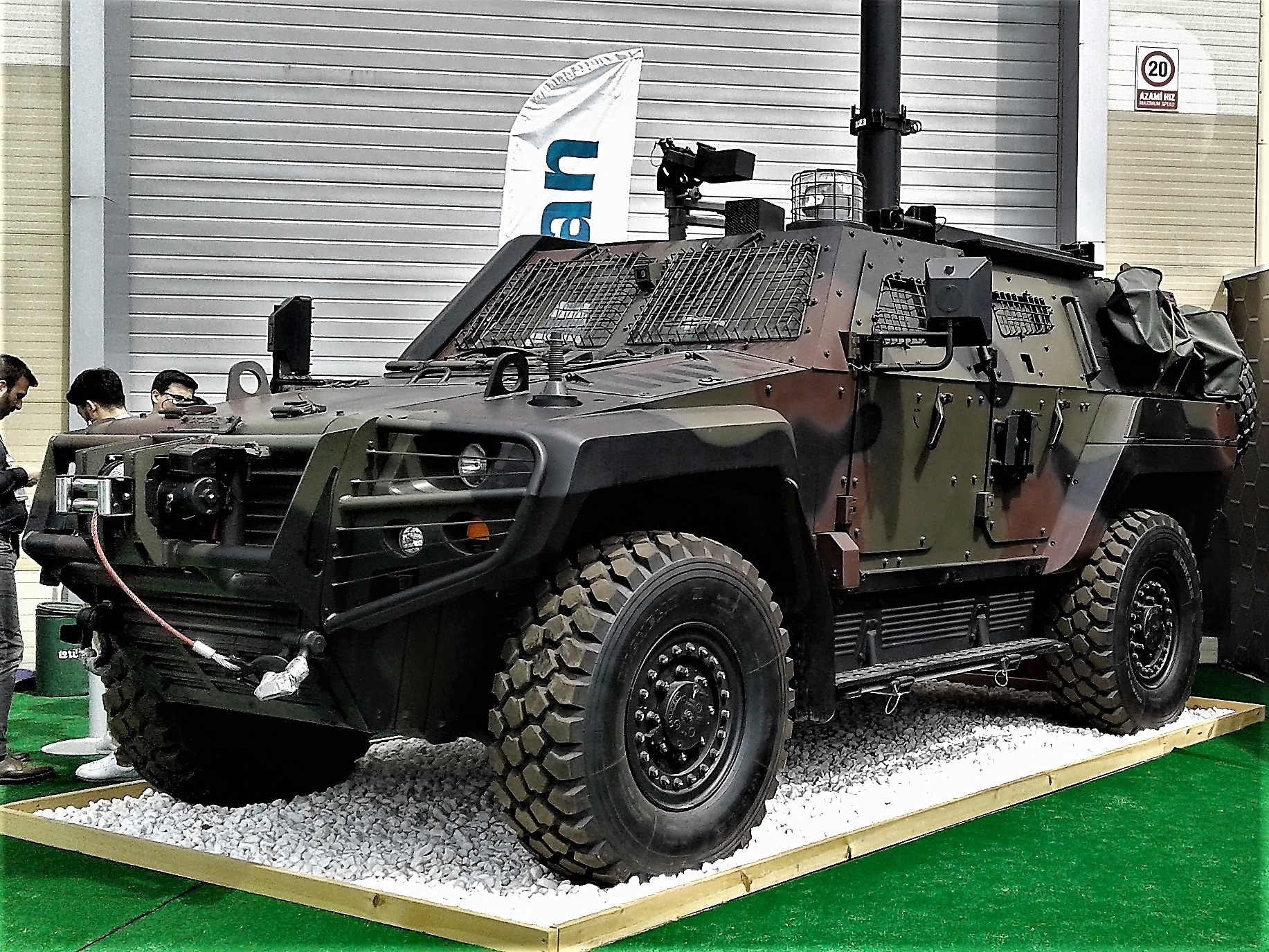
Most armoured vehicles announce themselves the moment they start moving. A diesel engine of a few hundred horsepower is loud, hot and easy to find with a thermal sight. Otokar’s answer for the scout role was to take the engine out of the equation, at least in one version. The AKREP II, a compact 4×4 reconnaissance and patrol vehicle, was first shown in 2019 with an electric drivetrain, and it has been the company’s testbed for battery power in a combat vehicle ever since.
The vehicle is a different animal from the original AKREP of the 1990s, a light Land Rover-based armoured car that sold to a long list of customers. The “II” keeps the name and the reconnaissance mission, but little else.
| Manufacturer | Otokar Otomotiv ve Savunma Sanayi, Türkiye |
|---|---|
| Type | 4×4 wheeled armoured reconnaissance and fire-support vehicle |
| Crew | 3 (driver, commander, gunner) |
| Powertrain options | Electric (AKREP IIe), diesel (AKREP IId), hybrid offered as an option |
| Electric drive | Two electric motors, 180 kW each; lithium-ion batteries; electric axle developed with AxleTech |
| Top speed | Reported at 110 km/h |
| Ground clearance | 400 mm |
| Armament options | Remote turret with 25 mm cannon, or turret up to 90 mm |
| First shown | IDEF 2019, Istanbul (electric); IDEF 2021 (diesel) |
What Is the AKREP II Built to Do?
Otokar describes the AKREP II as a platform for quick reaction, reconnaissance, scout and surveillance missions, as well as base and air defence roles. The layout follows from that. It is small, low and carries only three people, which is a deliberate trade against the troop-carrying armoured vehicles that dominate the Turkish catalogue.
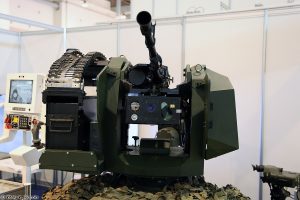
Otokar and the trade press describe two ways to scout with it. One is by stealth, relying on an electro-optic sensor suite to observe without being seen or heard. The other is by fire, mounting a turret that can take a gun of up to 90 mm calibre. The vehicle shown at IDEF 2019 carried a remote turret with a 25 mm cannon, reported to be a Bozok design with a coaxial 7.62 mm machine gun.
Other configurations Otokar lists include fire support, light infantry fire support and a laser-weapon carrier. Protection is described as the same baseline as the COBRA II, with add-on armour available. Specific protection levels are not published in open sources, and one 2019 report cites STANAG 4569 Level 3 only as reported by trade media.
Why Did Otokar Make an Electric Version?
The reason is signature. A battery-electric drivetrain is quiet and runs much cooler than a diesel, which matters for a vehicle whose job is to look at the other side without being noticed. Janes reported at the time that the electric motor also delivers its full torque from a standstill, so the vehicle can leap out of cover without waiting for an engine to climb its rev range.
The electric version was developed with AxleTech, the US drivetrain specialist. Otokar announced the cooperation on 26 April 2019, a few days before IDEF opened. Its components, as described in the announcement, are an electric motor built into the axle, a battery pack and a power-control algorithm, on a four-wheel-drive chassis with independent suspension and optional steerable axles. EDR Magazine also reported drive-by-wire control. The batteries were reported to come from the Turkish firm Altinay.
Otokar’s general manager at the time, Serdar Görgüç, called it Türkiye’s first full electric-drive armoured vehicle and a first step toward hybrid and autonomous armoured vehicles. That is a careful claim: the AKREP IIe was shown as a technology demonstrator, and EDR Magazine put its technology readiness level at 5. It was a proof of what could be done, not a vehicle on a production line.
How Far and How Fast Does It Go?
Here the numbers vary by source, and they should be read with that in mind. Two 180 kW motors give roughly 360 kW of drive power, which a Turkish trade report converted to about 500 hp. The top speed most often quoted is 110 km/h.
Range is where accounts diverge. EDR Magazine cited about 200 km for the electric version, possibly doubled with an extra battery. Army Technology lists about 250 km, and a Defence Turkey report from the 2019 press event also cited 250 km with a roughly three-hour recharge. Shephard noted at IDEF that cost remained an obstacle for green military vehicles in Türkiye. Since the electric version never entered a published procurement, treat all range figures as manufacturer or press claims, not test results.
Mobility figures are more consistent. The vehicle is listed with a 60 percent gradient, a 40 percent side slope, and 45 degree approach and departure angles. Ground clearance is 400 mm, the same as the COBRA II.
Is There a Diesel AKREP II?
Yes. Otokar unveiled the diesel AKREP IId at IDEF 2021, held in Istanbul in August of that year. Shephard reported it was developed for an export customer, though no customer was named and none is confirmed in the sources reviewed.
The diesel vehicle is a bigger machine than the 2019 demonstrator. Reports on the IDEF 2021 show put its length at 5.9 m, up from 5.5 m, and height over the hull at 1.95 m, up from 1.8 m. Gross weight was reported at 15 tonnes against the 13.5 tonnes declared in 2019. An early Defence Turkey report had mentioned about 11 tonnes for the first prototype, a reminder of how much the design shifted between the two shows.
The 2019 announcements referred to a planned diesel of roughly 360 hp (265 kW) in one report and 450 hp in another, so the final engine rating should be checked against Otokar’s current datasheet. Army Technology notes that the hybrid and diesel versions use fully automatic transmissions.
Where Does It Sit in Otokar’s Range?
Otokar’s land vehicle family runs from light tactical vehicles to heavy 8×8 platforms. The COBRA II mine-protected vehicle, covered in our look at the Romania deal behind it, is the company’s best-known export. The ARMA II 8×8 sits at the heavy end, and the tracked TULPAR carries a Leonardo turret in firing trials. The AKREP II is the smallest of the group, and the only one to have been shown with an electric drivetrain.
For the wider picture of how the company sells these vehicles abroad, see the piece on Otokar’s armoured vehicle export business and the broader explainer on why countries buy Turkish armoured vehicles. The AKREP II does not yet have a publicly confirmed operator, so it appears in those discussions as a product on offer, not a fielded one.
What Happens to the Electric Idea Next?
Militaries have been cautious about battery vehicles at the front. Charging infrastructure, battery weight and fire risk are real objections, and a 15-tonne vehicle with a large battery pack and a 90 mm gun asks a lot of a drivetrain. The hybrid option Otokar lists is the more realistic bridge: it lets a unit drive silently for short stretches, then fall back on a diesel for range.
What the AKREP IIe did achieve is to put a working electric armoured vehicle in front of Turkish and foreign buyers, built with a Western axle supplier and domestic battery makers. Whether it turns into an order will depend on a customer deciding that a quiet, cool-running scout is worth the extra complexity. As of the sources reviewed, no such order has been announced.