ATMACA vs Harpoon as the Turkish Navy Swaps One for the Other

For more than three decades, the anti-ship missile on most Turkish surface combatants has been the American Harpoon. The missile that is now taking its place carries the name ATMACA, the Turkish word for hawk, and it comes from a factory in Ankara rather than St. Charles, Missouri. The comparison most readers want is ATMACA against Harpoon on paper. The more useful one is what the Turkish Navy is actually doing with the two missiles, because that is where the trade-offs show up.
Short version: on published figures ATMACA reaches roughly twice as far as a ship-launched Harpoon Block II and carries a comparable warhead. Harpoon keeps the edge in installed base, combat history and the breadth of its launch platforms. Neither advantage decides much for a navy that has already chosen to replace one with the other.
How Do ATMACA and Harpoon Compare on Published Figures?
The table sets ATMACA against the ship-launched Harpoon Block II. ATMACA numbers are ROKETSAN’s own product figures. Harpoon numbers are the commonly published ones for the Block II, which is the version most often cited in current comparisons. Manufacturers measure range under different conditions, so read the gap as indicative, not exact.
| Parameter | ATMACA (ROKETSAN) | Harpoon Block II (Boeing) |
|---|---|---|
| Origin | Türkiye | United States |
| Published range | 250 km | Over 67 nautical miles (about 124 km), ship-launched |
| Warhead | 220 kg, high-explosive fragmentation with penetration effect | 221 kg (488 lb) |
| Length | 4.3 to 5.2 m | About 4.6 m, surface and submarine launch |
| Weight | Under 750 kg | About 691 kg including booster |
| Speed | Not published by ROKETSAN | About Mach 0.71 |
| Navigation | INS, GPS, barometric and radar altimeter | INS and GPS (Block II), sea-skimming flight |
| Terminal seeker | Active radio-frequency | Active radar |
| In-flight link | Data link for target update, re-attack and mission abort | Data link arrived with the later Block II+ upgrade |
| Launch platforms | Surface ships, submarines, coastal batteries | Ships, submarines, aircraft, coastal batteries |
The two missiles are close in size and warhead weight. ATMACA pulls ahead on range and on the mission-management features ROKETSAN lists: three-dimensional mission planning, time-on-target and simultaneous time-on-target salvos, and re-attack. Harpoon’s current standard is a missile whose design dates to the 1970s, refreshed with guidance and software from the SLAM-ER family.
Which Turkish Ships Carry Which Missile?
The Barbaros and Yavuz class frigates were built around Harpoon, with two quad-pack launchers holding eight missiles. The Ada-class corvettes, the first hulls of the MİLGEM family, are listed with eight Harpoon or ATMACA, which tells you how the swap works in practice: same ship, different missile in the launchers. Turkish Type 209/1400 submarines have also been associated with submarine-launched Harpoon, and the Air Force is reported to operate the AGM-84K SLAM-ER, a Harpoon-derived land-attack weapon, on its F-16s.
The replacement itself is an industrial programme, not a plug-in. According to a Naval News report from August 2023, STM and ROKETSAN signed a contract on 23 November 2022 to integrate ATMACA on 11 Turkish naval platforms. Completion is contracted for April 2027. Open sources report that the list includes the Ada-class corvettes, the İstanbul-class frigates, G-class frigates and the Hisar-class offshore patrol vessels, with the planned TF-2000 destroyers also earmarked. The exact hull-by-hull schedule is not public, and neither is the size of the Turkish Harpoon inventory being retired.
Integration matters more than the missile’s specification sheet. A missile is only useful if the ship’s combat management system can plan, launch and hand over targeting data to it. Part of what ATMACA offers Ankara is that the missile maker, the integrator and the customer all sit in the same country.
How Did ATMACA Get From Design Study to Fleet Missile?
The programme began in 2009, when the then Undersecretariat for Defence Industries signed a development contract with ROKETSAN. Design studies in their current form began in 2012. Then came a short run of milestones:
- 29 October 2018: serial production contract, signed before the firing campaign was finished.
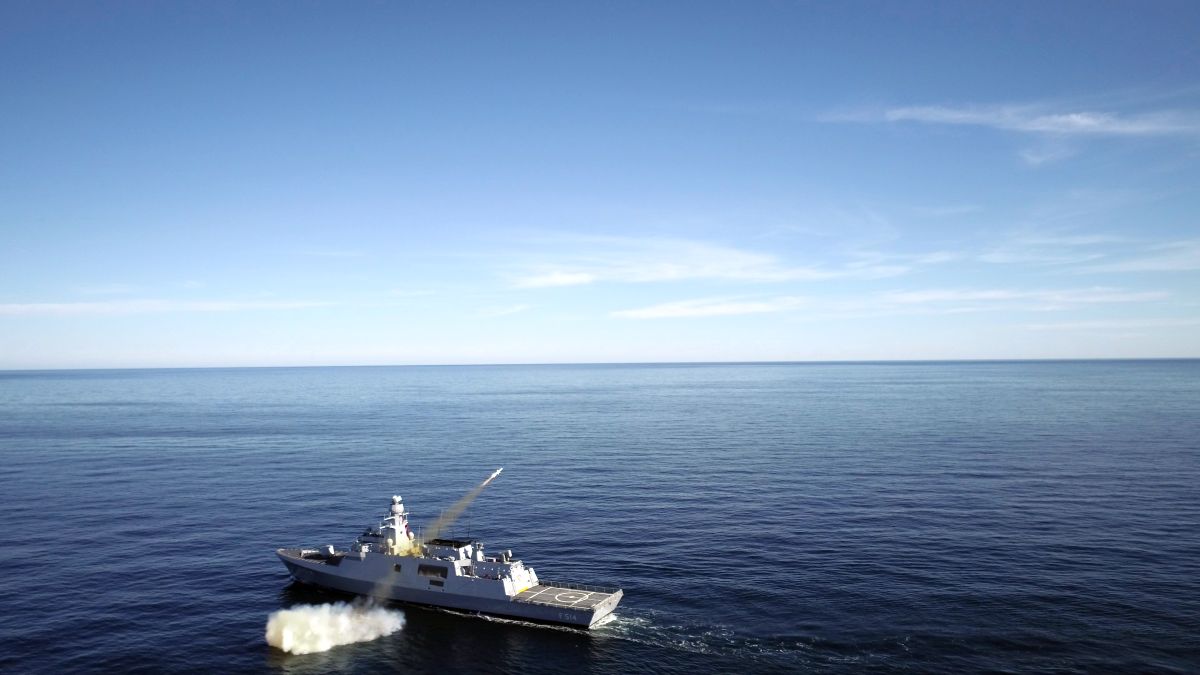
- 3 November 2019: first ship launch, from the Ada-class corvette TCG Kınalıada in the Black Sea.
- 1 July 2020: a hit on a target at more than 200 km.
- February 2021: a live-warhead shot off Sinop.
- June 2021: a certification test against the decommissioned ex-TCG Işın, which opened the way to serial production.
- 10 March 2024: a hit powered by the Kale KTJ-3200 turbojet, a Turkish engine marketed as free of US export-control content.
- 12 March 2025: first launch from a submarine, in the encapsulated AKATA configuration.
The engine change is the one that matters most for the Harpoon comparison. Early ATMACA rounds used the French Microturbo TRI-40. With the KTJ-3200 the missile no longer depends on a foreign engine, and with a seeker from ASELSAN, ROKETSAN can present the missile as exportable on its own authority. A Harpoon, by contrast, is a US missile sold through US government channels. How that difference plays out in practice is covered in our explainer on whether Turkish weapons are ITAR-free.
Why Is Harpoon Becoming Harder to Buy New?
Harpoon is not going away, but the supply side has changed. According to Army Recognition, the US Navy announced on 15 April 2026 that the last missile of its Lot 91 multi-year production agreement had been delivered, and no follow-on multi-year lot has been announced. Refurbishment and obsolescence work on Block II continues, and thousands of rounds remain in inventory worldwide. For a navy that needs a new-build anti-ship missile, though, the default Western choice has moved from automatic to optional.
Türkiye’s decision long predates that. ATMACA started as a national answer to a requirement the Navy set in 2009. What the 2026 supply picture adds is timing: Türkiye has a qualified, in-production replacement just as the incumbent stops being a simple catalogue purchase.
Where Does Harpoon Still Win?
Four places, and none of them is small.
Combat record. Harpoon has been fired in anger. ATMACA has an extensive test record, including live-warhead and sinking tests, but no documented operational use.
Installed base. Harpoon serves around 30 operators and has been integrated on many ship classes over four decades. ATMACA’s public export book is two customers.
Air launch. Harpoon exists in aircraft-launched forms on platforms from the F/A-18 to the P-8. ATMACA is marketed for ships, submarines and coastal batteries; ROKETSAN’s product page does not list an air-launched version in service.
Support ecosystem. Spares, test equipment and training pipelines for Harpoon are well established around the world. ATMACA operators rely on ROKETSAN’s own support chain, which is still scaling up to feed both Turkish fleet fit-outs and export orders.
What Do Export Customers Make of the Choice?
Two navies have bought ATMACA so far. Indonesia contracted for 45 rounds, reported by Janes in January 2024, and later signed a co-production agreement. Malaysia signed in April 2026 for 24 rounds valued at about €79.5 million, to arm its Littoral Mission Ship Batch 2 corvettes, which are built on a design derived from the Ada class. For those buyers the pitch was not that ATMACA out-ranges Harpoon. It was that the missile, its integration support and its export licence came from one supplier willing to offer technology transfer.
Turkish industry has used that formula before, and the same buyer logic runs through how countries buy Turkish weapons: contract, credit, local work share.
What Comes After the Ship-Launched Version?
Two developments move the comparison further. The submarine-launched AKATA variant addresses a role the Turkish Navy has filled with submarine Harpoons. And the land-attack family around KARA ATMACA has no Harpoon counterpart in Turkish service; the nearest US analogue, SLAM-ER, is air-launched. Türkiye is now building one missile family for jobs it once filled with separate imported weapons.
For the Turkish Navy, then, the answer to ATMACA vs Harpoon is less about which missile wins a spec-sheet contest and more about which one the fleet is contracted to carry. With fleet-wide integration due by April 2027, that missile is ATMACA.