
How FNSS Turned Turkish Armoured Vehicles Into Exports From Malaysia to Slovakia

FNSS does not look like a typical export champion. The Ankara company builds heavy, conventional armoured vehicles, it has no missile or drone line to lean on, and its home customer is a single army. Yet its vehicles run in Oman, Malaysia and Indonesia, a Slovak joint venture is being set up around one of its tank designs, and a Saudi framework agreement points to a fourth production site. The way FNSS got there says more about Turkish land-systems exports than any single contract does.
| Field | Detail |
|---|---|
| Company | FNSS Savunma Sistemleri A.Ş. |
| Headquarters | Gölbaşı, Ankara, Türkiye |
| Founded | 1988, as the FMC Nurol joint venture (Wikipedia) |
| Ownership | Subsidiary of Nurol Holding |
| CEO | Selim Baybaş, since 1 January 2026 (succeeded Kadir Nail Kurt) |
| Main activities | Tracked and wheeled armoured vehicles, turrets, hybrid powerpacks, modernisation, test laboratories |
| Key product families | KAPLAN, PARS, ACV-15, MAV (ZAHA), OTTER, AACE, ACV-AD |
| Documented export and licence markets | Oman, Malaysia, Indonesia; framework agreements with Slovakia (CSG) and Saudi Arabia (SAMI Land) |
| Website | fnss.com.tr |
Where does FNSS come from?
The company was founded in 1988 as FMC Nurol Savunma Sanayii, a joint venture between the American FMC Corporation and Türkiye’s Nurol Holding. Its first big job was the ACV-15, an armoured combat vehicle family descended from the American AIFV, which in turn grew out of the M113 personnel carrier. The first production vehicles reached the Turkish Land Forces in 1992. The design came from a foreign partner. The know-how, over the following three decades, stayed in Gölbaşı.
Today FNSS describes itself as a Nurol Holding subsidiary specialising in armoured combat and tactical wheeled vehicles, turrets, hybrid powerpacks and modernisation packages. Leadership changed at the start of this year. Selim Baybaş, previously CEO of Nurol Teknoloji, took over from Kadir Nail Kurt, who had run the company for 18 years and started his career there on the armoured combat vehicle programme.
The product range is wide for a firm of its size. On the tracked side sit the KAPLAN family, the ACV-15 and ACV-19, the ACV-AD air-defence platform and the MAV marine assault vehicle. On the wheeled side sit the PARS 4×4, 6×6 and 8×8 vehicles. Specialist equipment includes the OTTER wet-gap crossing system and the AACE amphibious earthmover. FNSS also builds its own turrets and weapon stations, among them TEBER-II, SABER, SANCAK and ÇAKA, and it has unmanned vehicles on the books, including the Shadow Rider and U-MAV.
How did the ACV-15 and PARS open foreign markets?
FNSS’s first foreign success was a kit-and-licence story. Malaysia ordered 211 ACV-15 vehicles in 2000 and a further 56 in 2008, reported figures from public reference data. Part of the fleet was delivered as kits and assembled at the DefTech plant in Pekan, where the vehicle became the ACV-300 Adnan. The United Arab Emirates is also reported to operate the family.
The PARS line came later. Development started around 2002 with a US partner, and the 8×8 version was first shown at IDEX in Abu Dhabi in 2005. Gulf testing followed, with the vehicle covering 11,000 km in UAE desert trials in 2008. The payoff arrived in Oman, which took 172 PARS vehicles in 6×6 and 8×8 configuration, with deliveries running from July 2017 to August 2020 according to published reference data.
Malaysia then went a step further. In June 2011 FNSS signed an agreement with DefTech to help design a national 8×8 vehicle based on the PARS. The result was the AV8 Gempita, built in Pahang, with 257 vehicles reported across a dozen variants. Turkish hulls and Turkish know-how, Malaysian factory and Malaysian name. FNSS did not sell a vehicle. It sold a capability, and the buyer kept the production line.
What does the PARS III look like in practice?
The PARS III 8×8 is the export workhorse. FNSS lists a combat weight of 30,000 kg, a diesel powerpack with a fully automatic transmission, a maximum road speed of up to 100 km/h and a range of more than 800 km. It carries up to nine dismounts, climbs a 0.7 m step, crosses a 2 m trench and, according to FNSS, turns in a circle of 8 m thanks to all-axle steering. Protection is modular, so the ballistic and mine package can be tailored to the customer.
That modularity is the commercial point. A buyer in a hot, dusty region and a buyer in a wet, forested one can order the same hull with different armour, turret and air conditioning. The design also accepts remote weapon stations and two-man turrets, which is how the same basic vehicle ends up as an infantry carrier in one army and a mortar or anti-tank platform in another.
What is PARS ALPHA and why does FNSS keep pushing it?
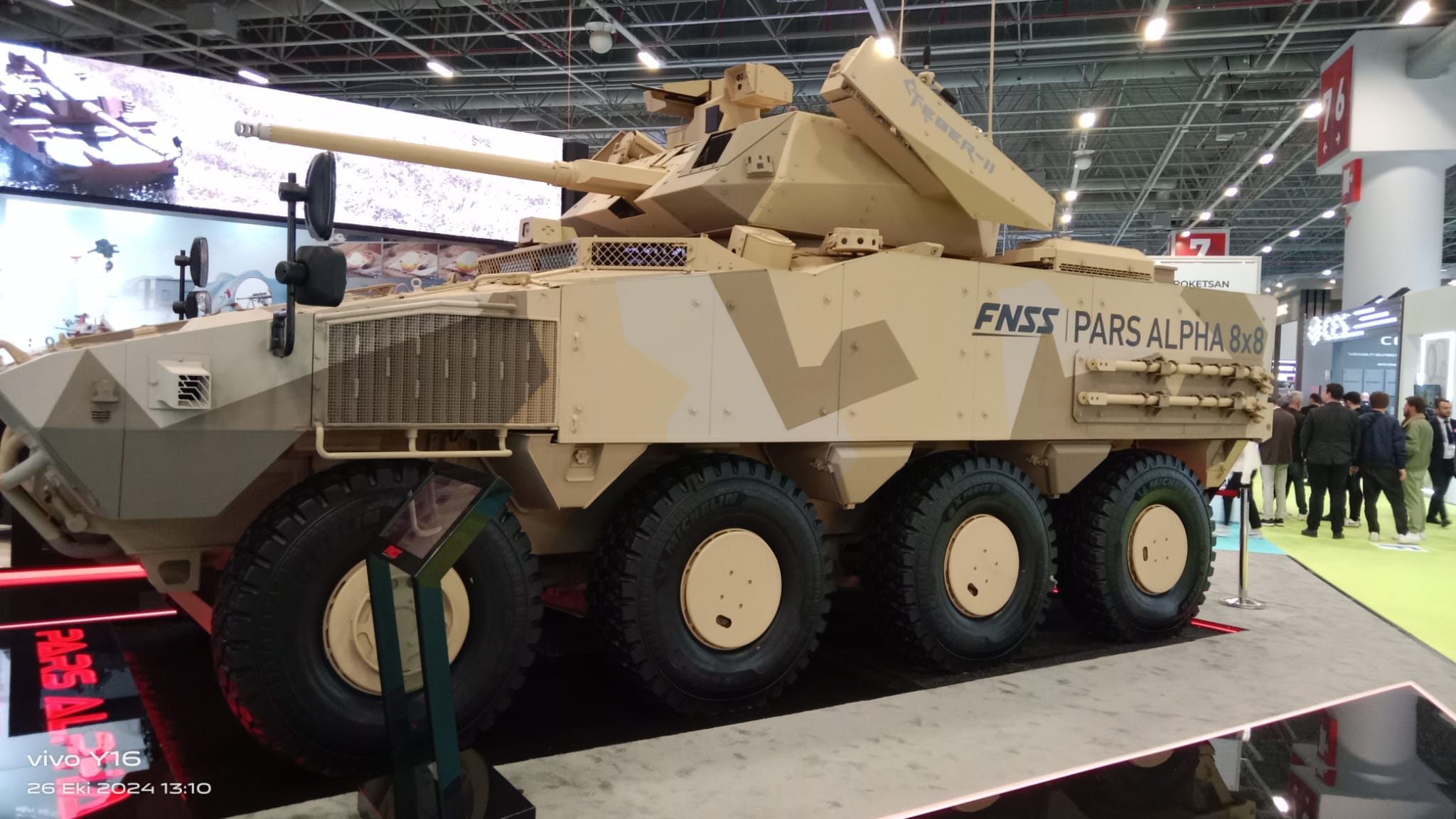
PARS ALPHA is the next step. Unlike older front-engine 8×8 layouts, it puts the crew and dismounts behind the powerpack, so the driver and commander sit side by side with a field of view FNSS puts at more than 180 degrees. The company quotes a road speed above 115 km/h, a range above 800 km, 70 percent gradients, 40 percent side slopes, 2.4 m trenches and 0.8 m vertical obstacles. The vehicle uses hydro-pneumatic suspension with adjustable ride height, which can lift ground clearance past 60 cm for mine protection.
Its usual armament is the TEBER-II 30/40 HF remote-controlled turret. The 30 mm dual-feed cannon can be swapped for a 40 mm barrel by changing the recoil spring and forward feeder, and two ready-to-fire anti-tank missiles extend engagement range beyond 4 km. FNSS also says the vehicle can be carried by A400M, C-17, C-5, An-124 and Il-76 aircraft.
PARS ALPHA has been the centrepiece of FNSS’s recent marketing, including its SAHA Expo stands. Earlier reports of a European partnership around the vehicle made the same point: FNSS wants a new-generation wheeled platform to carry its next decade of sales.
Why is KAPLAN MT the company’s tracked flagship?
KAPLAN is the family that gives FNSS its tracked credentials, and the KAPLAN MT medium tank is its best-known member. Türkiye and Indonesia agreed in May 2015 to develop a medium-weight tank for the Indonesian Army, with FNSS and the state-owned PT Pindad sharing the work and, reportedly, the intellectual property. The Indonesian name is Harimau, the Turkish and the Indonesian words both meaning tiger.
The tank mounts a high-pressure 105 mm gun in a Belgian-designed turret and is reported to weigh around 35 tonnes. FNSS stresses that, unlike medium tanks converted from personnel carriers, the powerpack sits at the rear in a conventional tank layout. It argues that this gives a lower silhouette, better gun depression and a driver who can see out without opening the hatch. FNSS also says the tank is the only Turkish export contract in the combat tank class.
The first batch of ten tanks was completed at FNSS’s Turkish plant in March 2022, with a second batch built by Pindad in Bandung. The split is the template for what followed. In September this year the two companies finished pre-delivery acceptance tests on the first KAPLAN APC, a tracked personnel carrier in the 30-tonne class that shares its automotive base with the tank. The KAPLAN APC tests show a customer returning for a second vehicle rather than opening a fresh tender.
What makes ZAHA different from the rest of the line?
ZAHA, sold abroad as the Marine Assault Vehicle or MAV, is a different kind of product. It is a tracked amphibious vehicle designed to swim from an amphibious ship, cross the surf zone and fight ashore, and FNSS says it is one of very few suppliers in NATO with a live production line for the type. The water-jet hull reaches 7 knots afloat and the vehicle runs at up to 70 km/h on land. It can right itself after capsizing and carries an ÇAKA remote-controlled turret.
The Turkish Naval Forces’ Amphibious Marine Brigade is the customer. The first 27-vehicle batch began delivery in March 2023, and a second-phase contract for 27 more was signed on 7 May 2026, according to the Presidency of Defence Industries announcement. The ZAHA programme is tied to the amphibious ship fleet, and FNSS says the vehicles are fully qualified for service from TCG Anadolu.
In August, FNSS showed an unmanned derivative at TEKNOFEST Mavi Vatan. İ-ZAHA, marketed as U-MAV, is an 8-tonne platform that FNSS says can run ahead of the manned wave, with ten declared mission configurations that range from mine clearance to casualty evacuation. As of now it is a concept shown publicly, not a fielded system.
How is FNSS moving production into Europe?
The most consequential recent step came on 16 June 2026 at Eurosatory, when CSG Defence and FNSS signed a framework agreement to establish Danube Defence Systems, a Slovakia-based company headquartered in Trenčín. On completion of the transaction it is expected to be owned 51 percent by CSG and 49 percent by FNSS. CSG would lead manufacturing and marketing, initially at the MSM Land Systems site in Trenčín, while FNSS supplies technology transfer, know-how and platform licences.
The flagship is the CFL-120 KARPAT medium tank, derived from the KAPLAN platform. It was unveiled at the IDEB 2026 exhibition in Bratislava with a 120 mm gun in a Leonardo HITFACT Mk II turret, according to published reports. The companies say the family could grow to include personnel carrier and infantry fighting vehicle versions, as well as other FNSS wheeled and tracked vehicles built in Europe.
The logic is simple. European tenders tend to favour local content and in-country assembly, and EU defence funding is aimed at producers inside the union. FNSS will be selling into that market as a minority partner in a native company rather than as a foreign exporter, which is a significant concession of control. It is also a bet that the Turkish design advantage is worth sharing. The agreement is a framework, and the final structure depends on regulatory and contractual steps still ahead.
Is Saudi Arabia next?
FNSS and SAMI Land, the land-systems arm of Saudi Arabia’s military industries holding, signed a framework agreement on 25 July 2025 to manufacture new-generation 8×8 armoured vehicles in the Kingdom. The Saudi Assistant Minister of Defense for Executive Affairs and the head of Türkiye’s Presidency of Defence Industries attended the signing. The announcement did not name a vehicle or quantities. FNSS’s 8×8 offering is the PARS family, which makes it the obvious candidate, but nothing in the public record confirms that.
What does the export record say about Turkish armour?
Line up the FNSS deals and a pattern emerges. Oman bought vehicles off the shelf. Malaysia and Indonesia took licences and built the vehicles in their own plants, in Malaysia’s case under a local name. Slovakia, if the deal closes, will produce under a joint venture in which the Turkish partner holds the minority stake. Each step gives the buyer more industrial content and FNSS less control of the production line.
That is a deliberate trade. A company whose main customer is one army cannot fund a global sales network from one home order book, so FNSS borrows the buyer’s factories and the buyer’s flag instead. Why countries buy Turkish armoured vehicles usually comes down to speed, price and willingness to localise, and FNSS sits squarely in that third category. The same pattern appears across the wider map of Turkish defence factories abroad, where Turkish firms usually hold minority stakes or own nothing at all.
There is a cost. The more of the vehicle is built abroad, the smaller the share of value that returns to Ankara, and licensing revenue is slower than hull sales. The 2015 KAPLAN agreement already gave Indonesia a share of the design rights. The Slovak arrangement puts a KAPLAN derivative under a company in which FNSS is the minority owner. Whether that pays off depends on whether the Danube venture wins orders, and as with every framework agreement, the orders still have to come.
What should buyers and readers watch?
Four things will show whether FNSS’s model works. The first is whether Danube Defence Systems closes and moves KARPAT from show vehicle to contract. The second is the Indonesian KAPLAN APC, which needs final acceptance in Indonesia before it becomes a programme of record. The third is what vehicle SAMI Land actually builds. The fourth is whether PARS ALPHA, FNSS’s most heavily promoted platform, lands a launch customer of its own.
Until then the record stands at three operating markets, two licence-built vehicle families and a growing pile of framework agreements. For a company that started as an American licence in Ankara, that is already a long way from 1988.


