
Which Countries Operate the ANKA Drone? Operators and Exports


Six countries outside Türkiye have been publicly linked to the TUSAŞ ANKA, and four of them are documented well enough to be treated as confirmed operators: Tunisia, Chad, Kazakhstan, Indonesia and Malaysia, with Algeria widely reported but never officially acknowledged by either government. That is a short list next to the Bayraktar TB2’s export footprint, and the reason is not that the ANKA is a weaker aircraft. It is that Turkish Aerospace sells the ANKA a different way — as a government-to-government package of satellite-controlled aircraft, ground stations, trained crews, local assembly promises and, in at least one case, Turkish state export credit. Those deals buy a deeper industrial relationship. They also take far longer to turn into aircraft in a customer’s hangar.
DEFENCETÜRKIYE DATA BOX
| Manufacturer | Turkish Aerospace / TUSAŞ (Ankara) |
| System | ANKA medium-altitude long-endurance (MALE) UAV; ANKA-S satellite-controlled variant |
| Category | Armed ISR / strike MALE UAV, 1,700 kg class |
| Programme status | In serial production and in service; actively exported |
| First flight | 30 December 2010 (rollout 16 July 2010) |
| Confirmed operators | Türkiye, Tunisia, Chad, Kazakhstan, Indonesia, Malaysia |
| Reported, unconfirmed | Algeria; Uzbekistan |
| Fleet flight hours | More than 400,000, per Turkish Aerospace |
| Current milestone | Malaysia’s first operational flight, 3 April 2026; Kazakhstan joint-venture agreement, 14 May 2026 |
Who operates the ANKA today
The table below separates what is documented from what is merely reported. That distinction matters more for the ANKA than for most platforms, because neither Ankara nor most of its customers publish contract values, and several of the numbers circulating in English trace back to a single Turkish newspaper report.
| Country | Reported quantity | Order | Delivery status | Industrial element | Confidence |
|---|---|---|---|---|---|
| Türkiye | Not published | ANKA-S batch of 10 contracted Oct 2013 | In service: Air Force, Navy, intelligence service | Domestic production | Official |
| Tunisia | 3 or 6 — sources conflict | March 2020 | Deliveries from 2021 | 3 ground stations; 52 personnel trained in Türkiye | Operator confirmed; terms reported |
| Kazakhstan | Not published | Reported late 2021 | Reported complete 2023 | Assembly and MRO joint venture, agreed 14 May 2026 | Operator confirmed; JV official |
| Chad | 2 reported | Not published | In service from 2023; also operates AKSUNGUR | None disclosed | Operator confirmed; terms unknown |
| Indonesia | 12 | Contract 3 Feb 2023 | First aircraft delivered late 2025 | 6 of 12 to be assembled by PTDI at Bandung | Confirmed by Indonesian MoD |
| Malaysia | 3 | 2023 | Delivered Jan 2026; first RMAF flight 3 Apr 2026 | Customised satcom and sensor fit | Confirmed; value published in ringgit |
| Algeria | Up to 10 reported | Not published | Not officially acknowledged | None disclosed | Reported only |
| Uzbekistan | Not published | Reported | Not officially acknowledged | None disclosed | Reported only |
Compiled by DefenceTürkiye from manufacturer statements, customer-government announcements and the reporting cited at the foot of this page. Türkiye publishes no ANKA fleet total and no export contract values.
What each customer actually bought
Tunisia: the first export customer, and a cautionary tale about numbers
Tunisia opened the ANKA export account at the Tunis air and defence show in March 2020. What it bought is genuinely unclear in the public record. Defense News reported at the time, citing industry sources, that Turkish Aerospace had sold six ANKA-S aircraft and three ground control stations for around $240 million. Nine months later The Defense Post, relaying reports from the Turkish outlets Haberler.com and Habertürk, put the deal at three aircraft and three ground stations for $80 million, with 52 Tunisian Air Force pilots and maintainers trained in Türkiye and the purchase financed by a Türk Eximbank loan.
Neither government has published a figure. Both numbers are still repeated as fact in English-language coverage. For a procurement analyst the useful takeaway is not the price — it is that Turkish export credit was reportedly part of the structure from the very first ANKA sale, and that the training package was sized in people, not hours. How that credit works, and which routes and instruments sit behind it, is set out in our guide to how countries actually buy and pay for Turkish weapons.
Kazakhstan: four years from memorandum to joint venture
Kazakhstan is the most instructive ANKA case, because it shows how long the industrial half of a Turkish drone deal takes. Astana is reported to have contracted for aircraft in late 2021, with deliveries completed in 2023. On 10 May 2022, the state holding Kazakhstan Engineering announced a military-technical cooperation memorandum with Turkish Aerospace under which an ANKA assembly line and maintenance capability would be organised in Kazakhstan, with technology transfer and personnel training. It was signed by Kazakhstan Engineering chairman Temirzhan Abdrakhmanov and then Turkish Aerospace president Temel Kotil.
That memorandum did not become a joint venture until 14 May 2026, when the two governments signed a production-and-maintenance JV agreement in Astana during President Erdoğan’s visit — one of 13 documents concluded at the High-Level Strategic Cooperation Council, according to the Kazakh state agency Kazinform citing the presidency. Four years after the memorandum, the investment volume, the production site and the implementation timeline all remain undisclosed, and no locally assembled aircraft has been announced. Kazakhstan may still become the first overseas ANKA production base. It is not one yet. Envanter Medya has looked at the wider pull factor here in a Turkish-language analysis of why Central Asian states keep turning to Turkish UAVs.
Indonesia: the largest order, and the offset that has not started
Indonesia is the biggest single ANKA customer. Its defence ministry said in August 2023 that it had signed on 3 February that year for 12 aircraft worth $300 million, a package covering training, logistics support and related equipment with a warranty of two years or 600 flying hours, and delivery expected before November 2025. Six aircraft were to be built in Türkiye and six assembled locally by the state manufacturer PT Dirgantara Indonesia at Bandung, with PTDI running the final assembly and flight line and receiving training for engineers, pilots and flight-test engineers plus data-link know-how.
The aircraft side has moved: the first ANKA-S was reported delivered to Supadio air base at Pontianak in late 2025, tasked with maritime surveillance. The industrial side has not. In February 2025 PTDI’s own newsroom carried a report stating that the procurement contract had not yet become effective, that the deal was still working through financing, and that the transfer of technology was contingent on that effectiveness. PTDI communications manager Adi Prastowo was quoted saying the partnership “will become effective when the ANKA procurement contract becomes effective.” Indonesia has run this playbook before with Turkish industry — FNSS and PT Pindad’s Kaplan armoured vehicle programme is the land-systems equivalent — but a buyer counting on the offset should price in the gap between signature and effectiveness. The same gap recurs across the Turkish offset record as a whole.
Malaysia: the cleanest timeline in the portfolio
Malaysia ordered three aircraft in 2023 for MYR 423.8 million, about $104 million. Janes records that the three were delivered in January 2026 and flown for the first time in Royal Malaysian Air Force service on 3 April 2026, a three-hour sortie from Labuan air base in Sabah, with the type assigned to No. 11 Squadron and designated Anka-THS locally. The mission is ISTAR over eastern Malaysia and the South China Sea, and the aircraft were specified with satellite communications and an electro-optical/infrared sensor.
Roughly three years from order to first operational flight, for a customised satcom-equipped aircraft with no local-production component, is the fastest documented ANKA delivery cycle. It is a useful benchmark: strip the industrial participation out of the package and the schedule tightens considerably.
Chad and Algeria: Africa’s two very different cases
Chad has flown the ANKA since 2023 — two aircraft, per open-source reporting — and separately operates the larger AKSUNGUR, which shares the ANKA’s avionics architecture and ground systems. No contract terms have been published by either side. Algeria is reported to have taken up to ten ANKA-S and is often listed as an operator, but neither Algiers nor Ankara has acknowledged the sale, and Algeria’s habitual silence on procurement means that is unlikely to change. It belongs in the “reported” column until a government says otherwise.
WHY IT MATTERS
Türkiye now runs two parallel drone export businesses with genuinely different logics. Baykar sells the TB2 broadly and quickly — the company says 36 countries have signed export agreements — as an affordable, off-the-shelf capability. Turkish Aerospace sells the ANKA narrowly and slowly, as a state-to-state package built around satellite control, crew training, local assembly and, at least once, Turkish export finance.
For a foreign buyer that is a real choice, not a marketing distinction. One route gets aircraft flying fast. The other promises an industrial foothold — and, on the evidence of Kazakhstan and Indonesia, takes years longer to deliver the part that made it attractive.
How long an ANKA deal actually takes
Plotting the four documented export programmes on one timeline makes the pattern visible. The aircraft arrive on a reasonably predictable schedule. The industrial commitments do not.
DefenceTürkiye original chart, built from the contract and delivery dates sourced at the foot of this page.
The aircraft itself
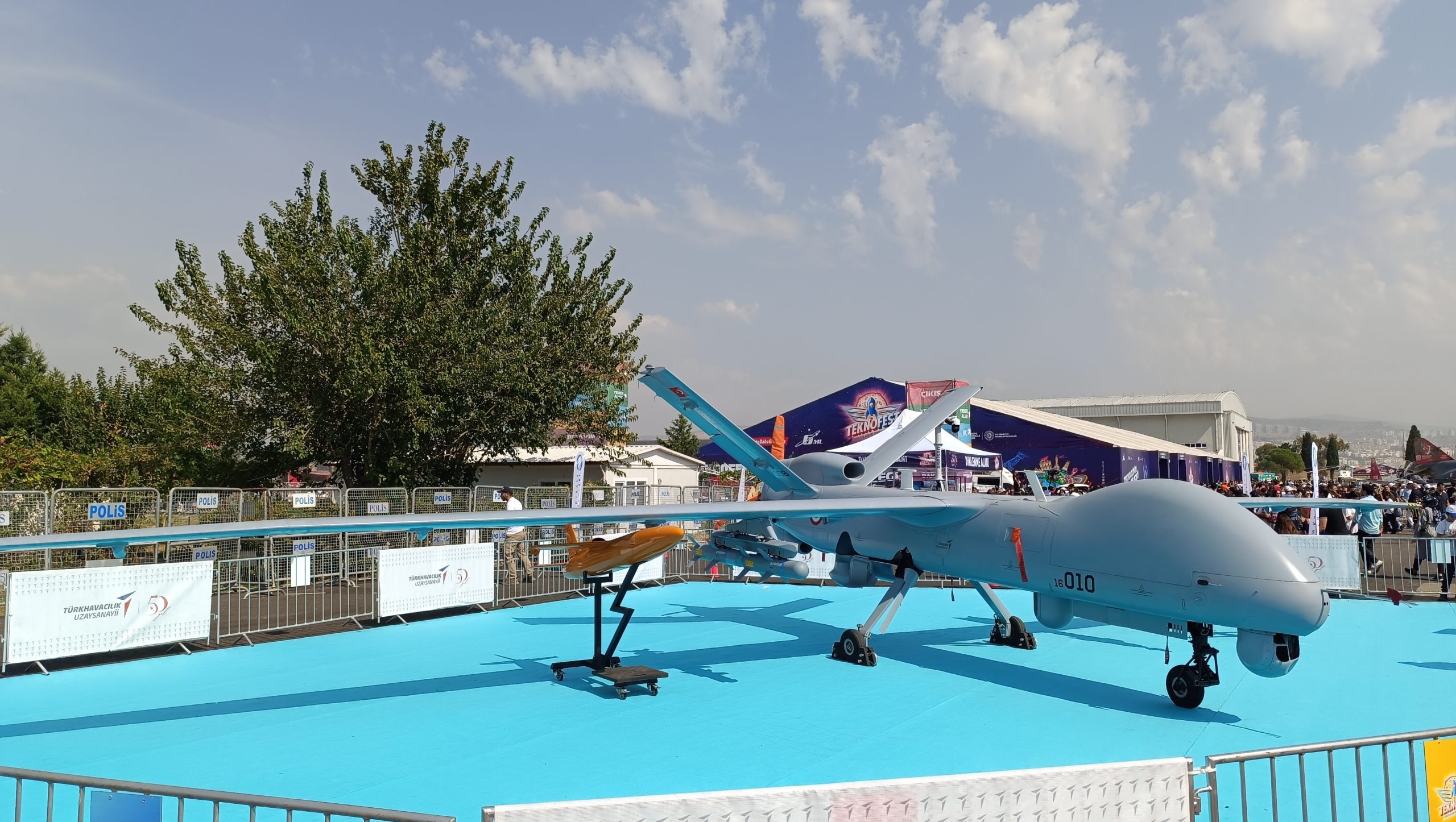
Turkish Aerospace publishes the ANKA’s headline figures: a 17.5 m wingspan, 8.6 m length, 1,700 kg maximum take-off weight, more than 350 kg of payload, endurance of up to 30 hours and a 30,000 ft service ceiling. The line-of-sight datalink is quoted at more than 250 km and the satellite link at more than 2,500 km — the latter being the whole point of the ANKA-S configuration, and the capability that separates it from shorter-legged tactical UAVs.
The company’s official product page lists a payload catalogue that reads as a full ISR and electronic-warfare suite rather than a strike platform with a camera bolted on: electro-optical/infrared turrets and SAR/GMTI-ISAR radar for reconnaissance; COMINT, ELINT, ESM, electronic attack and communications jamming for EW; and precision-guided bombs, laser-guided rockets and anti-tank missiles for strike. Turkish Aerospace says the ANKA fleet has passed 400,000 flight hours. Envanter Medya maintains a detailed Turkish-language technical profile of the ANKA for readers who want the subsystem-level walkthrough.
Importantly, the ANKA is the anchor of a family rather than a standalone product. Turkish Aerospace states that the ANKA, the heavier twin-engined AKSUNGUR and the jet-powered ANKA-III share a common avionics architecture and common ground systems. That is a sales argument aimed squarely at air forces that do not want to fund three separate training and support chains.
The engine question
The ANKA’s powerplant is one of the clearer indigenisation successes in Turkish aerospace, and it is worth stating precisely because the same is not true further up the family. The aircraft flies on the TEI-PD170 turbodiesel, developed by TUSAŞ Engine Industries under SSB sponsorship explicitly to replace the imported Thielert Centurion unit the early ANKAs used. TEI’s published specification gives 172 hp, a 162 kg dry weight, two-stage turbocharging, a 45,000 ft maximum altitude and a TEI-developed FADEC, with a first flight on the ANKA on 27 December 2018 and serial production from 2019. The same engine powers the AKSUNGUR — which TEI credits with a 45-hour single-sortie record at 42,000 ft — and has flown on Baykar’s TB3.
So a buyer acquiring an ANKA today is not acquiring an aircraft whose engine can be blocked by a third-country export licence. That is a meaningful discriminator in this market segment, and it did not use to be true. Our guide to who builds Türkiye’s aircraft engines sets out where the remaining gaps are — and they are concentrated in the large turbofan class, not here. The wider argument about how far that independence actually extends is covered in our assessment of Türkiye’s defence-production independence.
Where the ANKA sits in the market
The ANKA competes in the crowded 1,000–2,000 kg armed MALE segment, against the Chinese Wing Loong and CH-4, the Israeli Heron family where politics allow, and — for the small number of governments that can buy it — the General Atomics MQ-9. It is not an MQ-9 equivalent: the Reaper is a larger, heavier, longer-ranged aircraft with a deeper weapons ecosystem and a US export-control regime attached. Nor is it a TB2 equivalent in the other direction. The TB2 is a 700 kg-class aircraft optimised for cost and quantity; the ANKA carries roughly five times the payload, flies materially higher, and is built around beyond-line-of-sight satellite control as standard.
The categories overlap in mission but differ in procurement logic. Against Chinese MALE UAVs, the ANKA’s arguments are NATO-standard interoperability, a documented training pipeline and — on the Kazakh and Indonesian evidence — a willingness to put assembly work in the customer’s country. Against Western systems, the arguments are availability and the absence of US licensing friction, a subject we examine in detail in our explainer on whether Turkish weapons are ITAR-free.
Limitations a buyer should price in
- Published contract data is thin and inconsistent. Only Malaysia’s value is on an official public record, in ringgit. Tunisia’s figure differs by a factor of three depending on the source. Türkiye does not publish ANKA export values.
- The industrial half of these deals slips. Kazakhstan took four years to move from memorandum to joint venture and still has no announced site or timeline. Indonesia’s local assembly was still waiting on contract effectiveness in early 2025, two years after signature.
- No fleet or production numbers are published. Neither Türkiye nor Turkish Aerospace discloses how many ANKAs exist, how many are in Turkish service, or annual output. Any total you see elsewhere is an estimate.
- Combat record is largely undisclosed. Turkish ANKAs have been used operationally, but Ankara does not publish sortie or engagement data for the type, and no export operator has released combat results.
- The jet-powered successor is not yet an exportable product. ANKA-III remains in flight test with a small prototype fleet.
BUYER VIEW
Delivery: roughly three years from order to first operational flight where no local production is involved (Malaysia); longer where it is. Cost data: one officially published value across the entire export portfolio. Financing: Turkish export credit has reportedly featured since the first sale, and at least one customer’s contract stalled on financing rather than technology.
Industrial partnership: genuinely on offer — assembly, MRO and data-link training have all been written into contracts — but treat announced timelines as aspirations until a facility is named. Engine dependency: none from a third country on the baseline aircraft. Support: commonality with AKSUNGUR and ANKA-III reduces long-run training and logistics cost for operators who intend to grow the fleet. This is open-source editorial analysis, not procurement advice.
What comes next
The ANKA line continues, but the programme’s centre of gravity is shifting to the jet-powered ANKA-III. Turkish Aerospace gives it a 12.5 m wingspan, a 6,500 kg maximum take-off weight, 1,200 kg of payload across two internal and five external stations, a 40,000 ft ceiling, ten hours’ endurance at 30,000 ft and a maximum speed of Mach 0.7. It first flew on 28 December 2023, hit a target with a TEBER-82 guidance kit on its twelfth sortie, has since fired the TOLUN munition, and a second prototype is now flying. The company markets it for manned-unmanned teaming and AI-enabled swarming — the role that ties it to the KAAN fighter programme.
The honest caveat is the engine. TEI is developing the TF6000, a 6,000 lbf-class indigenous turbofan intended for Türkiye’s jet-powered unmanned aircraft, but it is not yet in service, and the flying ANKA-III prototypes have been reported to use an imported powerplant in the interim. Until the TF6000 is integrated and qualified, the stealth-shaped successor to the ANKA carries exactly the foreign dependency the baseline ANKA shed in 2018.
For export customers the near-term picture is simpler. Turkish Aerospace is still selling the propeller-driven ANKA, still bundling it with training and industrial participation, and still finding buyers among middle-income air forces that want persistent armed surveillance without a Western export-licence conversation. Whether the ANKA-III ever reaches that market depends less on the airframe than on the engine behind it.
FAQ
Which countries operate the ANKA drone?
Türkiye, Tunisia, Chad, Kazakhstan, Indonesia and Malaysia are documented operators. Algeria and Uzbekistan have been reported as customers but neither has been officially confirmed by the buyer or by Türkiye.
Who was the first export customer for the ANKA?
Tunisia, which signed at the Tunis air and defence show in March 2020. Public reporting on the size and value of that contract conflicts — between three and six aircraft, and between $80 million and $240 million — and neither government has published the terms.
How much does an ANKA cost?
There is no published unit price. The only officially disclosed export value is Malaysia’s MYR 423.8 million (about $104 million) for three aircraft with ground equipment and support. Indonesia’s ministry of defence stated $300 million for 12 aircraft including training, logistics and a two-year warranty. These are package prices covering ground stations, training and support, not flyaway costs, and they are not directly comparable.
Is the ANKA built anywhere outside Türkiye?
Not yet. Indonesia’s PTDI is contracted to assemble six of that country’s twelve aircraft at Bandung, and Kazakhstan signed a production and maintenance joint-venture agreement with Turkish Aerospace on 14 May 2026. Neither has announced a completed locally built aircraft.
What is the difference between the ANKA and the Bayraktar TB2?
They are different classes built by different companies. The TB2 is a Baykar product of roughly 700 kg with a smaller payload, sold widely and cheaply. The ANKA is a TUSAŞ product of 1,700 kg carrying more than 350 kg of payload, with satellite control as standard, sold to far fewer customers in larger, more complex packages.
Does the ANKA use a foreign engine?
No. The current aircraft flies on the TEI-PD170 turbodiesel, developed in Türkiye specifically to replace the imported engine used on early ANKAs, and in serial production since 2019. The jet-powered ANKA-III is a separate case: its indigenous TF6000 turbofan is still in development.
Sources
- Turkish Aerospace, official ANKA and ANKA-III product pages (specifications, programme history, flight hours)
- TEI, official TEI-PD170 and TEI-TF6000 product pages
- Kazakhstan Engineering, announcement of the ANKA assembly and maintenance memorandum, 10 May 2022
- PT Dirgantara Indonesia newsroom, report on the pending effectiveness of the ANKA contract, February 2025
- Janes, Malaysia operates newly acquired Anka UAVs
- Defense News, Indonesia buys 12 Anka drones and TAI sells Anka-S drones to Tunisia
- The Defense Post, Tunisia signs deal for Turkish Anka-S drones
- Asia-Plus, citing Kazinform and the Kazakh presidency, Kazakh and Turkish authorities agree to produce ANKA drones at a joint venture, 15 May 2026


[…] Indonesia’s technology transfer was still waiting on contract effectiveness in early 2025. Our guide to which countries operate the ANKA sets out each contract and its delivery […]
[…] effectiveness in early 2025, so the aircraft have arrived well ahead of the industrial work. Our country-by-country ANKA operator guide tracks both sides of each […]
[…] The technology was never the obstacle. The payment structure was. The pattern repeats across the ANKA’s wider export customer base, where industrial commitments consistently take longer to land than aircraft […]
[…] The weakest form is a memorandum of understanding, or a contract clause conditioned on something that has not happened yet. Kazakhstan is the clearest case. Kazakhstan Engineering and Turkish Aerospace signed a military-technical cooperation memorandum in May 2022 covering an ANKA assembly line, maintenance capability, technology transfer and personnel training. The aircraft themselves were reported delivered by 2023. The memorandum did not become a joint venture until 14 May 2026, four years later, during a presidential visit to Astana — and no site or production timeline has been announced since. A fuller account sits in our page on which countries operate the ANKA and what each of them agreed. […]