Türkiye and Azerbaijan Sign Over $500 Million in Defence Deals at ADEX 2026

Türkiye and Azerbaijan signed more than $500 million in defence contracts and memoranda on September 30, the opening day of the Azerbaijan International Defence Exhibition (ADEX) in Baku, in a package that runs from trainer aircraft and coastal-defence missiles to a planned factory on Azerbaijani soil. The agreements, confirmed by Haluk Görgün, head of Türkiye’s Presidency of Defence Industries (SSB), cover five Turkish companies and extend a defence-industrial relationship that already runs deeper than most of Ankara’s export markets.
The package was announced on the first of ADEX’s three days, with Görgün telling reporters in Baku that “local production and joint projects will be steps that strengthen our bonds of brotherhood,” according to Anadolu Agency. It is the clearest sign yet that Türkiye and Azerbaijan are shifting from an arms-supplier relationship toward one built around co-production and technology transfer. Türkiye arrived at this year’s show with its largest-ever delegation to ADEX, a signal of how much weight Ankara is putting on the Baku market.
What Was Signed
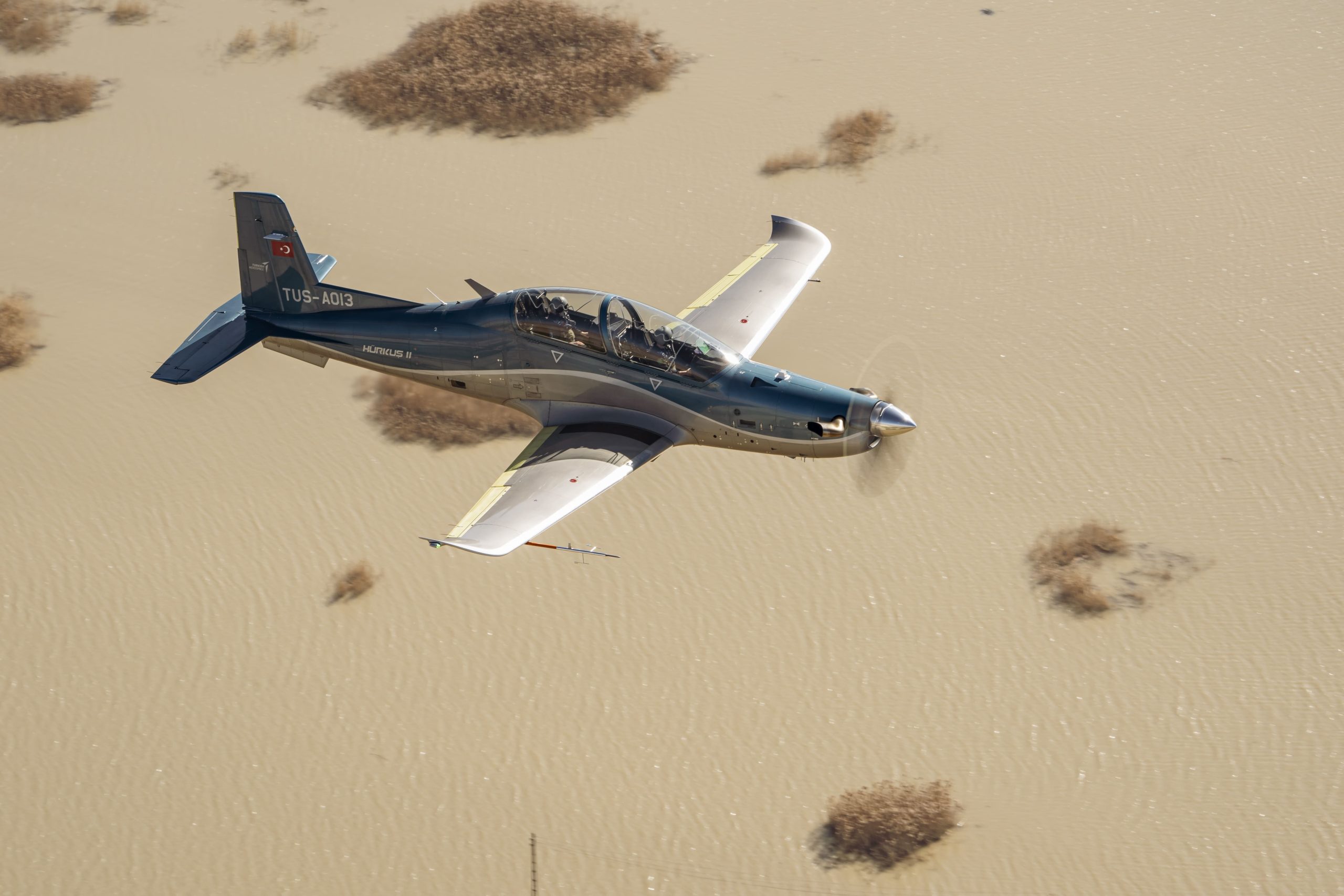
Turkish Aerospace Industries (TUSAŞ) will deliver 14 HÜRKUŞ-II basic trainer aircraft to Azerbaijan, with first deliveries expected before the end of 2026, Görgün said. The HÜRKUŞ-II is the production-standard version of Türkiye’s indigenous turboprop trainer, already in service with the Turkish Air Force and Gendarmerie.
ASELSAN signed a memorandum of understanding to supply the ALP-100, a multifunction S-band AESA radar with a stated detection range beyond 100 nautical miles, alongside a separate contract for the ANTIDOT 2ES 100, a roughly 30-kilogram electronic-warfare pod designed to detect and locate hostile radar emissions. Because the radar deal is an MoU rather than a firm contract, quantities, delivery dates and final pricing have not been disclosed.
Baykar will supply the Mızrak smart loitering munition — a long-range strike system Baykar rates at over 1,000 kilometres of range, more than seven hours of endurance and a warhead of up to 40 kilograms — along with its Antidot family of systems under a separate agreement. Roketsan’s contribution is the Barbaros coastal defence system, a mobile battery architecture that can fire the ATMACA anti-ship missile and the shorter-range ÇAKIR cruise missile from truck-mounted launchers.
The most structurally significant item in the package may be the smallest to announce: ASELSAN and Azerbaijani firm NOVASIS signed a preliminary agreement to establish a joint factory in Nakhchivan, the Azerbaijani exclave bordered by Armenia, Iran and Türkiye. Reporting on the agreement has linked the site to possible future production of TOLUN-series guided munitions, though SSB and ASELSAN have not confirmed a product line for the plant, and the agreement itself remains preliminary rather than a signed construction contract. Separately, Turkish state arms maker MKE and Azerbaijani firm MİRAS discussed cooperation on BMP-1 modernisation and integration of the TOLGA fire-control system, and Türkiye’s Council of Higher Education (YÖK) signed an academic-cooperation memorandum with Azerbaijan’s defence-industry and education ministries covering joint engineering training and research.
A Relationship Built on More Than Sales
Azerbaijan is not a new customer finding its way into the Turkish defence catalogue. Baku was one of the first operators of the Bayraktar TB2, flying the drone during the 2020 war over Nagorno-Karabakh in a campaign that did as much as any single conflict to establish the TB2’s export reputation. Since then, the relationship has been formalised well beyond arms sales: a 1992 military training agreement, a 1996 agreement on technical cooperation, the 2010 Agreement on Strategic Partnership and Mutual Assistance, and the 2021 Shusha Declaration, which commits both states to mutual defence assistance and explicitly ties that commitment to joint defence-industrial work.
That legal and political scaffolding is why the Nakhchivan factory plan matters more than its dollar value suggests. A production line on Azerbaijani soil — even a small one — moves the relationship from “Türkiye sells, Azerbaijan buys” toward “Türkiye and Azerbaijan build together,” the same template Ankara has used to deepen defence ties with Pakistan and, more recently, Egypt. For Azerbaijan, local production supports a longer-term goal of building its own defence-industrial base rather than remaining a pure importer. For Türkiye, it is a hedge against a market where several Gulf and Central Asian states are now requesting the same kind of co-production terms Baku is getting.
Why This Matters Beyond the Caucasus
The ADEX package is also a useful cross-section of what Turkish industry is currently selling abroad: a trainer aircraft already in domestic service, a radar and an electronic-warfare pod still being marketed on MoU terms, a loitering munition competing in the crowded Lancet-and-Shahed-adjacent market that the Ukraine war created demand for, and a coastal-defence system built around a missile — ATMACA — that Türkiye has pitched as an alternative to the US-made Harpoon. None of these are headline programmes like KAAN or SİPER; they are the mid-tier systems that make up the bulk of Turkish export revenue — the same category covered in the €1.23 billion ASELSAN-ROKETSAN air defence deal signed days earlier — which SSB says has pushed Turkish defence and aerospace exports toward roughly $11 billion over the trailing twelve months. Readers wanting the fuller buyer picture can see which countries actually buy Turkish air defence systems and how those purchases are typically financed.
The deal also lands at a moment when ADEX itself has grown larger and more contested. Organisers opened a fifth exhibition pavilion for the first time this year to accommodate what they put at more than 270 companies from 29 countries, and the show’s sponsor list — ROKETSAN as General Sponsor, Northrop Grumman as Country Partner Sponsor — reflects Baku’s deliberate positioning of the fair as a multi-bloc marketplace rather than a Turkish or Russian stronghold. Lockheed Martin and SIG Sauer made their ADEX debuts this year, a reminder that Turkish firms are not negotiating with Baku in a vacuum.
What to Watch Next
Three things will determine whether this package matters beyond a single exhibition news cycle. First, whether the ALP-100 and ANTIDOT MoUs convert into signed contracts with disclosed values — Turkish industry has a mixed record on exhibition MoUs maturing into firm orders. Second, whether the Nakhchivan facility produces an actual groundbreaking date and confirmed product line, rather than remaining a preliminary agreement. Third, whether the 14 HÜRKUŞ-II aircraft arrive on the stated 2026 timeline, which would make Azerbaijan one of the first export customers to take delivery of the type.
ADEX 2026 runs through October 2 at the Baku Expo Center, with Turkish officials and company representatives expected to hold dozens of further bilateral meetings before the show closes.
Sources: TRT World / Anadolu Agency; Aviacionline; FlightGlobal.