Two Small Turbojets Now Keep Türkiye’s Cruise Missiles Flying Without Foreign Engines

A cruise missile is mostly fuel, warhead and electronics, but none of it matters if the engine quits. For years the engines inside Türkiye’s longer-range cruise missiles came from abroad. That is no longer true, and the replacements are two very small turbojets that most readers have never heard of.
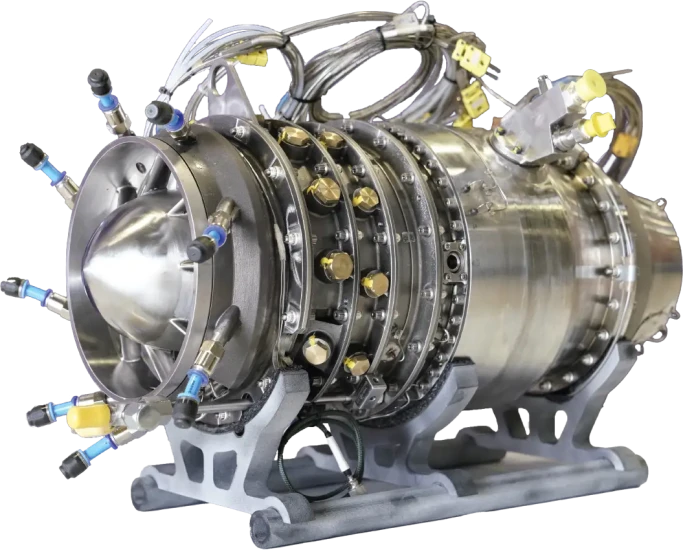
The Kale Group’s KTJ-3200 and the TEI-TJ300 built by Türk Havacılık ve Uzay Sanayii’s engine arm are not glamorous. They are expendable, single-use powerplants designed to run for a few minutes of flight and then be destroyed with the missile. They still decide whether a national missile programme can be exported or fired without a foreign licence.
What Is a Small Turbojet and Why Do Missiles Use It?
A turbojet is the simplest gas-turbine engine: a compressor, a combustor and a turbine, with all thrust coming from the exhaust. It burns fuel hungrily, which is why airliners abandoned it decades ago. For a missile that only has to fly for roughly 15 to 20 minutes, thirst is a fair price for a compact, cheap and light engine that can sit in storage for years and start on demand.
Compared with a rocket motor, a turbojet lets a missile cruise low and far. That is the difference between a short-range rocket and a sea-skimming anti-ship missile like ATMACA. The solid-fuel side of the story is covered in our piece on how solid rocket motors sit behind Türkiye’s missile output; turbojets handle the long, low-altitude leg.
Why Did Türkiye Need Its Own?
The older SOM stand-off missile and early ATMACA configurations relied on a French Microturbo engine, the TRI-40 (also written TR40). Reporting by Defense News and others describes the Kale effort as a way to replace those imported engines, and notes that development gained urgency as French sales of jet engines to Türkiye became restricted. The programme itself began in 2012, according to Defense News.
The result of that import dependence is visible in the SOM story, which we followed in SOM’s switch away from its French engine. A missile counted as national but powered by a foreign part is a missile whose export licence and wartime resupply sit in someone else’s hands.
What Is the Kale KTJ-3200?
Kale Arge, founded in 2013 as a subsidiary of Kale Group, developed the KTJ-3200 with its own funding, according to EDR Magazine’s coverage of SAHA Expo 2024. Defense News reported the first deliveries in September 2021, one engine to TÜBİTAK SAGE and one to Roketsan, with a serial production contract signed at IDEF that August. Other sources give an earlier date for a first batch to Roketsan, in November 2020, so the delivery chronology varies by outlet.
| Item | KTJ-3200 |
|---|---|
| Developer | Kale Arge (Kale Group) |
| Type | Single-spool turbojet |
| Thrust | 3.2 kN |
| Length / diameter | 630 mm / 330 mm |
| Weight | About 50 kg (dry) |
| Specific fuel consumption | 1.18 kg/h/daN |
| Used on | SOM, ATMACA |
Defense News describes it as architecturally close to the French TR40, with negligible performance differences. That matters: it implies Türkiye matched a proven design rather than inventing a risky one. The engine was reportedly qualified through altitude testing, endurance trials, water ingestion tests and MIL-STD-810 environmental standards.
How Does the TEI-TJ300 Differ?
TEI approached the same need from a smaller size class. According to TEI’s own product page, the TJ300 grew out of a project begun in September 2017 with Roketsan and TÜBİTAK support, and its first prototype test took place on February 25, 2020. The company says it set a class record in April 2021 with 1,342 newtons of thrust from a 224 mm diameter.
| Item | TEI-TJ300 |
|---|---|
| Developer | TEI (Türkiye) |
| Maximum thrust | 1,400 N (TEI figure) |
| Length / diameter | 450 mm / 224 mm |
| Dry weight | 34 kg |
| Specific fuel consumption | 37.4 g/kN·s |
| Stated role | Medium-range anti-ship missile |
TEI also says the engine can start in flight without an external starter and operate at up to 90 percent of the speed of sound at 5,000 feet. Analysts at Quwa noted that 1.3 kN is too little for a larger missile such as ATMACA, which fits a shorter-range class instead. TEI’s wider engine business, from piston to turbofan, is in our TEI company profile.
Where Do These Engines Fly?
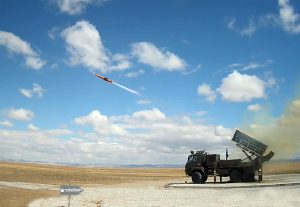
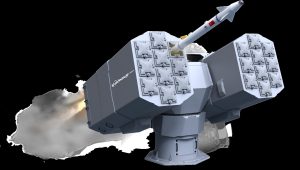
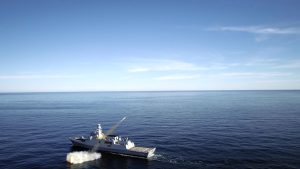
The KTJ-3200 is reported to be the standard engine for ATMACA and SOM, both quoted at about 250 km range. The anti-ship role is explored in where ATMACA fits in the global anti-ship missile market. Wikipedia lists a 2025 Brazilian contract for MANSUP anti-ship missiles as another application, though that claim rests on a secondary source and is reported here as such.
Kale has since extended the family. EDR Magazine and Defence Turkey describe the KTJ-1750 (1,750 N, 464 mm long, 202 mm diameter, 22.5 kg) for the ÇAKIR cruise missile and the KTJ-3700, a derivative with more than 15 percent extra thrust in the same dimensions, tested on KARA ATMACA. Our report on the ground-launched ÇAKIR firing and the KARA ATMACA land-attack missile cover the airframes those engines propel.
Can Kale Actually Build Them in Numbers?
Production is where independence is won or lost. In an October 2024 interview with Defence Turkey, Kale Arge’s Cüneyt Kenger said the company had gone from two engines per week to seven in a year, and that its workforce had doubled from 120 to 240. The same interview mentioned an altitude test rig being expanded from 5,000 to 10,000 metres, with two parallel chambers. These are company statements and not independently audited figures.
Engines are reportedly endurance-tested for three to four times their operational duration before approval. The company also said it was planning turbofan work for longer-endurance missiles, a path that connects to the larger efforts in our look at three new Turkish turbofans.
What Does Domestic Mean for Export and Licensing?
An engine built at home removes a licensing step from every missile sale. Several outlets say the KTJ-3200 was produced without ITAR restrictions, which is the American export-control regime that complicates many Turkish programmes. Our explainer on ITAR and Turkish defence exports shows how a single foreign component can stall a contract.
Kale’s published envelope for the KTJ-3200 is an operating altitude from sea level to 6,000 metres and a speed range up to Mach 0.95, according to EDR Magazine. That suits subsonic sea-skimmers and stand-off weapons, not supersonic designs. Anything faster needs a different engine class, usually a ramjet, which is a separate development track.
Cost is the other argument. Kale’s management said its engines stay competitively priced against international alternatives, though it also admitted that currency swings and material costs ate into savings from learning-curve effects. No unit price has been published, and none is cited here.
Do Small Turbojets Lead to Fighter Engines?
Not directly, and nobody involved claims otherwise. Kale’s own chief was quoted by Defense News saying the first critical step toward future aircraft engines is designing a long-lasting engine. A throwaway missile turbojet teaches materials, combustion, controls and test discipline. A fighter engine needs thousands of hours of life, afterburning and far higher pressure ratios.
The broader supply chain, including who makes what across the industry, is mapped in who builds Türkiye’s aircraft engines. For the missile programmes, the practical milestone is simpler: the engines now exist in series, and the next open question is whether output keeps pace with Roketsan’s orders and export demand.