What Fuel Cells Give the Reis-Class Submarines That Diesel Boats Lack

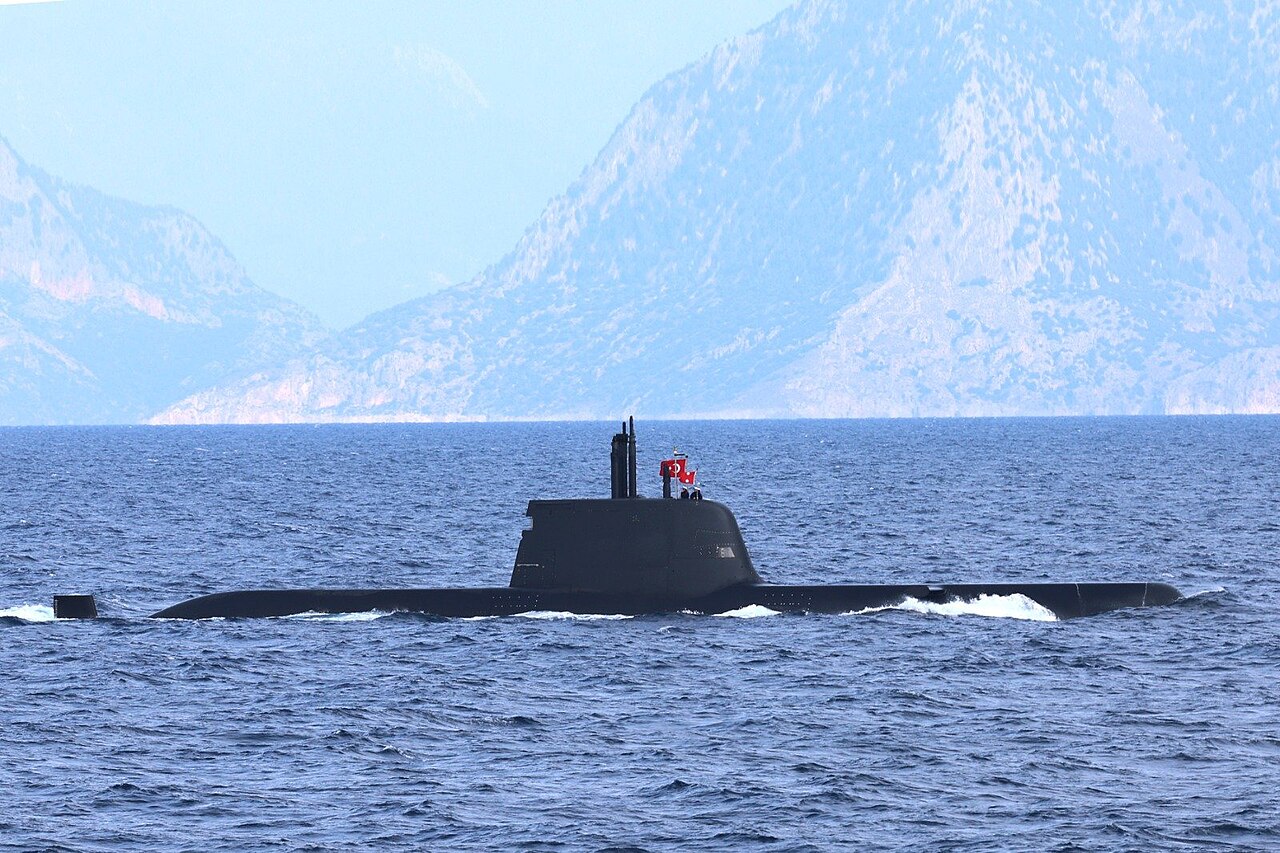
A conventional submarine has one weakness that no amount of crew skill removes. Its batteries run down, and to recharge them it has to run diesel engines, which means breathing air through a snorkel mast near the surface. That is when it is easiest to find. The Reis class, the Turkish Navy’s Type 214TN boats, was bought largely to shorten those exposed hours.
Two of the six boats are now in service, a third is in the water, and the remaining three are in various stages of construction at Gölcük. This is a look at what the fuel-cell system actually does, what the boats carry, and how much of the package is Turkish.
What Is the Reis Class?
The Reis class is the Turkish designation for the German Type 214 submarine as configured for Türkiye (the “TN” suffix marks the Turkish Navy variant). The design authority is TKMS, formerly HDW. The boats are assembled under licence at the Gölcük Naval Shipyard under a 2009 contract covering six hulls. Reported contract values differ between sources, so no figure is repeated here.
The programme runs under the Turkish Navy’s New Type Submarine Project (YTDP). It replaced the ageing Type 209 boats that had formed the backbone of the submarine force for decades.
| Item | Detail |
|---|---|
| Design | Type 214TN, German design by TKMS, built under licence |
| Builder | Gölcük Naval Shipyard, Kocaeli |
| Boats planned | Six (S-330 to S-335) |
| Length / beam | 68.35 m / about 6.3 m |
| Displacement | About 1,860 tonnes surfaced, about 2,010 tonnes submerged (reported) |
| Propulsion | Diesel-electric with PEM fuel-cell AIP |
| Submerged speed | About 20 knots (reported) |
| Armament | Eight 533 mm torpedo tubes; Mk 48 and DM2A4 torpedoes, mines, missiles |
| Operator | Turkish Naval Forces Command |
How Does Fuel-Cell AIP Let a Submarine Stay Hidden?
AIP stands for air-independent propulsion. On the 214TN it takes the form of polymer electrolyte membrane (PEM) fuel cells, which combine stored hydrogen and oxygen to produce electricity, with water as the by-product. Reported figures put the installation at two 120 kW modules, alongside large battery banks.
The practical effect is on the slow, quiet part of a patrol. A boat creeping along at a few knots while it listens or waits near a choke point draws little power. The fuel cells can cover that low demand without the diesels running, so the boat does not need to come up to snorkel depth to recharge. A diesel-electric submarine without AIP has to do that every few days at the latest, depending on speed and battery state.
The fuel cells do not replace the batteries. For a high-speed sprint the boat still draws on the batteries, and AIP is not a way to run flat out for days. It is a hotel-load and slow-transit system. That is also why published endurance numbers need care. Figures for how long a 214-type boat can stay submerged vary by source and by assumed speed, and the Turkish Navy does not publish an official number, so this article does not give one.
Fuel cells also have almost no moving parts and produce very little noise. A snorkelling diesel is one of the loudest things a submarine can do.
Which Boats Are in Service and Which Are Still Building?
The schedule has slipped. Construction of the lead boat began in 2015, and the original plan had it in service several years earlier.
- TCG Piri Reis (S-330) was commissioned on 24 August 2024 at Aksaz Naval Base, with President Recep Tayyip Erdoğan attending.
- TCG Hızırreis (S-331) was delivered in late 2025. Naval News reported a ceremony on 21 December 2025 at which the boat was presented to the fleet; other sources give a hand-over date of 27 November.
- TCG Murat Reis (S-332) was launched in May 2025 and is being outfitted. Official statements have pointed to service entry in 2026.
- TCG Aydın Reis, Seydi Ali Reis and Selman Reis are the remaining three, still under construction. Erdoğan said at the 2024 ceremony that all six should be complete by 2029.
The gap between launch and commissioning is long on these boats, often more than a year. Much of that time goes on outfitting, system integration and sea trials, which are slow for a submarine because every compartment has to be certified before the boat dives with a full crew.
What Do the Reis-Class Boats Carry?
The eight bow tubes fire 533 mm weapons. The initial outfit is reported to include the US-made Mk 48 Mod 6 and the German DM2A4 heavyweight torpedo, plus mines and submarine-launched Harpoon missiles. The plan is to move to Turkish weapons over time.
That means Roketsan’s AKYA heavyweight torpedo and a submarine-launched version of the ATMACA anti-ship missile. The Sub-ATMACA was shown at the Piri Reis commissioning event in 2024, according to Naval News. Which boat gets which domestic weapon, and when, has not been published in detail.
The boats can also embark a small special operations team, reportedly around 11 personnel, in addition to a crew of roughly 27 to 30. Those are reported numbers, not official ones.
How Much of the Package Is Turkish?
The hull design, the AIP concept and much of the core engineering are German. Türkiye does not hold the design rights, which is why the boats are not an export product in their own right. What has become Turkish is the layer on top.
Reported domestic contributions include combat management and data-handling software from HAVELSAN, which also supplies the ADVENT combat management system used on surface ships, sonar and electronic systems from ASELSAN, and integration and subsystem work from STM. Roughly 30 Turkish firms are reported to be involved. The commonly quoted local-content share is around 80 per cent, but that is a claim about systems and workshare rather than design ownership, and it has not been independently audited in public.
The sensor side is covered in a guide to how Turkish sonar systems hunt submarines and mines. For where the hulls themselves are built and who else builds them, see the rundown of Turkish shipyards.
How Does It Compare With the Boats It Replaces?
The Turkish submarine fleet was built around the German Type 209 family, which entered service from the 1970s and was later modernised in several batches. Those boats are diesel-electric only. They are simple and proven, but they have to snorkel regularly, and their sensors and combat systems date from another generation.
The 214TN adds three things. The first is AIP, covered above. The second is a modern combat system and sonar suite that can work with current heavyweight torpedoes and missiles. The third is a larger hull with room for a special forces detachment and for growth. None of this makes the Reis class a nuclear boat or a long-range ocean raider, and it is not meant to be one. It is a coastal and regional submarine for the Black Sea, the Aegean and the eastern Mediterranean, where distances are short and quiet time on station is what counts.
Type 214 itself is not unique to Türkiye. Other navies, including Greece, South Korea and Portugal, operate boats from the same design family, usually with their own variations. That shared lineage helps with spares and training, though Turkish boats are built to the Turkish configuration and should not be treated as identical to those fleets.
Why Does Delivery Take So Long?
The Turkish Navy has not published a full explanation, but the usual factors in licence-built submarine programmes apply. Licence-built submarines depend on imported equipment, and delivery of that equipment affects every later step. The first-of-class work, including shipyard tooling and workforce training, was done from scratch at Gölcük. And each boat goes through a long test programme: harbour trials, sea trials, deep-diving and weapon-firing checks, then acceptance by the navy.
The encouraging sign is the pace between hulls. The first boat took years from keel-laying to service. The interval between the first and second commissioning was about fifteen months, and the third boat is already afloat. If the later hulls follow that rhythm, the 2029 target for all six looks achievable, though the programme has missed earlier dates and officials have revised them before.
Where Does the Reis Class Fit Next to MİLDEN?
The Reis boats are the bridge to the national programme. MİLDEN is meant to be the first submarine designed in Türkiye, and the workforce and suppliers who have learned to finish Type 214TN hulls at Gölcük are the ones who will be asked to build it. The Reis class is where Turkish industry practised integrating sonar, combat systems and weapons into a submarine hull. MİLDEN is where it is supposed to own the design too.
For the current state of that effort, see the Turkish-language report on the MİLDEN programme at Gölcük, and for the wider picture, the overview of Turkish submarine building.
In the near term, the things to watch are the delivery of Murat Reis and the first Turkish weapons loaded on a Reis boat. Those two events will say more about the programme than any local-content percentage.