The ANKA-3 Stealth Drone Is Turkish Aerospace’s Flying Wing Bet

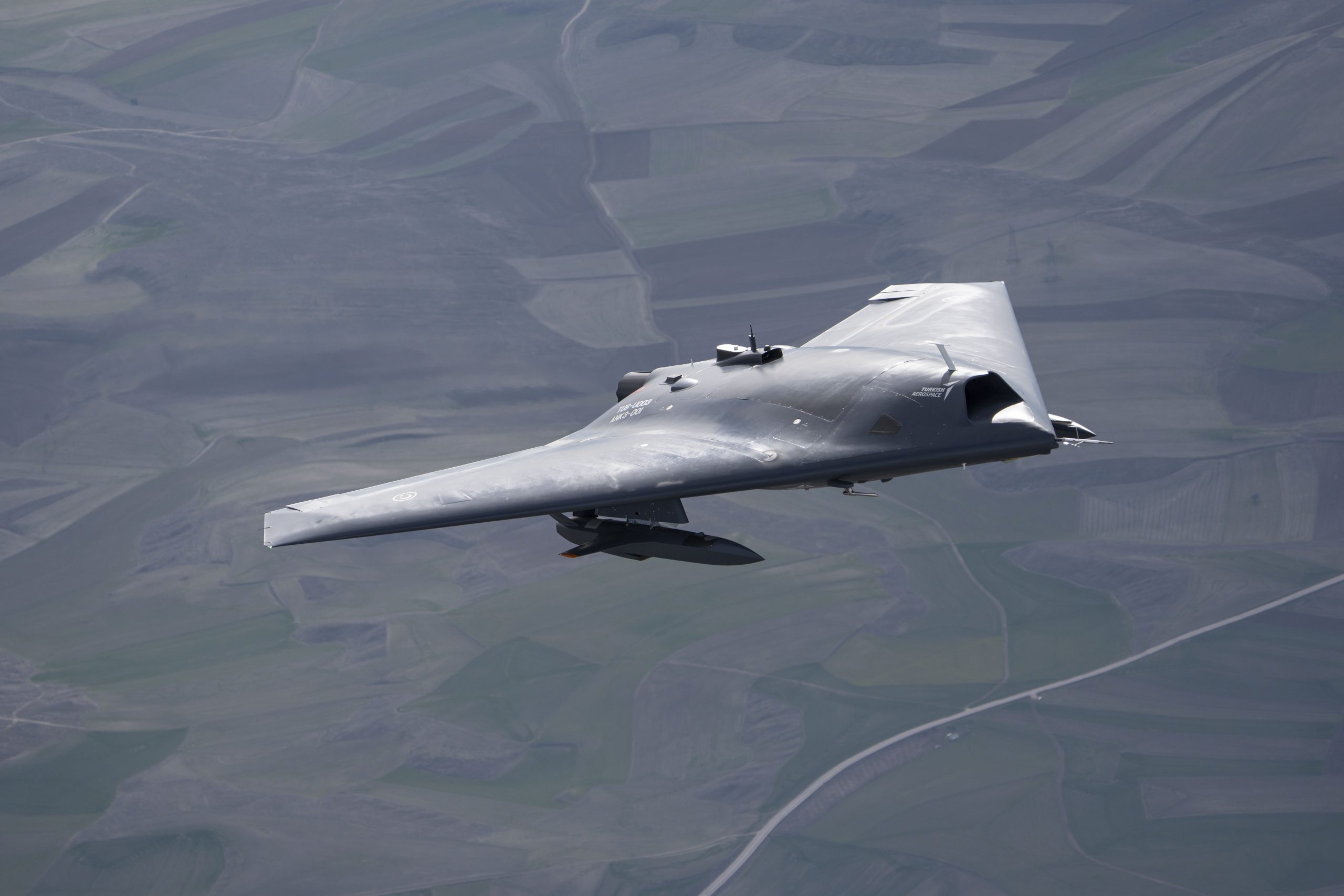
A tailless, arrow-shaped jet that looks more like a stealth bomber model than a drone: that is how most people first met the ANKA-3. Turkish Aerospace (TUSAŞ) rolled it out in 2023, flew it on 28 December 2023, and has spent the time since proving that a flying wing can do more than look good in renders. This piece explains what the aircraft is, what has actually been demonstrated, and where the open questions sit.
What Is the ANKA-3 and Why Is It Shaped Like a Wing?
The ANKA-3, written ANKA III on the company’s own pages, is a jet-powered unmanned combat aircraft for air-to-ground missions. It has no horizontal or vertical tail. The fuselage blends into the wing, and weapons can be carried inside the airframe rather than hung under it.
That layout is the whole argument for a low-observable drone. Tail surfaces, pylons and external stores all return radar energy. Remove them, hide the engine inlet and tuck the ordnance away, and the aircraft becomes harder to detect and track. TUSAŞ describes the flying-wing design as one that reduces radar visibility, paired with a turbofan for high-subsonic performance.
It is also a break from the family it is named after. The earlier ANKA drone family is a conventional medium-altitude, long-endurance turboprop design. The ANKA-3 shares the name and the company’s accumulated flight-test culture, not the airframe. TUSAŞ says the programme drew on experience from the ANKA and AKSUNGUR lines, and that around 250 engineers worked on it using AI-supported design and simulation.
What Are the ANKA-3’s Specifications?
The table lists figures from TUSAŞ’s product page for the prototype configuration. Other outlets quote slightly different numbers, which is common with a programme still being refined.
| Item | Figure (TUSAŞ) |
|---|---|
| Manufacturer | Turkish Aerospace (TUSAŞ) |
| Type | Jet-powered flying-wing unmanned combat aircraft |
| Length / wingspan | 7.9 m / 12.5 m |
| Maximum take-off weight | 6,500 kg |
| Payload | 1,200 kg |
| Service ceiling | 40,000 ft |
| Endurance | 10 hours at 30,000 ft |
| Maximum speed | Mach 0.7 (425 knots) |
| First flight | 28 December 2023 |
Some public references list a longer, heavier airframe and a payload above 1.5 tonnes. Those figures appear to describe later or planned configurations and are not confirmed by the company page, so treat them as reported rather than settled.
How Has the Flight-Test Campaign Gone?
The programme moved quickly. The aircraft was powered up in early 2023 and conducted taxi tests that spring. Its maiden flight on 28 December 2023 lasted about 70 minutes, with a TUSAŞ Hürkuş turboprop as chase aircraft; defence outlets reported an altitude of roughly 8,000 ft and a speed near 150 knots on that first sortie.
The weapons work followed the next year. TUSAŞ says that on its 12th sortie the aircraft hit a target using a TEBER-82 guidance kit, Roketsan’s precision kit for Mk 82 bombs. Later reporting added an internal-bay release of ASELSAN’s TOLUN penetrator bomb in January 2025, which would be the first internal-bay weapon release by a Turkish aircraft. That detail comes from secondary sources and is worth reading as reported.
Army Recognition reported the aircraft had flown more than 150 hours, and that a 46th verification sortie in December 2025 validated its autonomous flight envelope. Those counts are reported figures, not company statements, but they fit the cadence of a programme with two prototypes flying regularly.
What Happened to the Prototype in June 2025?
One of the two prototypes was damaged on 25 June 2025 during the Anatolian Eagle exercise at Konya. Aviation Week and other outlets reported a hard landing after a malfunction. Turkish accounts described a controlled approach to the ground that damaged the landing gear and other components. Images that circulated showed the wing structures separated from the centre body.
The exact cause has not been published in detail, and whether the airframe was a total loss is a point on which accounts differ. What matters for the programme is that it lost half of its flying prototype fleet at a busy moment, and still reported continued flight-test activity afterwards. That points to a test programme with enough depth to absorb the setback, though the schedule impact has not been spelled out officially.
What Powers It, and Why Does the Engine Matter?
The prototype uses a single turbofan of Ukrainian origin; the Ivchenko-Progress AI-322 is the engine most often named. That is a dependency Ankara would rather not carry into serial production, given how supply chains for Ukrainian-made engines have been strained.
Turkey’s answer is domestic. Reporting points to TEI’s TF6000 turbofan as an indigenous fallback for the type, and TEI’s larger TF-10000 has been mentioned in connection with future supersonic ambitions. Neither engine has been confirmed as the production powerplant, so the propulsion route remains an open item. The same engine problem shapes the KAAN fighter programme, where the indigenous engine is not expected for years.
The prototype’s round exhaust nozzle is not the final word on signature. Early coverage noted the nozzle could be replaced with a low-observable version, and TUSAŞ leadership has spoken of a later aircraft with a buried nozzle and further signature work.
What Can It Carry and See With?
The ANKA-3 has two internal weapons bays plus external stations. TUSAŞ shows a mission set that includes ISR with electro-optical and radar sensors, electronic warfare functions covering COMINT, ELINT and jamming, and precision strike. Publicly named munitions include the TEBER-82 and TOLUN, and reports list the SOM-J stand-off cruise missile as a planned or integrated option.
Sensor fit is where the aircraft stops being a strike drone and begins to resemble a combat aircraft. ASELSAN is reported to be preparing integration of its MURAD 100-A active electronically scanned array radar, which would give the ANKA-3 an air-to-air and air-to-ground radar rather than relying on cameras alone. As with the engine, the sensor package seen today is a prototype fit and the production aircraft may differ.
The company has also demonstrated a crewed-uncrewed control concept. Public reporting describes a cruise-missile-armed ANKA-3 being controlled from another aircraft in October 2024, the first step towards the loyal wingman role that would pair it with crewed fighters.
How Does It Compare With KIZILELMA?
Turkey is funding two jet-powered unmanned combat designs that look similar on a briefing slide and differ in practice. The ANKA-3 is a flying wing built for stealth and internal carriage. Baykar’s KIZILELMA is a tailed, fighter-like design intended to fly air-to-air missions and operate alongside crewed jets.
The wing shape tends to favour range, payload and signature; the conventional layout favours agility and a more fighter-like role. The two are not strictly rivals. They sit in different parts of the same force structure, and both feed the idea of crewed-uncrewed teaming around KAAN.
It also helps to think about who builds what. TUSAŞ, the Turkish Aerospace, owns the ANKA-3. Baykar, a private company, owns KIZILELMA. For the Turkish Air Force, that gives a competitive supply base, which is exactly what has been missing in many other countries’ unmanned programmes.
Is Serial Production Coming?
TUSAŞ chief executive Mehmet Demiroğlu said in early 2026 that the programme had passed its critical design review, that the configuration was frozen and that production-related work had begun. According to those reports, the Turkish Air Force was expected to place an initial order of more than 50 aircraft in 2026, with two additional aircraft in the updated design planned the same year. Treat the order number as an expectation attributed to the company, not a signed contract; no contract value has been published.
A more stealthy configuration was reported to be planned for a flight in late 2026. If that holds, the next visible milestone is a production-standard aircraft with the refined nozzle and radar, rather than another prototype sortie.
For export, the picture is thinner. The company’s older ANKA is already sold abroad, and its customer list is covered in our look at which countries operate the ANKA drone. No export customer for the ANKA-3 has been confirmed officially; some reports mention foreign interest, but none of it rests on a published agreement.
What Remains Unproven?
The flying wing is a proven shape; the ANKA-3 still has to prove its details. Signature figures are not public, and no one outside the programme can say how stealthy it really is. The production engine, the radar integration and the payload of the final aircraft are all moving pieces. The prototype loss in 2025 is a reminder that the test fleet is small.
What is established is the pace. A design shown in March 2023 was flying nine months later, dropping guided weapons within a year, and heading for series production on a stated timetable. If TUSAŞ delivers the order and the low-observable refinements on schedule, Türkiye will have a second stealth-oriented unmanned combat aircraft in service while most of its peers are still arguing over requirements.