CİRİT Gave Helicopters a Guided Rocket Cheaper Than a Missile

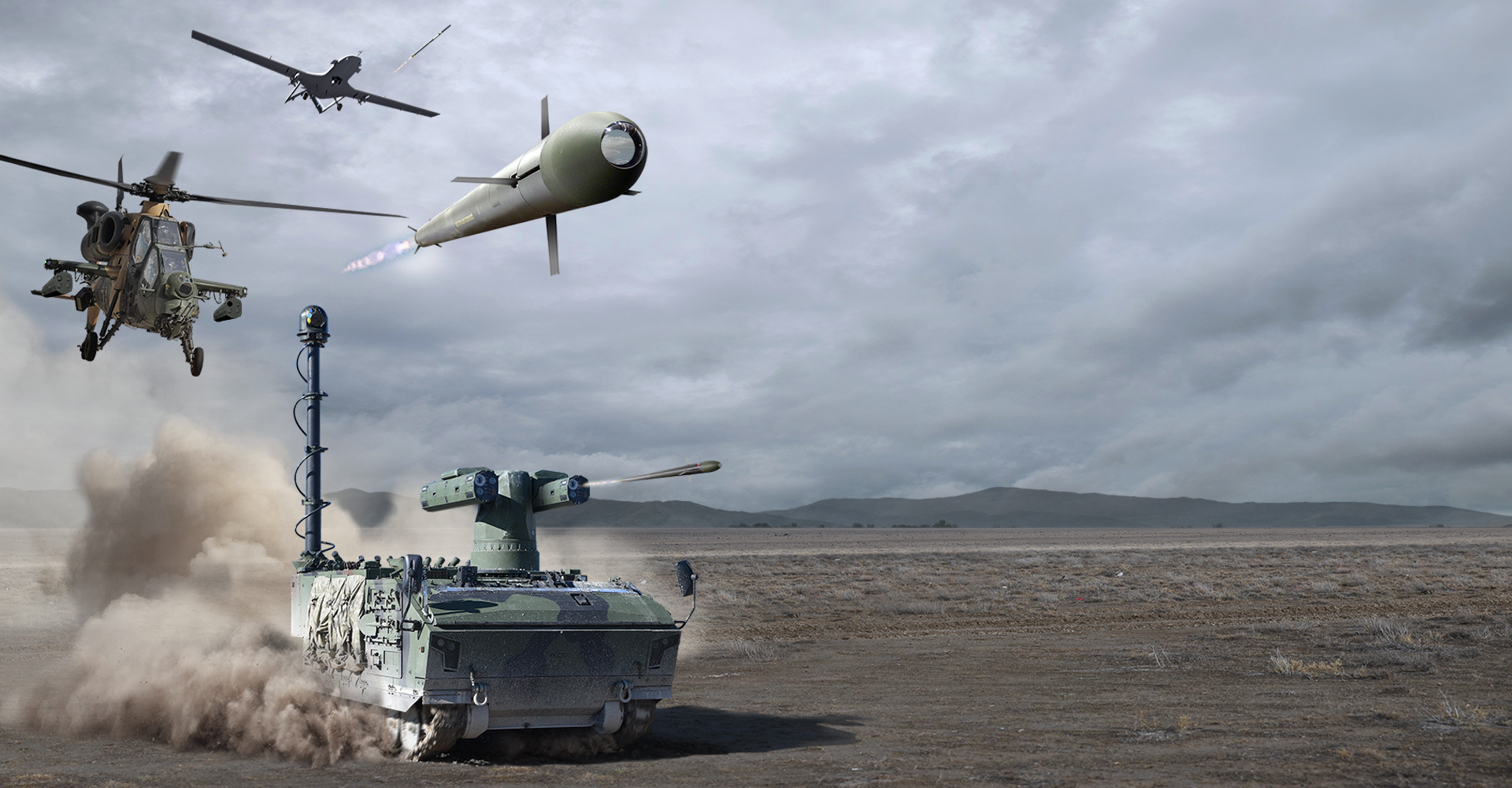
A standard 70 mm rocket is cheap, plentiful and inaccurate. A full anti-tank guided missile is accurate, but it costs far more than most targets on a modern battlefield deserve. ROKETSAN’s CİRİT was built to sit between the two: a laser-guided 2.75-inch round that lets a helicopter or drone hit a pickup truck, a bunker window or a lightly armoured vehicle without spending an anti-tank missile on it.
The company describes CİRİT as a cost-effective solution for armed helicopters, optimised against static or moving lightly armoured and unarmoured targets. That is a deliberately modest pitch, and it explains why the missile has outlasted several flashier programmes.
| Field | Detail |
|---|---|
| Manufacturer | ROKETSAN, Türkiye |
| Type | Laser-guided 70 mm (2.75 in) air-to-surface and surface-to-surface missile |
| Weight | 15 kg without canister |
| Range | 1.5 to 8 km |
| Guidance | MEMS-based inertial midcourse guidance, semi-active laser seeker, laser designation |
| Warheads | Multi-purpose (anti-armour, anti-personnel, incendiary); high-explosive anti-personnel |
| Integration | Helicopters, unmanned aerial vehicles, ground vehicles, naval and fixed platforms |
What Gap Was CİRİT Designed to Fill?
Attack helicopters carry two kinds of ordnance that do not overlap well. Unguided rockets are good for area suppression but waste ammunition on point targets. Anti-tank missiles such as UMTAS are precise and lethal, yet each round is expensive and heavy, so a helicopter can carry only a limited number.
ROKETSAN’s own wording is that the next-generation CİRİT was designed to fill the tactical gap between 2.75-inch unguided rockets and guided anti-tank missiles. Because it uses the same 70 mm diameter as the familiar rocket, a launcher pod can hold a large number of rounds. That is the core of the logic: more precision shots per sortie, at a lower cost per shot.
Open-source references say the design work ran through the second half of the 2000s, with the missile shown publicly at IDEF 2007 and entering production around 2010. Treat those dates as reported rather than official; ROKETSAN’s product page does not publish a development timeline.
How Does a Laser-Guided Rocket Actually Work?
CİRİT is not a rocket with a guidance kit bolted on. It is reported to be built as a complete round, and the published description points to inertial midcourse guidance using MEMS sensors, followed by a semi-active laser seeker for the terminal phase.
“Semi-active” means the missile does not illuminate the target itself. Someone else does: the launching aircraft’s targeting sensor, another aircraft, or a soldier on the ground with a laser designator. The seeker homes on the reflected laser energy. The practical consequence is that the shooter and the designator can be different platforms, which matters for the drone-and-helicopter teaming Türkiye has been working on.
The range of 1.5 to 8 km is also worth reading carefully. The lower bound reflects the distance a guided missile needs to stabilise and acquire the laser spot, so CİRİT is not a close-in weapon. The upper bound keeps the shooter outside the reach of most small-arms fire and many short-range air defence systems.
What Warheads Does CİRİT Carry?
ROKETSAN lists two warhead options. The multi-purpose warhead is the workhorse, combining anti-armour, anti-personnel and incendiary effects in one package. The high-explosive variant is aimed at personnel. Third-party sources also mention a thermobaric version, but ROKETSAN’s current product page does not list one, so that claim is best held loosely.
None of these warheads is meant to defeat a modern main battle tank. A 15 kg missile carrying a warhead of roughly 3 kg, according to open-source data, has enough punch for trucks, light armour, fortified positions and infantry. Heavy armour remains the job of UMTAS, L-UMTAS or other larger ROKETSAN precision munitions.
Which Platforms Fire It?
The first customer platform was the Turkish Army’s helicopter fleet. CİRİT has been associated with the T129 ATAK attack helicopter, and open sources also cite older AH-1 Cobra variants. The Turkish-designed trainer and light attack aircraft family around HÜRKUŞ-II has appeared in the same context in published references, though a production weapons configuration should be confirmed with TUSAŞ before being treated as settled.
ROKETSAN says the missile’s design allows integration on different platforms and that it has proven itself in both air-to-surface and surface-to-surface scenarios. That ground-launched role is the less publicised half of the story. A light missile that can be fired from a vehicle or a fixed post gives infantry units and naval craft precision without the logistics of a larger weapon.
The drone angle matters too. Medium-altitude unmanned aircraft are constrained by payload, and a 15 kg round is easier to carry in numbers than a heavy anti-tank missile. Reporting in 2023 said Bangladesh procured CİRİT for its Falco unmanned aircraft, a good illustration of how the missile travels beyond Turkish airframes. For context on how armed drones changed the economics of this class of weapon, see the Bayraktar TB2 programme overview.
Who Uses CİRİT?
The Turkish Armed Forces are the launch operator. Open-source compilations list supply relationships with the United Arab Emirates, Bahrain, Chad, the Philippines and Bangladesh. Some lists go further, but official confirmation from customers is thin, and ROKETSAN does not publish a customer table. Operator lists should therefore be read as indicative.
The same caution applies to combat use. CİRİT is reported to have been employed in Türkiye’s operations in Syria and in other conflicts, but detailed public battle-damage assessments are rare. What can be said safely is that the missile is in service and in production, and that it has not been a one-off technology demonstrator.
The bigger export story around ROKETSAN, including where its portfolio meets licensing limits, is covered in our ROKETSAN company profile.
What Came After CİRİT?
CİRİT did not stay alone in the small-precision niche. ROKETSAN went on to develop the MAM family of smart micro munitions, and the company now also markets METE, a laser-guided mini missile system, and the KARAOK short-range anti-tank weapon. The latter recently posted a first hit on an aerial target, as we reported in ROKETSAN’s KARAOK test.
Open sources describe a micro munition derivative of CİRİT, MAM-C, that appeared around 2018, though ROKETSAN’s own pages should be consulted for any variant-level detail. The direction is consistent: smaller, cheaper, precision weapons fired from lighter platforms.
For a buyer, CİRİT’s appeal is arithmetic. Every target that can be handled by a 15 kg round is a target that does not consume a far more expensive missile, and that logic is unlikely to lose force while cheap drones and light vehicles keep multiplying on battlefields.