AKSUNGUR Is the Twin-Engine Drone Turkish Aerospace Built for the Navy

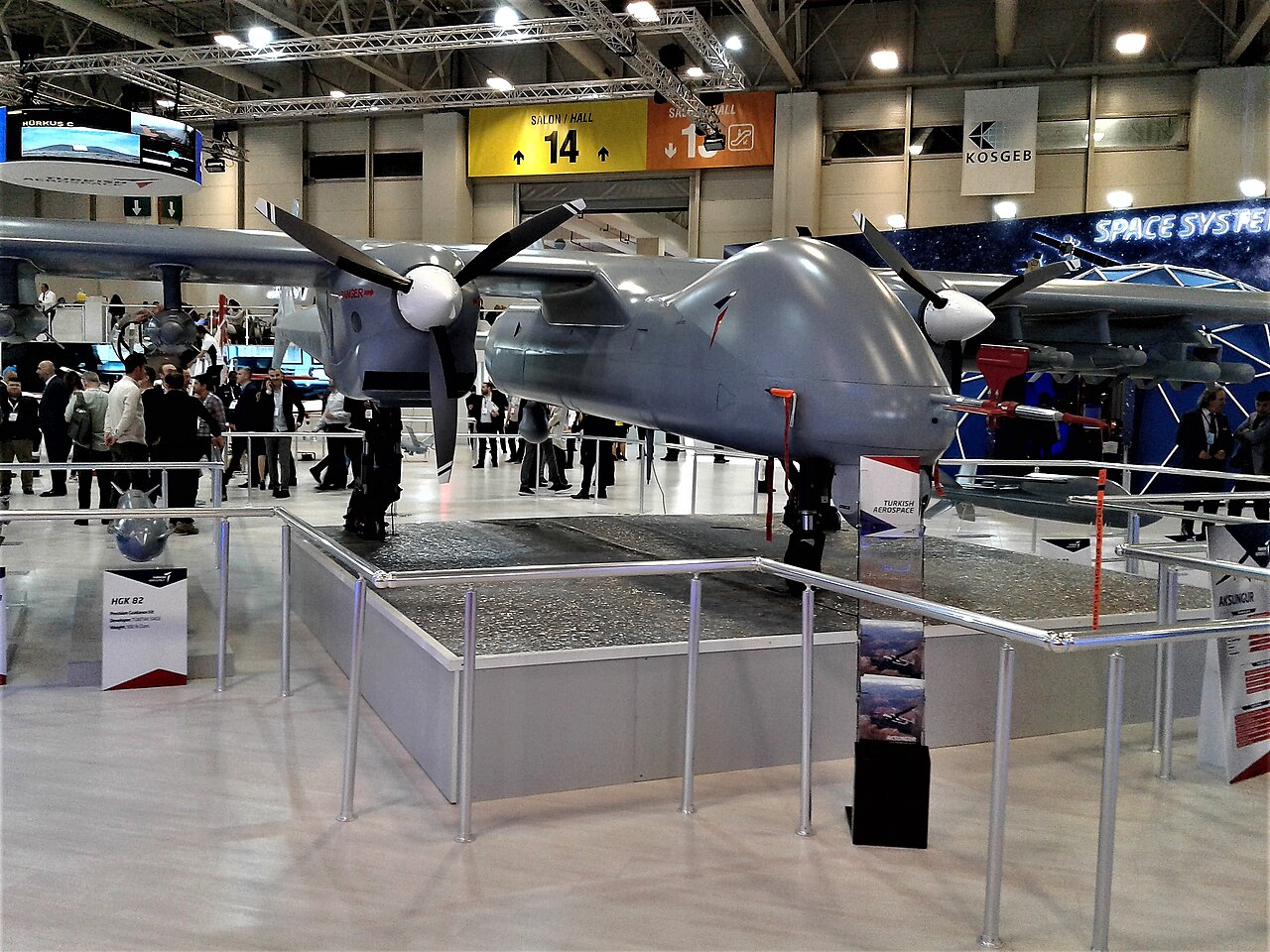
Most of Türkiye’s drone headlines belong to single-engine aircraft. AKSUNGUR is the exception. Turkish Aerospace (TUSAŞ) built it as a twin-engine, medium-altitude long-endurance platform, and its 750 kg payload makes it one of the heaviest-lifting unmanned aircraft the company fields. Its first customer was not the air force. It was the Turkish Naval Forces, which wanted something that could stay over water for a full day or more.
In August 2026 TUSAŞ General Manager Mehmet Demiroğlu said the company plans to lift the drone’s payload to 1,250 kg by 2027, with endurance of about 60 hours, according to reporting that cited Anadolu Agency. This guide covers what the aircraft is, how it got here and what the navy actually uses it for.
| Item | Detail |
|---|---|
| Manufacturer | Turkish Aerospace (TUSAŞ) |
| Type | Twin-engine MALE unmanned aircraft |
| First flight | 20 March 2019 |
| First delivery | October 2021, Turkish Naval Forces |
| Length / wingspan | 12.5 m / about 24 m |
| Maximum takeoff weight | 3,300 kg |
| Payload | 750 kg (1,250 kg targeted) |
| Service ceiling | 40,000 ft |
| Engines | Two TEI PD-170 turbocharged diesels |
| Endurance | Figures of 40 to 50 hours or more are quoted, depending on configuration |
What Is AKSUNGUR and Who Builds It?
AKSUNGUR is a medium-altitude, long-endurance (MALE) drone designed and built by Turkish Aerospace. The company is better known for the KAAN fighter and the ANKA family, and AKSUNGUR sits above ANKA in size. Where ANKA is a single-engine aircraft, AKSUNGUR carries two engines, a larger airframe and a payload several times heavier.
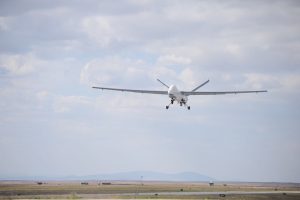
Public sources put development at roughly 18 months before the first flight. That flight took place on 20 March 2019 and lasted about four hours and twenty minutes. A second sortie followed in early April, and the aircraft was shown to the public at the IDEF fair in Istanbul at the end of that month.
How Did AKSUNGUR Go From Prototype to Navy Service?
The test campaign moved quickly. In September 2020 the aircraft flew an armed trial carrying twelve MAM-L smart munitions, staying airborne for about 28 hours at 20,000 ft. A heavier payload test followed in April 2021, and by August 2021 the fleet had reportedly logged 1,000 flight hours.
The first production aircraft went to the Turkish Naval Forces on 20 October 2021. That delivery shaped the programme. A navy customer does not primarily want a strike drone. It wants hours on station, a radar that can work a wide patch of sea and the ability to carry something heavy, such as a sonobuoy pod.
Open sources list further users. Turkish Air Force and police (General Directorate of Security) aircraft have been reported, and export deliveries have been reported to Kyrgyzstan and Chad. Algeria was reported to have ordered six aircraft in October 2022, with Angola, Niger and Uzbekistan also named in reports. TUSAŞ does not publish a full customer list, so treat these numbers as indicative. For the export picture on the smaller sibling, see which countries operate the ANKA.
What Makes the Twin-Engine Layout Matter?
Two engines give the airframe more lift capacity and more margin over open water, where an engine failure a few hundred kilometres from the coast is a serious problem. The aircraft uses two TEI PD-170 turbocharged diesels, each in the range of 170 horsepower, in a tractor layout with three-bladed propellers.
The engine has a programme story of its own. TUSAŞ reported the first AKSUNGUR flight with the domestically developed engine in November 2023, with about 41 hours of endurance at 30,000 ft, and the aircraft has since been reported above 40,000 ft. The engine makers are covered in our guide to who builds Türkiye’s aircraft engines.
Turkish drone makers have spent years reducing reliance on foreign powerplants, and a national engine on a heavy twin is one of the clearer results of that effort.
What Does AKSUNGUR Carry for Maritime Patrol?
The navy version is where the airframe earns its place. Published configurations include a SAR/GMTI-ISAR radar for surface search, an automatic identification system (AIS) receiver, a sonobuoy dispensing pod and a magnetic anomaly detector (MAD) boom. Those last two are the tools of anti-submarine warfare.
Electro-optical turrets from ASELSAN, such as the ASELFLIR 500 and 600 series, are listed on the aircraft, along with the Fulmar 500-A radar. SATCOM gives a range beyond 5,000 km in published figures, while line-of-sight links reach more than 250 km. Electronic support measures and COMINT/ELINT payloads are also on the option list.
In October 2022 the drone was reported to have operated over the Aegean Sea dropping sonobuoys. The exact mission has not been officially detailed, so it should be read as a reported deployment rather than a confirmed tasking.
TUSAŞ says it is developing configurations that combine sonobuoys, torpedoes and different radar systems. A torpedo-carrying unmanned aircraft would push the type from detection toward engagement, although a fielded ASW strike capability has not been publicly confirmed.
What Weapons Can It Use?
AKSUNGUR has six underwing hardpoints. Published figures give three per wing, rated for 500 kg, 300 kg and 150 kg stations. Munitions that have been cited include CİRİT and L-UMTAS missiles, MAM-L and MAM-C smart munitions, TEBER laser-guided bomb kits, and HGK and KGK guidance kits. Most of the missile and munition families come from Roketsan, which also supplies naval weapons the aircraft may eventually use.
Strike is not the headline mission for the navy, but the option is there. The same heavy-lift capacity that carries a sonobuoy pod can carry a mixed weapons load. Endurance and payload trade against each other, and published figures reflect that. One commonly quoted set lists 12 hours with the full 750 kg at 25,000 ft, against 40 hours or more on lighter ISR fits.
How Does It Compare With AKINCI and ANKA?
The big Turkish MALE and high-altitude drones are often mixed up. A quick way to separate them is by design intent.
- ANKA is TUSAŞ’s single-engine workhorse, widely exported.
- AKSUNGUR is the twin-engine aircraft with the larger payload and the maritime patrol outfit.
- Baykar’s AKINCI is a twin-engine armed drone from a different manufacturer, built around strike with air-to-air and stand-off weapons.
The rivalry is real, but the roles overlap less than the marketing suggests. AKSUNGUR is sold on ocean surveillance and heavy mixed loads, with strike as a secondary option.
What Has Gone Wrong in Service?
Like every armed drone in regular use, AKSUNGUR has suffered losses. Open-source reports describe a Naval Forces aircraft crashing in northern Iraq in November 2023, an army aircraft reportedly shot down by PKK militants in May 2024, and another aircraft reportedly downed near Kirkuk in August 2024. The circumstances were not always officially confirmed.
A fleet of about a dozen airframes by early 2023 is a small base from which to draw reliability conclusions. What the record does show is use in real operations, which matters more to buyers than a brochure.
What Comes Next for the Programme?
The next step is the heavier configuration. According to the August 2026 remarks reported by Anadolu Agency, TUSAŞ is aiming for a 1,250 kg payload, an increase of about two thirds, with roughly 60 hours of endurance, in 2027. That would allow a fuller ASW suite of radar, sonobuoys and stores than the current aircraft can carry.
Two questions remain open. One is whether a heavier version keeps the endurance advantage, since payload and loiter time compete for the same fuel and structure. The other is whether foreign navies will buy into the maritime version, as opposed to the land-focused export deliveries seen so far. Both will be answered by test flights and contract announcements, not by specification sheets.