HAVELSAN, Ankara Launch KOVAN Software Specialist Programme

Türkiye’s defence industry has spent the past two years signing export contracts, opening production lines and breaking ground on new factories. This week it addressed a quieter bottleneck: who is going to run the software that holds all of it together.
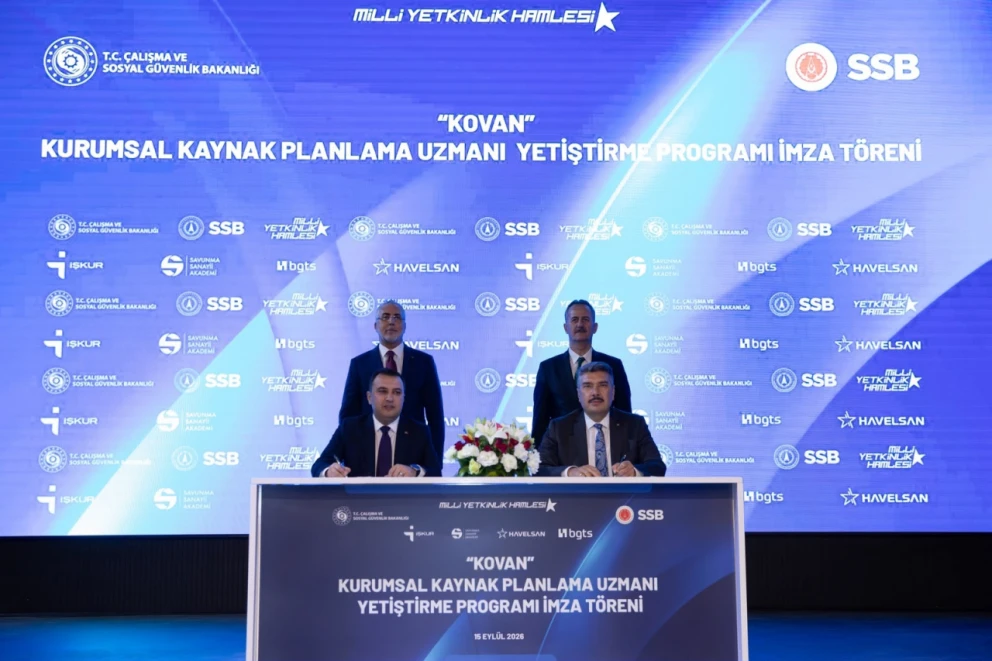
On 15 September, state-owned systems house HAVELSAN signed a cooperation protocol with the Turkish Employment Agency (İŞKUR), the Ministry of Labour and Social Security, the Defence Industry Academy and training firm BGTS to launch a dedicated training pipeline for specialists in KOVAN, HAVELSAN’s domestically developed enterprise resource planning (ERP) system. Labour and Social Security Minister Vedat Işıkhan visited HAVELSAN’s Ankara technology campus on 18 September to open the programme, alongside Presidency of Defence Industries (SSB) Secretary Haluk Görgün.
What KOVAN Is
KOVAN is HAVELSAN’s national ERP platform, used to manage finance, procurement, human resources and logistics processes. According to HAVELSAN, the system already serves more than 62,000 users across Turkish public and private-sector organisations, including defence industry firms that have adopted it in place of foreign enterprise software. That scale is the problem the new programme is meant to solve: as more state bodies and contractors migrate onto KOVAN, HAVELSAN has struggled to find enough trained implementation specialists to install, configure and adapt the system for each new customer.
A 500-Person Pipeline, Funded by the State
The programme falls under Ankara’s broader “National Competence Initiative,” a skills-training push administered through İŞKUR. It targets university graduates aged 18 to 30 and runs a 420-hour vocational course covering KOVAN installation, configuration and business-process adaptation. HAVELSAN says the first cohort of 26 trainees has already started; the partners aim to train 500 KOVAN specialists over the coming year, with the government covering roughly 45 million lira (about $1.1 million) in programme costs, according to İŞKUR. Trainees receive a daily stipend, health and workplace-accident insurance, and a monthly income of around 28,000 lira during the course.
“This is a new example of vocational training tailored to the needs of the defence industry,” Işıkhan said at the launch, framing the initiative as a way to both staff a growing sector and open career paths for young graduates. Görgün, whose agency oversees Türkiye’s state and private defence contractors, said the effort reflects a broader pattern: capabilities built for defence programmes, including in-house software platforms, are increasingly finding customers and applications outside the sector. HAVELSAN CEO Mehmet Akif Nacar said KOVAN “reflects HAVELSAN’s long-standing experience and engineering expertise,” built up through decades of developing command-and-control and simulation software for the Turkish military.
Why a Staffing Programme Matters to Outside Observers
Workforce announcements rarely make defence-industry headlines, but the KOVAN programme is a useful marker of where Türkiye’s defence sector actually is in its growth cycle. ASELSAN alone reported a record order backlog above $23 billion in its most recent results, and the country’s five SIPRI-ranked defence contractors posted combined 2025 revenue of roughly $14.9 billion. Scaling production and exports at that pace requires more than assembly-line capacity — it requires the back-office software, logistics and procurement systems that keep multi-billion-dollar contract books running, and the people who can operate them.
The programme also illustrates a trend SSB has been promoting publicly: pushing technology and know-how developed for defence programmes into civilian sectors, a pattern Görgün’s agency has flagged before in fields such as healthcare, semiconductors and artificial intelligence. In KOVAN’s case the flow runs in both directions: a platform built partly to serve defence-sector back offices is now being staffed through a state-funded civilian training scheme, with graduates likely to end up supporting both defence and non-defence clients.
No export or foreign-customer dimension has been announced for KOVAN itself, and HAVELSAN has not said whether the platform will be offered outside Türkiye. For now, the programme is a domestic capacity investment — one more data point in a defence-industrial base that has grown fast enough to start running short of the specialists needed to administer it.
Sources
- HAVELSAN, “KOVAN Specialist Training Programme Launched During Minister Işıkhan’s Visit to HAVELSAN,” 18 September 2026
- Türkiye İş Kurumu (İŞKUR), “Bakan Işıkhan’ın Teşrifleriyle İŞKUR ve HAVELSAN Arasında KOVAN Protokolü İmzalandı,” 16 September 2026