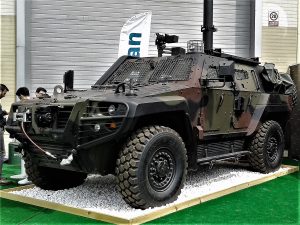
FNSS’s KARPAT Medium Tank Fires Live Rounds for First Time in Slovakia


The CFL-120 KARPAT medium tank fired live rounds for the first time on November 20, moving off-road and engaging targets at the Záhorie Military Testing Area in Slovakia, FNSS Savunma Sistemleri announced. The demonstration, staged for potential military customers, marks the first time Türkiye’s largest private armoured vehicle maker has fielded a tank-class product built around Western European industrial partners rather than exported wholesale from Ankara.
The vehicle itself is a three-way split: a Turkish tracked chassis, an Italian turret, and Slovak final assembly. FNSS supplies the KAPLAN tracked platform and the underlying design and technology. Leonardo provides the HITFACT MkII turret, armed with a 120mm L45 smoothbore gun compatible with NATO-standard ammunition — the company says a 105mm option is also available. CSG, the Czech-Slovak industrial group, and its subsidiary MSM Land Systems supply the Slovak manufacturing base at Trenčín, where FNSS and CSG plan to build the tank for European and export customers.
From Jakarta to Bratislava: The KAPLAN Lineage
KARPAT did not start as a blank-sheet design. Its chassis is a derivative of the FNSS KAPLAN MT, the medium tank platform FNSS co-developed with Indonesia’s PT Pindad and which Indonesia fields as the Harimau. FNSS has spent more than a decade refining that hull — low silhouette, high power-to-weight ratio for its class, and modular STANAG 4569 protection — before offering it as the basis for a European-market vehicle with a different gun and fire-control system.
That reuse is central to FNSS’s pitch. General Manager Selim Baybaş has described the European partnership model as one where “the technology comes from us and part of the manufacturing comes from Europe,” with design, R&D and licensing rights remaining at FNSS’s Ankara engineering centre even as production moves to Slovakia. It is the same logic the company has applied to its PARS wheeled vehicle family in talks with other European partners, and it reflects a broader pattern across Türkiye’s armoured vehicle exporters: keep the intellectual property at home, localise the metal-bending abroad.
The Danube Defence Systems Venture
The industrial structure behind KARPAT is Danube Defence Systems, a joint venture FNSS and CSG agreed to form under a framework signed at Eurosatory 2026 in Paris in June. Reporting at the time put the planned ownership split at 51% for CSG and 49% for FNSS, pending completion of the transaction, with the venture based in Trenčín and KARPAT as its flagship product. CSG contributes manufacturing capacity through MSM Land Systems; FNSS contributes the platform and engineering support.
The Záhorie demonstration added a second layer to that structure. According to coverage of the event, CSG Defence, MSM Land Systems and Leonardo signed a separate memorandum covering long-term cooperation on marketing, sales and localised production of the HITFACT MkII turret at MSM’s Trenčín site — tying Leonardo more directly into the Slovak manufacturing base rather than supplying turrets from Italy alone. MSM Land Systems CEO Michal Baláž called the live-fire event “an important milestone in the continued development of the CFL-120 Karpat project.”
FNSS says the KARPAT platform is designed to reach serial production roughly 19 to 20 months after an order, with initial operational capability around 26 months out. Those are manufacturer targets rather than contractual deadlines, since no state customer has yet signed for the vehicle.
Why a Medium Tank, and Why Now
KARPAT is pitched into a specific gap in the European market: NATO members that want 120mm main-gun firepower without the weight, cost or strategic-lift burden of a 55-to-70-tonne main battle tank. At a combat weight FNSS puts at up to 34 tonnes, with a quoted road speed of about 70 km/h and range of roughly 450 km, KARPAT is positioned against a small but growing field of “medium tank” and heavy direct-fire support vehicles emerging in Europe, including Sweden’s CV90120 and South Korea’s K2-based offerings pursued for some of the same Central European modernisation programmes — a lighter-vehicle niche distinct from, but adjacent to, the 8×8 wheeled-vehicle segment where Turkish exporters already compete with Boxer and Patria’s AMV. Slovakia itself has an open armour-modernisation requirement that several of these designs, KARPAT among them, are competing to influence — though no shortlist decision has been confirmed.
For FNSS, the commercial logic extends beyond a single programme. Winning European customers would mark its first tank-class sale inside the EU and NATO’s core membership, building on wheeled-vehicle exports that already run from Malaysia to the Gulf. It also gives Ankara a second route into European defence-industrial programmes — alongside Otokar’s wheeled vehicle exports and ASELSAN’s and Roketsan’s missile and electronics partnerships — at a moment when Brussels is pushing rearmament funding toward suppliers with a foothold inside the EU, a question Türkiye’s own defence industry is still navigating under the bloc’s SAFE fund rules.
What Remains Unconfirmed
FNSS and CSG have not published independent data on firing accuracy, ammunition performance or the results of extended durability and mobility testing beyond the single demonstration. No government has announced an order, letter of intent, or formal evaluation contract for KARPAT, and Slovakia’s own tank-modernisation decision remains open. The 19-to-20-month production timeline FNSS cites assumes a contract has already been signed — which, as of this report, none has.
FNSS’s press statement on the Záhorie demonstration, along with reporting from Anadolu Agency, Daily Sabah and Shephard Media, were used in preparing this article.