Türkiye–UK Defence Relations: What Britain Sells and Blocks


The United Kingdom is about to become one of Türkiye’s largest arms suppliers, and is not one today. That sentence contains almost everything a foreign analyst needs to understand the relationship. Britain has sold Türkiye 20 new-build Eurofighter Typhoons in a programme the UK government values at up to £8 billion, signed a follow-on training and support contract in March 2026, and begun cutting metal — but the first aircraft does not arrive until 2030. In SIPRI’s data for 2021–25, the UK does not appear among Türkiye’s top three suppliers at all. The relationship’s value sits almost entirely in the future.
That timing gap is what makes Türkiye–UK defence relations worth reading carefully rather than at the level of the headline. The two countries have built a framework — a security and defence partnership signed in July 2026, a joint industrial council, a licensing regime with no live restrictions — well ahead of the hardware. Whether the framework fills with anything beyond Typhoon is the open question, and on 19 November 2026 a British minister in Ankara said in as many words that London wants it to.
DEFENCETÜRKIYE DATA BOX
Relationship: Türkiye – United Kingdom, defence and defence-industrial
Framework: UK–Türkiye Security and Defence Partnership, joint statement 8 July 2026, NATO summit in Ankara
Industrial body: Türkiye–UK Defence Industrial Council
Anchor programme: 20 Eurofighter Typhoon Tranche 4, contract signed 27 October 2025
Programme value: about £5.4bn for the aircraft; up to £8bn including training and in-service support (UK government figure)
Deliveries: six in 2030, eight in 2031, six in 2032
Current UK share of Turkish arms imports: not in the top three (SIPRI 2021–25: Germany 31%, Spain 29%, Italy 19%)
Flow in the other direction: no publicly recorded UK Ministry of Defence order for a major Turkish platform
Known limit: GCAP participation — a trilateral UK–Italy–Japan decision, per the UK minister
The deal that defines the relationship
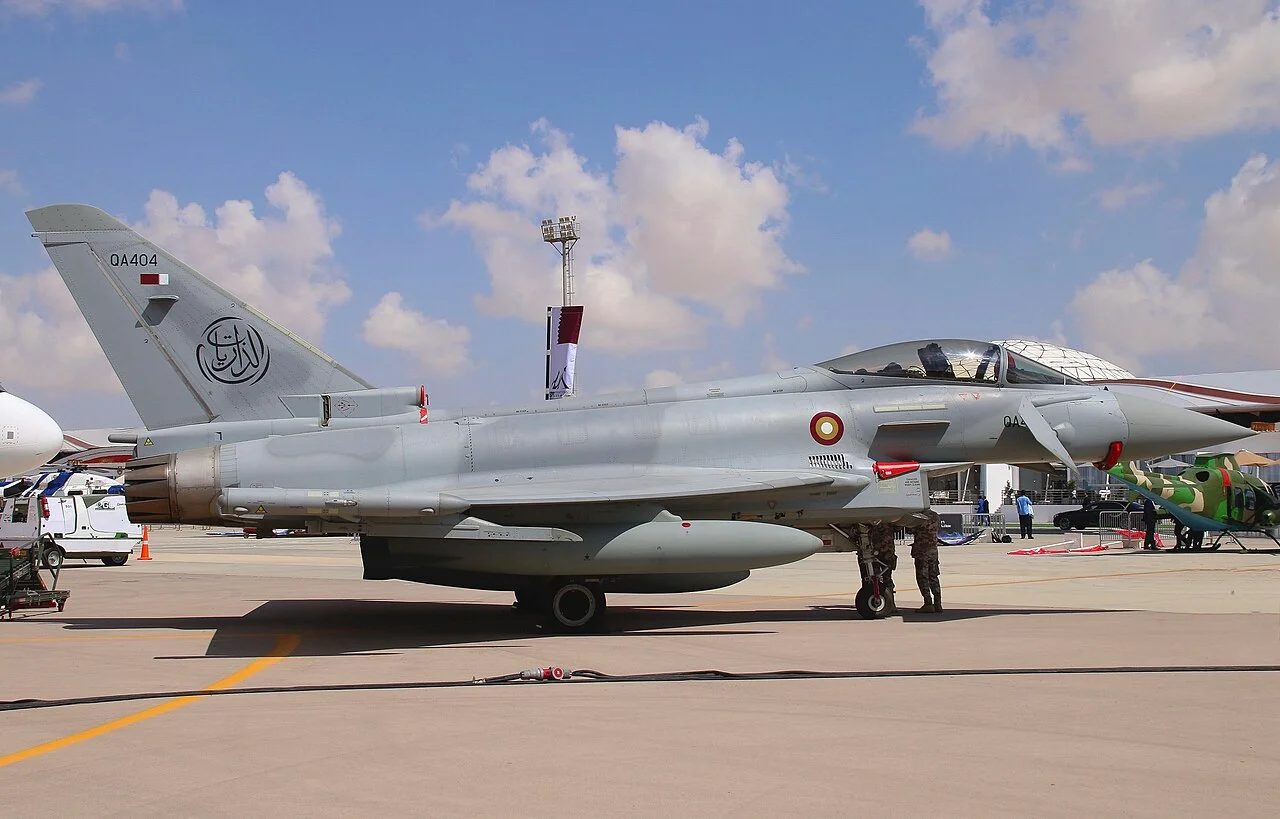
Türkiye signed for 20 Tranche 4 Typhoons in Ankara on 27 October 2025, during a visit by then-Prime Minister Keir Starmer. BAE Systems put the aircraft contract at roughly £5.4 billion; the UK government describes the full programme, including training and in-service support, as worth up to £8 billion. It was the largest Typhoon export in years, and it came after Germany — a partner nation with a veto inside the four-nation consortium — dropped its long-standing objection. Readers wanting the aircraft itself rather than the deal will find a Turkish-language technical profile of the Eurofighter Typhoon and its tranche standards in Envanter Medya’s platform database.
The second contract matters as much as the first and gets far less attention. On 25 March 2026 UK Defence Secretary John Healey and Turkish Defence Minister Yaşar Güler signed a training and support agreement in London. The Ministry of Defence did not publish a value; press reporting placed it near £2.5 billion. What it covers is unusually specific for a public release: training for 10 Turkish pilots and nearly 100 ground crew technicians across mechanical, avionics, weapons and mission systems; long-term maintenance support; production of components and spares; support equipment; training simulators; and electronic warfare capabilities.
Assembly is under way. BAE Systems has begun building the front fuselage of Türkiye’s first aircraft at Samlesbury in Lancashire, with the centre fuselage coming from Airbus Defence and Space in Germany under the consortium’s standard work-share, before final assembly at Warton. The build start was announced in early November 2026, roughly a year after contract signature and four years before the first delivery.
Why Britain wanted this sale so badly
The UK government’s own release explains the enthusiasm better than any analysis can. Announcing the March 2026 support agreement, the Ministry of Defence said the Typhoon programme backs 20,000 UK jobs, with nearly 6,000 directly supporting the programme at BAE Systems sites, more than 1,100 in the South West and more than 800 in Scotland. More than a third of each Typhoon — 37 per cent — is built in the UK, across a supply chain of 330 British companies.
Those jobs are concentrated and politically visible: BAE Systems at Warton and Samlesbury in Lancashire, Rolls-Royce in Bristol building engine modules and acting as the main engine maintenance hub, Leonardo in Edinburgh making the radar. Healey called the Turkish order “a vote of confidence in British industry and British jobs.” With no new UK Typhoon orders of its own and the Warton line facing a production gap, the Turkish contract was, in plain terms, the thing that kept the line busy.
This matters for anyone reading the relationship from outside, because it explains the direction of British effort. The UK is not courting Türkiye primarily as a source of equipment or technology. It is courting Türkiye as a customer, and the customer has noticed.
WHY IT MATTERS
Türkiye spent a decade being told by Western capitals what it could not buy. The Typhoon deal is the clearest evidence that at least one major NATO member decided the cost of saying no was higher than the cost of saying yes — and the reason was industrial, not strategic.
For third countries weighing Turkish equipment, the British case is a useful data point: Western restrictions on Türkiye are reversible, they move with domestic industrial interest, and they are not a permanent feature of the market.
Britain is not yet a major supplier to Türkiye
It is worth stating the current position precisely, because the headline figures invite the opposite conclusion. In SIPRI’s 2021–25 window, Türkiye was the world’s 24th-largest importer of major arms, and its three largest suppliers were Germany at 31 per cent, Spain at 29 per cent and Italy at 19 per cent. The United Kingdom is not in that set. Türkiye’s import profile is, for now, a continental European one.
That will change mechanically once Typhoon deliveries begin. Twenty Tranche 4 fighters is a large transfer by SIPRI’s volume measure, and from 2030 the UK, Germany, Italy and Spain will all appear in Türkiye’s import column simultaneously — the four Eurofighter partner nations, in one programme. The British share of Turkish imports is therefore best understood as a 2030s number that has already been contracted rather than a current one.
The historical baseline is thinner than the current activity suggests but not empty. Türkiye bought British Aerospace Rapier short-range air-defence systems in the mid-1980s, later upgraded them, and is now replacing them with the domestically developed HİSAR family — one strand of the broader shift described in Envanter Medya’s Turkish-language account of Türkiye’s move from Hawk and Rapier batteries to HİSAR. British equipment has been in Turkish service before. It has not been a dominant line in the inventory for a long time.
What Britain licenses, and what it once stopped
The licensing record is the part of the relationship most often misread, in both directions. Britain did restrict arms exports to Türkiye, and the restriction was real but narrow and temporary.
In October 2019, after Türkiye’s offensive into northern Syria, the then Foreign Secretary said no new licences would be granted for items that might be used in military operations in Syria while the government conducted a review. Existing licences remained valid and deliveries under them continued. New licensing resumed after roughly three months, initially with that Syria condition attached. In December 2021 the UK government removed the restrictions entirely and returned to standard case-by-case assessment.
On volumes, the fullest public accounting comes from the Campaign Against Arms Trade, a campaign group that compiles UK government licensing data. Its analysis records more than £2 billion in permanent single licences to Türkiye between July 2016 and March 2025, 123 open individual licences over the same period, and more than £882 million in military goods licensed since the December 2021 removal of restrictions, plus 44 open licences. Two single licences — one in October 2021 and one in March 2022 — were each worth £250 million and covered technology for tanks and military vehicles.
One point from that analysis deserves emphasis for anyone modelling supply-chain exposure: CAAT notes that most UK exports tied to the A400M, F-35 and TF-X/KAAN programmes travel under open general licences, which are not itemised in the published value data. The licensed figures are therefore a floor, not a ceiling, and the real British content inside Turkish programmes is not fully visible in any public dataset. Türkiye’s own export-licensing architecture works on a different model, which is worth holding alongside this when comparing the two.
| Strand | What it is | Status |
|---|---|---|
| Typhoon aircraft BAE Systems |
20 Tranche 4 jets about £5.4bn |
Contracted Oct 2025; in build; first delivery 2030 |
| Training and support UK MoD |
Pilots, technicians, spares, simulators, EW | Signed 25 Mar 2026; value not published |
| Second batch Eurofighter consortium |
24 further new-build jets | Sales target on a briefing slide, Nov 2026. Not an order |
| Used Typhoons Qatar and Oman |
Reportedly 12 and 12 | Under negotiation; split unconfirmed |
| Framework Governments |
Security and Defence Partnership; Defence Industrial Council | Signed July 2026; no joint programme named yet |
| GCAP UK, Italy, Japan |
Sixth-generation combat air programme | Closed. Decisions taken trilaterally |
| Turkish sales to UK MoD Any prime |
No major platform order on record | None announced |
Compiled by DefenceTürkiye from UK Ministry of Defence releases, BAE Systems statements and consortium briefings.
The other direction: what Türkiye sells Britain
Very little, and that asymmetry is the most important under-reported feature of the relationship. There is no publicly recorded UK Ministry of Defence order for a major Turkish platform — no drones, no armoured vehicles, no ships. The best-known Turkish supply to the British forces remains a boot contract won in 2012. For a country that, by Turkish officials’ own count, sold into more than 180 countries and regions in 2025, Britain is a conspicuous absence from the customer list.
What exists instead is more interesting than a sale: Turkish industry has started using Britain as a manufacturing base to serve third countries. Nurol Makina established a UK subsidiary, NMS UK, and acquired a plant in Royal Leamington Spa in September 2024. On 17 November 2026 a ceremony at the Estonian Embassy in London marked the start of UK manufacture of the NMS Nomad protected vehicle — not for the British Army, but for the Estonian Centre for Defence Investments. UK Export Finance supports the bank guarantee underpinning that contract, and the company expects the work, together with other armoured-vehicle programmes due to start in 2027, to add up to 50 UK staff by the end of 2027.
Read that carefully: a British export-credit agency is helping a Turkish-owned manufacturer in Warwickshire sell vehicles to Estonia. The industrial traffic runs both ways. The procurement money, so far, runs one way. The British Army’s Land Mobility Programme — the requirement Nurol’s UK presence was built around — has not produced an order, and a Turkish 4×4 remains a candidate rather than a selection.
Where the cooperation stops
Britain has been the most permissive major Western supplier to Türkiye in this decade. It is not unlimited, and the limit was stated plainly this week.
Asked by Anadolu Agency whether Türkiye’s KAAN fighter and the Global Combat Air Programme could be linked, UK Minister for Defence Readiness and Industry Luke Pollard said each programme has its own requirements and development plans, and added: “Any decisions on GCAP will be taken trilaterally between the UK, Italy and Japan.” That is a courteous no. Türkiye can buy a British-built fourth-generation-plus fighter; it is not being invited into the British sixth-generation one.
The engine is the second limit, and it has a longer history. Kale Group and Rolls-Royce formed the Turkish Aero Engine Company in 2017, with Kale holding 51 per cent, to pursue an engine for the national fighter. That route did not become the KAAN engine; the Turkish programme consolidated around TEI and TRMOTOR, and the flying aircraft uses American General Electric F110-GE-129 engines. No British fighter-engine agreement has been signed. Rolls-Royce has said publicly that it wants a long-term co-development partnership in Türkiye, which is a position, not a contract.
There is one precedent worth keeping in view. The T129 ATAK attack helicopter is powered by the LHTEC CTS800, an Anglo-American Honeywell/Rolls-Royce product, and the licensing attached to that engine became the constraint on the helicopter’s biggest export campaign. The block came through American licensing rather than British, but the structural lesson holds for every partner-nation subsystem: a foreign engine is a foreign veto, wherever the partner sits. That is precisely the mechanism Türkiye’s ITAR-free positioning is designed to escape.
BUYER VIEW
For a third country evaluating Turkish equipment, the British relationship is evidence on two questions. First, political risk: the UK suspended, then conditioned, then fully removed restrictions on Türkiye within roughly 26 months. Western restrictions on Türkiye have historically been episodic rather than structural.
Second, supply-chain exposure: British content flows into Turkish programmes largely under open general licences that are not itemised publicly, so a buyer cannot read the real UK dependency out of licensing statistics. Ask the manufacturer for the subsystem origin list rather than inferring it.
This is open-source editorial analysis for readers assessing the market. It is not procurement advice, and DefenceTürkiye advises no government.
What comes next
Three things are live, and only one of them is contracted.
The contracted item is delivery. Six aircraft in 2030, eight in 2031, six in 2032, with British training of Turkish aircrew and technicians running ahead of it under the March 2026 agreement. Nothing about that schedule is unusual for a Typhoon order, and nothing about it is fast.
The second is the possible follow-on. The Eurofighter consortium’s chief engineering and operations officer showed a briefing slide at the International Fighter Conference in Munich on 4 November 2026 listing a Turkish “second batch” of 24 aircraft among the sales the consortium is chasing. That is a sales target, not an order, and it is separate from the used Qatari and Omani airframes Türkiye has been negotiating for. Those second-hand jets are the near-term capability bridge; the three-step acquisition route is what Ankara actually designed to cover the gap left by its exclusion from the F-35.
The third is the framework, and it is the one to watch. Pollard’s visit to Ankara on 19 November 2026 was built around the Türkiye–UK Defence Industrial Council and the partnership signed in July. “Eurofighter is a major milestone in our defence relationship, but our ambition extends well beyond a single programme,” he said, calling Türkiye “an important long-term defence and industrial partner.” No joint programme was named, no budget was attached, and no timeline was set beyond “the coming months and years.” Until one of those three things exists, the Türkiye–UK defence relationship is one large aircraft order and a well-drafted intention.
Judged against Türkiye’s other European relationships, that is roughly where the Spanish relationship stood before it became genuinely two-way. The test for London is whether a British armed service ever buys something Turkish.
FAQ
How many Eurofighter Typhoons has Türkiye ordered from the UK?
Twenty new-build Tranche 4 aircraft, under a contract signed in Ankara on 27 October 2025. Deliveries run 2030 to 2032. A further 24 have been pitched by the Eurofighter consortium but not ordered, and separate negotiations cover used aircraft from Qatar and Oman.
How much is the Türkiye–UK Typhoon deal worth?
BAE Systems put the aircraft contract at about £5.4 billion. The UK government describes the full programme value, including training and in-service support, as up to £8 billion. A separate training and support agreement signed on 25 March 2026 was not given a published value by the Ministry of Defence.
Is the United Kingdom one of Türkiye’s main arms suppliers?
Not yet. In SIPRI’s 2021–25 data Türkiye’s three largest suppliers of major arms were Germany at 31 per cent, Spain at 29 per cent and Italy at 19 per cent. The UK’s share rises substantially only once Typhoon deliveries begin in 2030.
Does Britain still restrict arms exports to Türkiye?
No. New licences were suspended in October 2019 for items that might be used in Syria, resumed with conditions after about three months, and all restrictions were removed in December 2021. Licensing now runs on standard case-by-case assessment.
Does the UK buy Turkish weapons?
There is no publicly recorded UK Ministry of Defence order for a major Turkish platform. Nurol Makina’s UK subsidiary manufactures protected vehicles at Royal Leamington Spa, but its current production there is for Estonia, not the British Army.
Can Türkiye join GCAP?
Nothing suggests it can at present. The UK Minister for Defence Readiness and Industry said on 19 November 2026 that decisions on GCAP are taken trilaterally between the UK, Italy and Japan, and that KAAN and GCAP each have their own requirements and development plans.
Does Rolls-Royce build the KAAN engine?
No. Kale and Rolls-Royce formed the Turkish Aero Engine Company in 2017 to pursue a national fighter engine, but that route did not produce the KAAN powerplant. The aircraft flies on American GE F110-GE-129 engines, with the domestic TEI-TF35000 in development.
Sources
- UK Ministry of Defence, “Multi-billion-pound support deal agreed as part of major UK export win”, 25 March 2026 — jobs, UK work-share, training scope, Healey quote.
- Anadolu Agency, written responses from Luke Pollard, UK Minister for Defence Readiness and Industry, 19 November 2026 — GCAP, Defence Industrial Council, partnership.
- Joint statement on the Security and Defence Partnership between the United Kingdom and the Republic of Türkiye, 8 July 2026.
- BAE Systems statements on the Türkiye Typhoon contract and the start of front-fuselage assembly, October 2025 and November 2026.
- SIPRI, Trends in International Arms Transfers, fact sheet, March 2026 — Türkiye’s supplier shares, 2021–25.
- Campaign Against Arms Trade, UK arms sales to Turkey country data, drawn from UK government licensing statistics, updated September 2025.
- NMS UK and the Estonian Centre for Defence Investments, ceremony marking the start of UK Nomad manufacture, London, 17 November 2026.
- Eurofighter briefing, International Fighter Conference, Munich, 4 November 2026 — second-batch sales target.