ASFAT to Deliver Five ASBOT Patrol Boats to Jordan in 2027

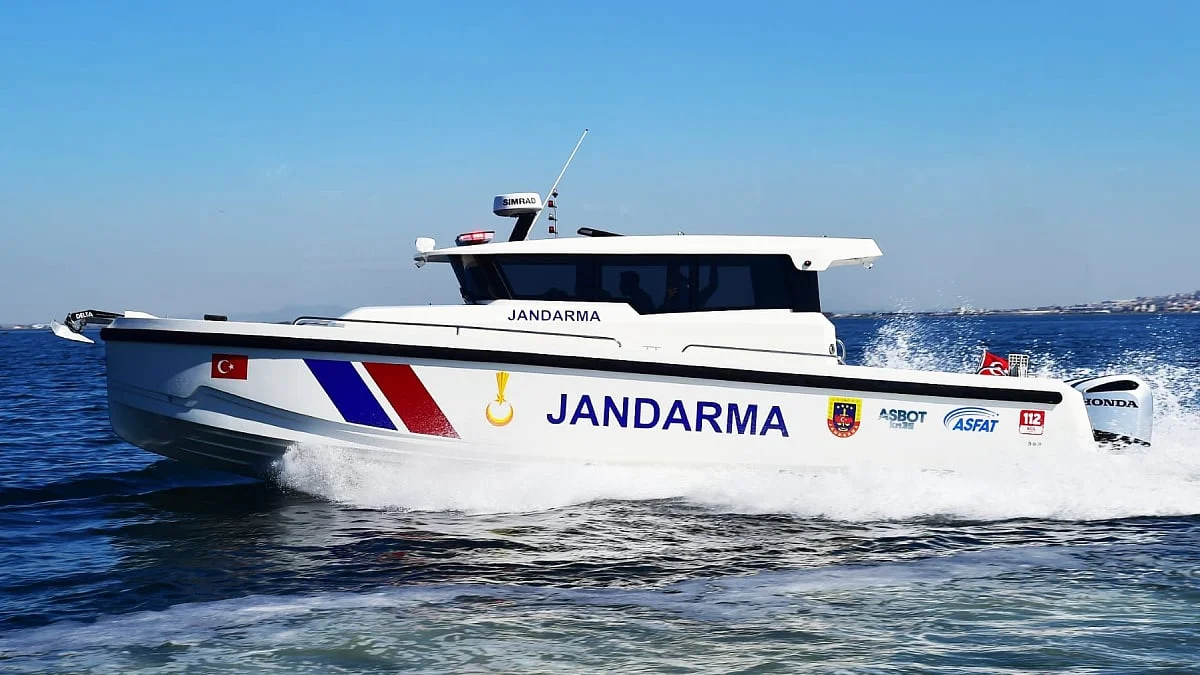
Jordan’s Royal Naval Force and Royal Boats Command will take delivery of five ASFAT-built ASBOT-class patrol boats in 2027, after the Turkish state shipbuilder agreed to stretch its standard composite hull design to meet Jordanian specifications, according to Turkish trade publication Defence Turkey. The order — four ASBOT KN-43 patrol craft and one KN-43 search-and-rescue variant — was contracted in February 2026, but the production and delivery schedule only became public in late October.
The contract was signed at Istanbul Naval Shipyard between ASFAT and the commander of Jordan’s Royal Naval Force and Royal Boats Command, acting on behalf of the Jordan Armed Forces–Arab Army, according to Jordan’s state news agency, Petra. The Jordanian side described the deal as a “qualitative leap” in bilateral defense relations. Petra and Defence Turkey are the only two outlets to have reported the contract with any specificity; neither has disclosed its value.
A Stretched Hull for a New Customer
ASFAT’s standard ASBOT design runs 10.2 meters, built on a twin-step composite planing hull using vacuum-infusion construction — the same family of small craft the company has supplied to Turkey’s Maritime Affairs General Directorate and Gendarmerie General Command for harbor control and coastal law-enforcement duties. For Jordan, ASFAT is lengthening the hull to 13 meters, which the company says better suits the Royal Naval Force’s coast-guard and maritime-border mission set along Jordan’s short but strategically important stretch of Red Sea coastline near Aqaba.
That stretch requires new tooling: ASFAT is manufacturing fresh molds for the enlarged hull, a process Defence Turkey reports will take roughly eight months before production proper can begin. Once underway, the five boats are due to reach Jordan within a 12-month window, split into two batches — three boats, then two — delivered around 40 days apart. ASFAT has built close to 30 ASBOT-family boats in total for various customers since the line entered production, making the Jordanian order a meaningful but not unprecedented addition to its order book.
Why a Small Patrol-Boat Deal Matters
On its own, a five-boat patrol craft order is a modest transaction by the standards of Türkiye’s defense-export headlines, which in 2026 have run more toward billion-dollar missile and radar contracts than coastal patrol boats. Its significance lies elsewhere: ASFAT is a state-owned contractor built primarily to serve the Turkish Armed Forces and other domestic security agencies, and exports of this kind extend its customer base beyond that core mission without competing directly against Türkiye’s larger private shipyards — STM, Dearsan, Sedef, Anadolu and Sefine — which are focused on frigates, corvettes and offshore patrol vessels for larger naval customers.
For Jordan, the deal adds a Turkish supplier to a naval procurement list historically dominated by the United States and European builders. The Royal Jordanian Naval Force maintains a comparatively small fleet focused on coastal patrol rather than blue-water operations, concentrated around the port of Aqaba, Jordan’s only sea access, which sits at the head of the Red Sea beside Israeli, Saudi and Egyptian waters — a crowded and strategically sensitive stretch of coastline where smuggling interdiction and border security are persistent missions. A dedicated search-and-rescue variant among the five boats points to that mixed law-enforcement and safety role rather than a combat function.
The order also fits a broader pattern: Türkiye has used small, customizable vessel programs — ASFAT’s ASBOT line, Dearsan’s export-driven patrol and offshore vessel catalogue, and Ares Shipyard’s unmanned ULAQ craft sold to Qatar — as an accessible entry point into new naval markets, often as a precursor to larger warship and corvette discussions. Jordan has not announced any larger Turkish naval program, but the willingness to sign for a bespoke hull variant suggests a working relationship Ankara will likely look to build on. ASFAT has been active elsewhere in the region this autumn too, most recently agreeing a naval cooperation roadmap with Syria following a Turkish Navy delegation visit to Latakia.
Status and Outstanding Questions
Several details remain undisclosed. ASFAT has not released contract value, and neither side has specified whether the deal includes a technology-transfer or local-assembly component of the kind Türkiye has offered on larger naval exports, such as its corvette programs with Pakistan and Ukraine. Delivery dates given by Defence Turkey — a 2027 target following roughly eight months of tooling work — should be treated as the manufacturer’s current schedule rather than a contractually fixed date, since neither Petra nor ASFAT has published a formal delivery timeline of their own.
Sources: Petra (Jordan News Agency); Defence Turkey.