Fergani Space and the Baykar Founder’s Push Into Orbit

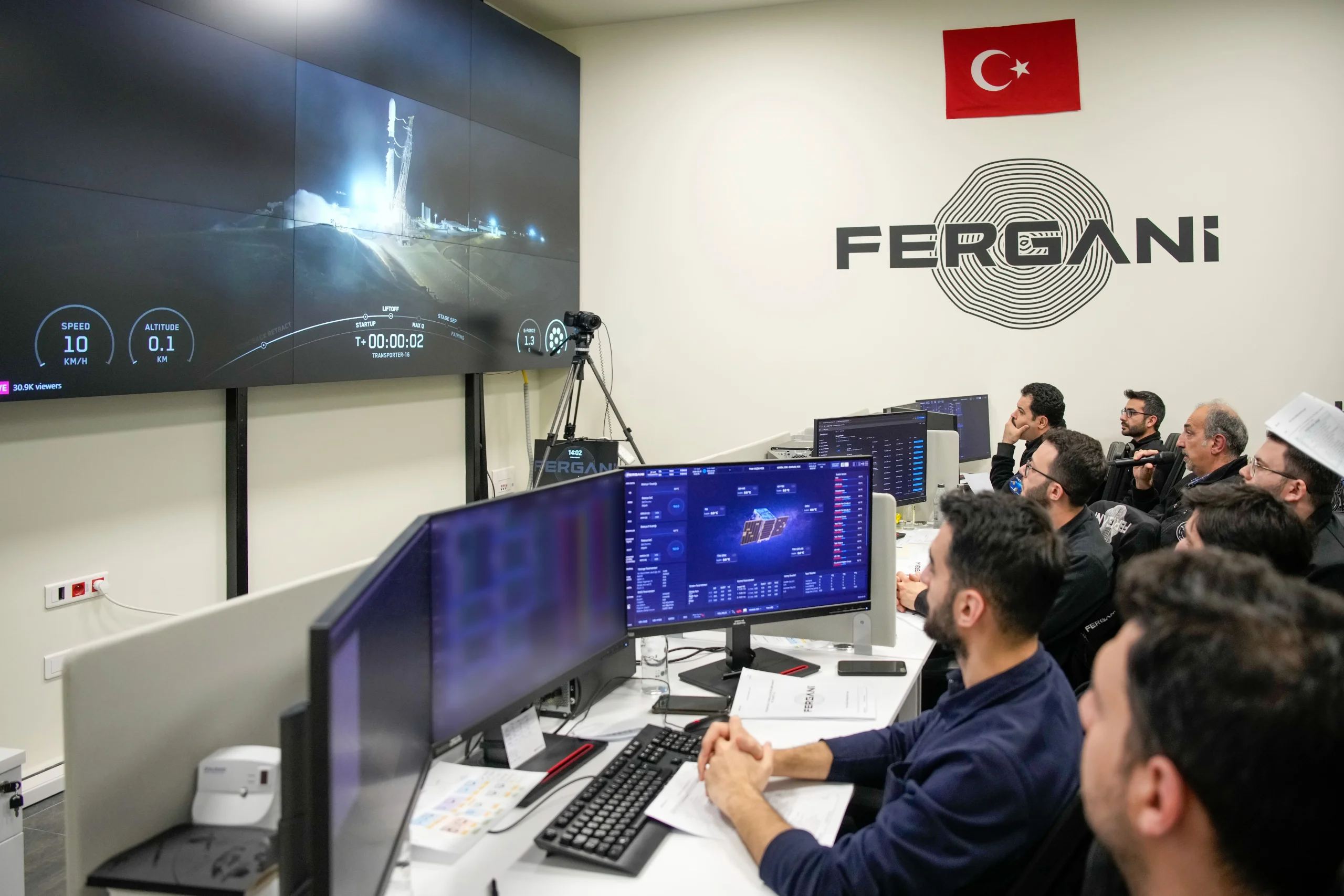
Most Turkish defence companies reach space by signing with a foreign launch provider and, often, a foreign satellite bus. Fergani Space took a different route. Founded in 2022 by Selçuk Bayraktar, the chairman and chief technology officer of Baykar, the Istanbul company builds its satellites, many of their subsystems and now an orbital transfer vehicle in-house. Only the rocket ride is bought abroad.
The company’s own announcements describe several launches in little more than a year. That pace, rather than any single spacecraft, is what makes Fergani worth following.
What Is Fergani Space?
| Item | Detail |
|---|---|
| Company | Fergani Space |
| Founded | 2022 |
| Founder and CEO | Selçuk Bayraktar (also Baykar chairman and CTO) |
| Headquarters | Arnavutköy, Istanbul |
| Team size | 135 employees, per the company’s November 2025 statement |
| Focus | Commercial satellites, satellite components, payloads, orbital transfer vehicles |
| Declared goal | More than 100 satellites in five years, for the planned Uluğ Bey positioning system |
Fergani describes itself as a space technology company working on commercial satellites, satellite components, payloads and orbital transfer vehicles with in-house propulsion. It is a separate venture from Baykar, linked by its founder; the ownership of the drone maker itself is covered in our piece on who owns Baykar. The company says it monitors its satellites from the Özdemir Bayraktar National Technology Center.
How Many Satellites Has Fergani Put in Orbit?
The launch record, as published by the company, runs as follows.
- FGN-100-d1, January 14, 2025. Launched on SpaceX’s Transporter-12 rideshare from Vandenberg Space Force Base in California. The company puts its mass at 102 kg and its sun-synchronous orbit at roughly 510 km, and calls it the largest satellite built by a private Turkish company. The team then numbered 106.
- FGN-100-d2, November 2, 2025. Launched from Cape Canaveral on SpaceX’s Bandwagon-4 mission. The company gives its mass as 104 kg, its altitude as about 510 km and its expected mission life as five to seven years.
- FGN-TUG-S01 and a CubeSat, November 28, 2025. Flown on Transporter-15. This was the first outing for the company’s orbital transfer vehicle, described below.
- FGN-100-d3, March 30, 2026. Launched from Vandenberg on Transporter-16. The company lists it at 113 kg, in an orbit of roughly 500 to 520 km, and its announcement calls it Fergani’s fifth satellite in orbit.
Every one of these was a rideshare slot on a Falcon 9. Fergani does not yet have a launcher of its own, and it lists an indigenous launch vehicle among its long-term targets. In January 2025 the company spoke of a roughly 50-ton rocket able to place about 1.5 tons in orbit, a goal that remains an ambition rather than a hardware programme with a public test record.
Why Does Fergani Fly on Rideshare Missions?
Rideshare is the cheapest way for a young operator to get hardware into a useful orbit. A satellite in the 100-kilogram class shares a Falcon 9 with dozens of other payloads, which spreads the cost and gives the company a regular launch calendar without negotiating a dedicated rocket. The trade-off is control. The rideshare operator sets the orbit and the date, so Fergani’s constellation ambitions depend on slots it does not own.
That dependence is why the transfer vehicle and the launcher goal appear together in the company’s messaging. A vehicle that can lift payloads from the drop-off orbit to the desired altitude reduces the penalty of flying on someone else’s schedule, and an eventual domestic rocket would remove it.
What Does the FGN-100 Platform Carry?
The FGN-100 series are small satellites in the 100-kilogram class. For the early launches the company stresses the domestic content: it lists reaction wheels, magnetic torque rods, magnetometers, an inertial measurement unit, GNSS receivers and an AI-capable on-board computer among the components it developed itself. Attitude control and on-board processing are the parts of a small satellite that newcomers usually import, so that list is the substantive claim.
The company’s wording on the third satellite emphasises communications and navigation functions. Detailed payload performance, such as data rates or positioning accuracy, was not published in the announcements we reviewed. We found no independent technical verification of in-orbit performance beyond the company’s statements that the satellites reached orbit and began operating.
Why Does the Orbital Transfer Vehicle Matter?
FGN-TUG-S01 is billed as Türkiye’s first indigenous orbital transfer vehicle. A transfer vehicle rides to orbit with its payloads and then moves them to different altitudes or planes, so one rideshare slot can serve several customers or constellation shells. According to the company, it works across roughly 500 to over 1,000 km, and its flight computer, avionics, power distribution and thermal control are built in-house.
The distinctive part is the engine. The vehicle uses a hybrid rocket motor, which pairs a solid fuel with a liquid oxidiser. Baykar’s press office framed the mission as the first in-space ignition of an indigenous hybrid engine, and an opinion piece in Daily Sabah said the same propulsion technology is planned for Türkiye’s lunar effort under the National Space Program. Hybrid motors are valued for safety and low cost, though they usually give up some performance against solid or liquid designs. The detailed results of the in-space burn have not been published in the sources we reviewed.
For readers following the lunar plan, the national programme is explained in our look at Türkiye’s space programme.
What Is the Uluğ Bey Positioning System?
This is where the strategic argument sits. Selçuk Bayraktar has said the company’s goal is more than 100 satellites within five years, forming what he calls the Uluğ Bey global positioning system. The announcements describe independent navigation and communication capability delivered from a constellation in low Earth orbit, with satellites at altitudes from about 500 km to beyond 1,000 km.
Two cautions are in order. First, there is no published schedule, budget or regulatory filing in the sources we checked, so the figure of 100 satellites is a stated aim. Second, navigation constellations are demanding. Low-orbit systems need many satellites, precise timing and ground infrastructure, and the company has so far shown small technology-demonstration spacecraft, not an operational service.
How Does Fergani Fit Into Türkiye’s Space Sector?
State programmes still dominate Turkish orbital capability. Reconnaissance relies on the GÖKTÜRK satellites, and military communications on Türksat platforms, a picture we laid out in our review of Turkish military satellite communication. Fergani is different because it is privately driven and works at the product cadence familiar from Baykar’s drone business.
Whether that approach translates to orbit is the open question. Drones are sold to militaries with a clear requirement. A private constellation needs a customer base, spectrum rights and launch access, and Fergani depends on a foreign provider for the last of those. The announcements we reviewed name no customers. What the company has demonstrated is a repeatable cycle of building, launching and operating its own spacecraft, with the team growing from 106 to 135 people between the first and second satellites.
Scale is the other variable. A team of 135 people is small next to the state agencies and large contractors that normally build satellites, so the growth rate of staff, test facilities and launch cadence will say more about the venture’s seriousness than any single press statement.
Three things are worth watching next: another transfer-vehicle flight with a customer payload, a detailed account of the hybrid-engine burn, and any formal step on Uluğ Bey beyond the announced ambition.