Four Turkish Companies Share the Electromagnetic Spectrum, and the Gaps Between Them

Electronic warfare rarely gets a parade slot, yet it decides whether a drone reaches its target, whether a radar sees what it is meant to see and whether a ship’s navigation survives a contested sea. In Türkiye the work is spread across a handful of companies with quite different profiles. One is a national champion, one is a Bilkent-owned specialist, one is a state-owned integrator and one is a software house with a small EW subsidiary.
This is a map of who does what, based on company materials and trade reporting. Where a figure comes from a single outside commentary, it is marked as reported.
Who Builds Electronic Warfare Systems in Türkiye?
Four names cover most of the ground: ASELSAN, Meteksan Defence, STM and HAVELSAN, the last through its EHSİM subsidiary. TÜBİTAK, the state research council, sits behind several of them as a funding and R&D partner rather than a competitor.
| Company | Ownership | EW focus | Examples |
|---|---|---|---|
| ASELSAN | Listed company headquartered in Ankara, founded 1975 | Strategic land-based EW, naval and airborne suites, counter-drone jammers | KORAL, KANGAL, BUKALEMUN |
| Meteksan Defence | Bilkent Holding, founded 2006 | Electronic attack, navigation warfare, anti-jamming GNSS, counter-drone | MERT, MERTER, SEYMEN, AGNOSIS, KAPAN |
| STM | State-owned defence engineering firm | Prime contractor and integrator on EW packages for platforms | 2017 EW supply contract with ASELSAN |
| HAVELSAN-EHSİM | HAVELSAN holds 51 percent, private investors the rest (per company material) | Countermeasure dispensing, EW simulation and analysis software | EWSS, EHSİM CMDS, EWAS |
What Does ASELSAN Bring to the Spectrum?
ASELSAN is the anchor. It covers radar, communications, avionics and EW under one roof, which matters because modern jammers are only as good as the sensors that cue them. Our ASELSAN company profile covers the wider business.
The flagship is KORAL, the land-based radar electronic support and attack system. A RUSI commentary describes it as contracted in 2009, entering Turkish Armed Forces inventory in 2016 and credited with a reach of roughly 150 to 200 km. Those range and combat-effect claims are the commentator’s, not an official data sheet, and should be read that way. The newer variant is covered in our KORAL II explainer.
At the other end of the scale sits KANGAL, a portable, rifle-shaped jammer. ASELSAN’s counter-drone family has grown quickly: at SAHA EXPO 2024 the company introduced KANGAL-FPV for first-person-view drones, the BUKALEMUN GNSS spoofing system and the SEDA 100-cUAV acoustic detection unit, according to defence trade coverage of the show. The idea is a layered answer, detect by sound or radar, then jam or spoof.
Where Does Meteksan Fit?
Meteksan Defence was set up in 2006 under Bilkent Holding to coordinate defence projects across the group’s technology firms. It is smaller than ASELSAN and sharper in focus. Its own materials list radar, EW, communications, underwater acoustics and simulation as core areas, and say it exports to more than 25 countries. For the corporate background, see Inside Meteksan.
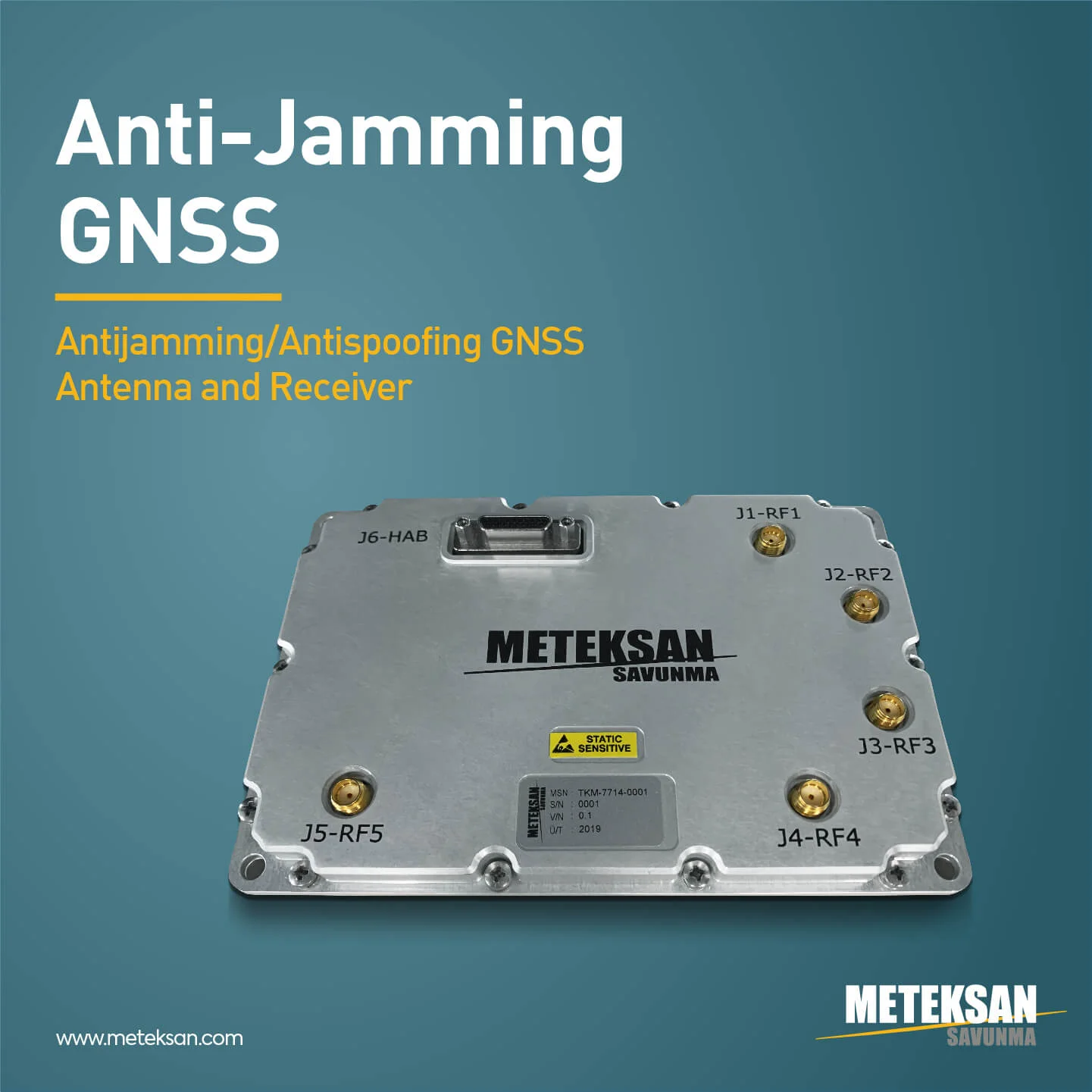
In EW terms, the company’s catalogue names the MERT and MERTER electronic attack systems, the SEYMEN navigation electronic warfare system, the KAPAN counter-drone system and the AGNOSIS anti-jamming GNSS family. The last is the most unusual. Rather than jamming anyone, it protects a platform’s own satellite navigation: Meteksan says the product finds the direction of an interfering signal and removes it by spatial filtering, then rebuilds a clean signal for a standard receiver. It supports GPS, GLONASS, Galileo and BeiDou on multiple bands, according to the company.
Meteksan is also a radar house, and the two businesses feed each other. Its Retinar FAR-AD drone detection radar was contracted by Roketsan for integration with the ALKA directed-energy weapon, per a Meteksan announcement from SAHA EXPO. Our overview Who Builds Türkiye’s Radars places that work among the other radar makers.
What Is STM’s Role?
STM does not compete with ASELSAN head to head on jammers. It acts as the contracting layer. In April 2017, Defence Turkey magazine reported that ASELSAN and STM signed a contract for an electronic warfare system valued at about 116 million euros, with deliveries due to be completed in 2020. A defence press report from March 2017 put a figure of $125 million on an EW contract for ASELSAN, so the exact value depends on the currency and source cited.
That structure explains a lot about the sector. STM is best known for ships, submarines and kamikaze drones, as our STM company profile explains. When a platform programme needs an EW suite, the prime contractor buys subsystems from specialists. The ASELSAN-STM relationship is the clearest public example.
What About HAVELSAN-EHSİM?
EHSİM was founded in 1998 by four electrical engineering graduates of Middle East Technical University, according to company-linked material, and later became a HAVELSAN subsidiary. Its work is narrower: electronic attack and countermeasure techniques, countermeasure dispensing, missile warning, signal and threat analysis, and tactical command and control. Its simulation and analysis tools, such as EWSS, are used to train crews and test EW concepts without live emissions. A TÜBİTAK-backed R&D project supported the EWSS software.
EHSİM’s own material also lists missile warning and countermeasure dispensing, the kind of self-protection equipment that sits on aircraft and helicopters. Those are small line items next to a KORAL battery, but every airframe that flies needs them, which gives the company a steady niche that does not depend on ASELSAN’s pipeline.
This is the quiet part of the sector. Jammers get the headlines, but crews need realistic threat environments to learn when to use them.
Why Has Counter-Drone Work Become the Main Battleground?
Strategic jammers such as KORAL are bought by governments in small numbers and over many years. Counter-drone gear is different: it is cheaper, sold in larger quantities and easier to demonstrate. That has pulled both ASELSAN and Meteksan toward the same customer base of border units, infrastructure operators and expeditionary forces.
The product logic is similar on both sides. A detection layer, either acoustic or radar, finds the threat. A soft-kill layer then jams the control link, disrupts satellite navigation or spoofs it. Hard-kill options such as turrets, lasers or interceptors follow for what soft-kill cannot stop. ASELSAN’s SEDA, KANGAL and BUKALEMUN line follows this chain, while Meteksan feeds it from the radar side through Retinar FAR-AD and from the jammer side through KAPAN.
Navigation is the quieter front. Satellite signals are weak by the time they reach a receiver, so a modest jammer can blind an unprotected platform, a point Meteksan makes itself when describing its AGNOSIS family. Protecting the receiver is now treated as a separate product category, not an afterthought bolted on to avionics. It is also an area where a mid-sized specialist can win business without matching ASELSAN’s scale.
Are They Rivals or Partners?
Both. ASELSAN and Meteksan overlap in counter-drone EW and navigation warfare, and customers can compare them. Yet the same firms appear on the same contracts: Meteksan’s radars in a Roketsan weapon, ASELSAN’s suites inside STM-led programmes. The state’s early push also shapes the field. Analysts note that Ankara has channelled funding to ASELSAN, HAVELSAN and TÜBİTAK for roughly two decades to build indigenous capability, and the result is a layered architecture, from strategic ground systems to tactical vehicle units and pods for manned and unmanned aircraft.
Export is the next test. Reports have linked KORAL to a roughly $50.7 million Moroccan contract and to interest from Oman and Iraq, but those are claims relayed by RUSI rather than confirmed contract notices. For a wider look at the product side of the sector, read how Türkiye turned the drone threat into an export line.
The competition that matters most may be less between Turkish companies than against foreign EW suppliers, in markets where buyers want jammers, navigation protection and drone defence from one source. The group that can show integrated, fielded systems with a clear upgrade path will be best placed, and the autumn defence shows are where that case gets made.