The NMS 4×4 Gives Nurol a Light Armoured Vehicle Estonia Already Fields


Nurol Makina’s NMS 4×4 is the vehicle that turned a mid-sized Turkish armour maker into a supplier to NATO’s northeast. Estonia took delivery of 100 of them by March 2025, according to European Security & Defence, after signing the contract in October 2023. Qatar was the first reported buyer, years earlier. Between those two orders sits a tactical light armoured vehicle that Nurol positions as a cheaper, lighter alternative to 6×6 carriers.
| Item | Detail |
|---|---|
| Manufacturer | Nurol Makina |
| Type | Tactical light armoured 4×4 (MRAP-level protection, scalable) |
| Public debut | IDEF, Istanbul, May 2017 (per Army Technology) |
| Hull | V-shaped monocoque with scalable composite armour |
| Capacity | Up to 9 (driver, commander, seven troops) in the standard layout; up to 11 in the extended-wheelbase configuration, per Nurol |
| Engine | 300 hp diesel (reported) |
| Top speed / range | About 140 km/h, about 700 km (reported) |
| Fording / gradient | 90 cm / 70% (Nurol) |
| Known operators | Qatar, Estonia, Hungary (Gidran derivative), others reported |
What exactly is the NMS 4×4?
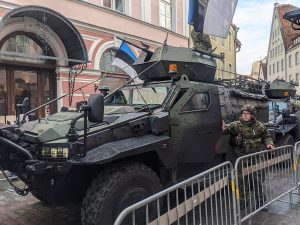
The NMS 4×4 is a wheeled armoured vehicle built around a conventional layout: engine at the front, crew cab in the middle, troop compartment at the back. Nurol lists a V-shaped monocoque hull, mine and IED resistance, lateral blast protection and an explosion-proof, puncture-resistant fuel tank. Run-flat tyres and hydraulic-assisted steering are standard.
Weight depends on the kit. Army Technology gives a gross weight of roughly 10 tonnes for the original vehicle, while European Security & Defence describes the current NMS 4×4 as a 13-tonne vehicle that can reach STANAG Level 4 ballistic and mine protection. The gap reflects different armour packages, not a contradiction worth chasing.
How does it fit next to Ejder Yalçın and the rest of the Nurol range?
Nurol’s own vehicle page lists seven 4×4 products: NMS 4×4, NMS-L 4×4, Ejder Yalçın 4×4, PARS 4×4, ILGAZ 4×4, Ejder Toma and Ejder Kunter. The Ejder Yalçın is the heavier tactical wheeled armoured vehicle that built the company’s export reputation. The NMS sits below it as a tactical light vehicle, and the NMS-L, shown at IDEF 2023, sits lower still.
For a wider view of the company and how the 4×4 line grew, see our piece on Nurol Makina’s bet on 4×4 armour in Europe.
What can it carry and shoot?
Nurol markets nine configurations, among them air defence, missile carrier, SWAT, combat, reconnaissance, anti-tank and pickup versions. Optional equipment includes 7.62 mm and 12.7 mm machine guns, a 40 mm grenade launcher, anti-tank weapon systems, a CBRN protection kit, 360-degree driver vision and military GPS tracking. Army Technology notes a roof-mounted remote weapon station as the typical fit.
Estonia’s version is a good example of customisation. The Estonian Centre for Defence Investments said the vehicles would be certified against small arms fire and mine blasts and fitted with smoke grenade launchers and 12.7 mm machine guns on roof turrets.
Who has bought it?
Qatar’s army reportedly ordered about 100 NMS 4x4s in 2017, with a further order for special forces units in March 2018, according to Army Technology. Vehicles appeared in a Qatari parade in December 2017.
Estonia is the best-documented deal. On 18 October 2023 the Estonian Centre for Defence Investments announced about 230 wheeled armoured vehicles for roughly €200 million, covering both Nurol’s NMS 4×4 and Otokar’s Arma 6×6, plus training, spares and support. The NMS share was 100 vehicles, with four more for the Explosive Ordnance Disposal Centre and allocations to the 1st and 2nd Infantry Brigades. The contract also came with a letter of intent between the Estonian and Turkish defence ministers on industrial cooperation. Reported values for the Nurol portion vary between sources, so treat any single figure with care.
Beyond Qatar and Estonia, a military vehicle database lists Indonesia and several African users, and Hungary builds a heavier derivative called Gidran through a joint venture with Raba. We could not confirm those customer lists against official sources, so they should be read as reported.
What is the NMS-L, and why does Nurol need it?
Deputy General Manager Anıl Karel told Defence Turkey that the NMS-L “fills the gap in the company’s light vehicle class.” The vehicle has an empty weight of about 8 tonnes, expandable to 12 tonnes with modular armour, a 4-tonne payload and a 300 hp diesel. Reported top speed is 150 km/h on paved roads. A pickup-style cargo bed with an internal passage to the cabin sets it apart, and protection scales up to STANAG 4569 levels. At IDEF 2023 it was shown with a 30 mm remote turret and an eight-cell launcher for loitering munitions.
Production capacity is reportedly 600 vehicles a year, and export orders are said to account for about 90 percent of revenue, with subsidiaries in Hungary and the United Kingdom (NMS UK, Birmingham, 2023). Those are management claims relayed by European Security & Defence rather than audited numbers.
How did the Estonian deliveries go?
Army Recognition reported that the first vehicles reached Estonia in late 2024, with the whole order expected by the end of 2025. The Estonian Defence Investment Centre handed nearly 50 of the Turkish-built vehicles to the 2nd Infantry Brigade on 11 March 2025, according to the same coverage, and European Security & Defence later said all 100 NMS 4x4s had arrived on schedule by that month. The sources differ slightly on timing, so the exact handover dates are best checked against Estonian procurement releases.
The 2nd Infantry Brigade had previously lacked wheeled armoured vehicles of its own, which explains why it was the priority recipient. The four NMS vehicles for explosive ordnance disposal teams go to the Rescue Board side of the deal, not to combat units.
What does the protection package actually offer?
Nurol describes MRAP-level ballistic protection that scales with add-on armour, plus a V-shaped hull intended to deflect mine and IED blast energy away from the cabin. Ballistic glass, smoke grenade launchers and explosion suppression are listed among the options by Army Technology. A defence-media profile cites an operating temperature range of -32 to +55 degrees Celsius, a figure that matters for a customer like Estonia and one like Qatar at the same time, though it comes from a secondary source.
Mobility numbers are modest but practical: 90 cm fording, 0.5 m obstacle climbing, 0.9 m trench crossing and a 70 percent gradient, as listed by Nurol. They suit road-heavy infantry support and patrol work rather than amphibious assault.
Why do buyers choose a 4×4 like this?
Cost and speed of delivery are the usual answers. A 4×4 with mine protection is cheaper to buy and run than a 6×6 carrier, and Turkish makers have tended to deliver on tight schedules. Our look at why countries buy Turkish armoured vehicles covers that pattern across the sector.
The NMS also competes at home with other Turkish light tactical vehicles such as the Katmerciler HIZIR II and, in the mine-protected class, the Otokar COBRA II. What separates Nurol is a narrow focus: it makes 4x4s and keeps adding rungs to the ladder instead of chasing 8×8 programmes.
Nurol has said it designs a new platform every three to four years from operator feedback and hinted at something outside the 4×4 family within a year of the May 2025 FEINDEF show. Nothing has been confirmed publicly in the sources we reviewed.