GÖKSUR Is Not a HİSAR Spin-Off and Turkish Naval Defence Is Better for It

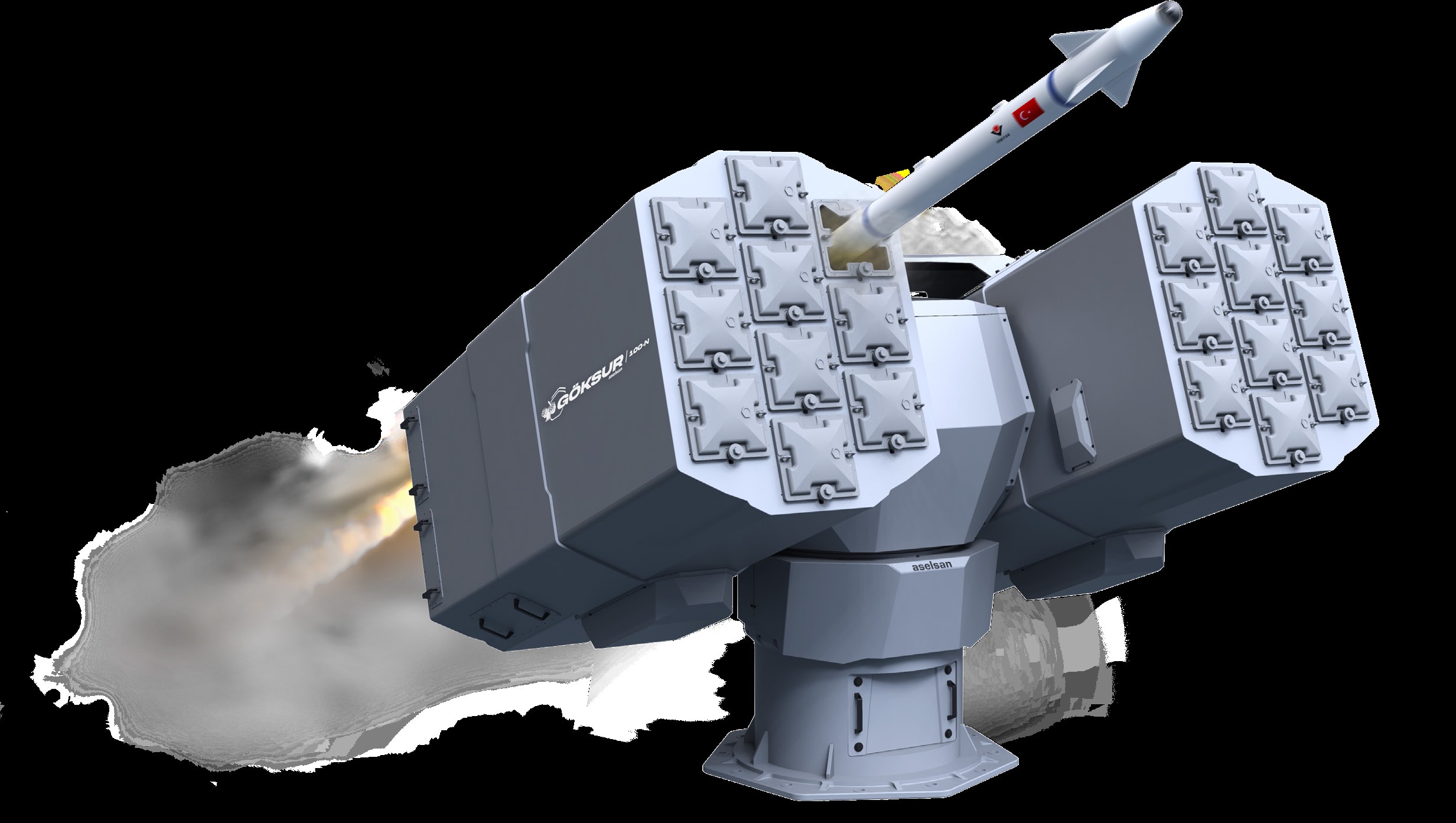
Turkish naval-defence coverage often drops GÖKSUR and HİSAR into the same sentence, as if the ship-borne point-defence missile were simply the army’s HİSAR family put on a deck. It is an easy assumption, because the names look related and both systems belong to the same layered air-defence story. The public record says something different. GÖKSUR comes from a different missile lineage, and that matters for what the Turkish Navy can expect from it.
Where Does the GÖKSUR Missile Actually Come From?
ASELSAN developed GÖKSUR together with TÜBİTAK SAGE. According to EDR Magazine’s coverage of the Euronaval 2024 debut, the missile is a surface-to-air adaptation of the Bozdoğan air-to-air missile, a within-visual-range weapon from the Göktuğ programme. Quwa, reporting on production imagery in August 2026, repeats that lineage and says the turret derives from the same Bozdoğan work.
HİSAR is a separate family. ASELSAN is prime contractor for the radars, fire control and battery integration, while ROKETSAN designs and builds the interceptor missiles. The two programmes share an industrial ecosystem and a taste for imaging infrared seekers. They do not share a missile airframe, at least not in any public source reviewed for this article.
So the shorthand “GÖKSUR is a naval HİSAR” does not hold up. The closer relative of the naval HİSAR idea is HİSAR-D, which was reported to be tested in 2024 for vertical-launch integration on surface combatants.
What Is the GÖKSUR 100-N System?
| Item | Detail (as reported) |
|---|---|
| Developer | ASELSAN with TÜBİTAK SAGE |
| Role | Naval point-defence missile system |
| Missile diameter / length | 160 mm / 3,300 mm |
| Missile mass | About 140 to 142 kg, depending on the source |
| Range | 15 km |
| Seeker | Imaging infrared, with a two-way datalink for mid-course updates |
| Warhead | Blast fragmentation |
| Standard launcher | 20 missiles in two 10-missile pods |
| Variants | GÖKSUR 100-N (turret), 100-N/StA (stand-alone), 100-N VLS (vertical launch) |
EDR Magazine noted that the 15 km range is a cut from the roughly 25 km of the air-to-air parent. The folding rear fins allow canister launch instead of rail launch, which is what makes a vertical-launch version practical. ASELSAN describes a fire-control system with AI features, 360-degree coverage and simultaneous engagement of multiple targets, and says the turret is stabilised for poor sea states. Those are manufacturer claims, not independent test results.
Why Does a Navy Want a 15 km Missile Between a Gun and an Area Interceptor?
A ship’s air defence works in rings. Long-range area interceptors, such as those planned for the TF-2000 destroyers, engage aircraft and ballistic threats far out. At the other end sits the close-in gun. ASELSAN’s GÖKDENİZ 35 mm CIWS is the last line, and EDR described its reach as about 4 km.
That leaves a gap. A sea-skimming anti-ship missile gives a ship seconds, not minutes. A gun has to be right almost immediately, and a long-range interceptor has to cope with a target that only appears over the horizon late. A short-range missile with an imaging seeker and a datalink is meant to fill that middle band, handling cruise missiles, drones and helicopters before they reach gun range.
EDR also lists loitering munitions and medium-sized drones among the intended targets, which reflects how cheap aerial threats have changed what ships worry about.
How Does the HİSAR Family Fit Into the Picture?
The land-based HİSAR missile family covers the low and medium layers: HİSAR-A+ for short range and HİSAR-O+ for medium altitude, with the latter reported at 25 km or more in its imaging-infrared version. HİSAR-D for naval use sits closer to a medium-range escort role. We examined the comparison between HİSAR and a Western medium-range system in HİSAR and NASAMS Take Different Routes to the Same Air Defence Job.
Put side by side, the logic is a division of labour. HİSAR-class missiles reach out to a ship’s medium-range zone. GÖKSUR is the short-range missile that protects the ship itself, which is why the closest foreign comparison is the American RIM-116 RAM and the SeaRAM mount. Quwa explicitly describes GÖKSUR as Türkiye’s equivalent to that pair.
What Has Actually Been Tested and Built?
The dated milestones are short and fairly clear.
- November 2024. ASELSAN unveils the 100-N at Euronaval in Paris. EDR reports a first firing expected before the end of that year and availability targeted within two years, both goals as stated at the time.
- 16 February 2025. The vertical-launch version fires from the corvette TCG Beykoz in the Black Sea off Sinop. Baird Maritime reports the test as successful against low-flying threat profiles including aircraft, helicopters, anti-ship and cruise missiles and UAVs.
- 3 August 2026. ASELSAN chief executive Ahmet Akyol posts images of a GÖKSUR 100-N turret on the production line, during a visit by the Turkish Coast Guard commander. Quwa says it is the first time the system has been seen as built hardware rather than an exhibition model.
No production contract value, delivery schedule or named customer has been confirmed publicly. Quwa lists the TF-2000 destroyer, the Ada-class corvettes and the Hisar-class offshore patrol vessels as plausible platforms, but that is analysis, not an announced fit list. For the production-line story in more detail, see our report on GÖKSUR 100-N reaching production.
How Does a GÖKSUR Engagement Differ From a Gun Engagement?
The difference is guidance. A CIWS gun such as GÖKDENİZ puts a stream of rounds into a predicted point and relies on its own sensors. A missile like GÖKSUR can be launched toward a target before its seeker has locked on. According to EDR, the imaging infrared seeker has off-boresight capability, and the datalink lets the ship pass course corrections during flight. That is useful against a sea-skimmer that the ship’s radar tracks but the seeker cannot yet see.
The infrared seeker also brings a limitation common to the class. An imaging infrared sensor does not depend on radar emissions and is hard to jam in the way a radar seeker can be, but weather and sea clutter can still affect it. ASELSAN has not published performance data on this, so any comparison with RAM remains unproven in open sources.
Which Ships Could Carry It?
The Burak-class corvette TCG Beykoz hosted the 2025 firing, and Janes reported the test from the NAVDEX exhibition. Quwa’s list of candidate hulls starts with the TF-2000 destroyers, where a 96-cell vertical launch system is reported for the long-range interceptors, with GÖKSUR as a close-in complement. It also names the Ada-class corvettes, which Wikipedia lists with a single RAM Block I launcher, and the Hisar-class offshore patrol vessels.
ASELSAN has been selling the gun side of the same inner layer abroad. The company’s GÖKDENİZ CIWS is reported to be heading for Pakistan Navy MILGEM-derived corvettes and for the Turkish Navy’s Istanbul-class frigates. A missile that sits with it on the same ship would give a buyer both a gun and a missile from one supplier, though no export customer for GÖKSUR has been announced.
Why Does the Lineage Matter for Sovereignty?
Türkiye’s Ada-class corvettes currently carry the American RAM. A missile made by ASELSAN and TÜBİTAK SAGE, with Turkish seekers and software, would not depend on a foreign government’s export licence for spares or resupply. That reasoning runs through Turkish defence policy and is the practical case for GÖKSUR, but whether the missile matches RAM in real conditions can only be judged once it is in service.
The shared Bozdoğan root has a second effect. Because the missile began as an air-to-air weapon, some development, such as the seeker, was already underway before the naval programme started. That is a plausible reason the schedule moved from a 2024 unveiling to production hardware in about two years, though no source quantifies the saving.
What Remains Unanswered?
Several things are still open. Public sources give the mass as roughly 140 or 142 kg, so treat that figure as approximate. ASELSAN has not published engagement-envelope data, kill probability or radar integration details. And the TF-2000 programme, whose lead ship began construction in January 2025, will be the natural proving ground, as part of the wider Steel Dome architecture that ties naval and land layers together.
For readers following the company side, the ASELSAN profile covers the corporate background. The headline for now is simpler than the shorthand suggests. GÖKSUR is a Bozdoğan descendant with a naval job, standing next to the HİSAR family rather than inside it.