Nurol Makina’s Narrow Bet on 4×4 Armour Is Paying Off in Europe

Most Turkish armour makers chase the big tracked and eight-wheeled programmes. Nurol Makina went the other way. The Ankara company builds light, tactical 4×4 vehicles, mostly in the 10 to 14 tonne class, and it has sold them to buyers as different as Qatar, Hungary and Estonia. That narrow focus is the reason it shows up in so many export tables, and also the reason its order book can look lumpy from one year to the next.
This profile covers where the company came from, what it actually builds, who has bought it, and what its new plants in Hungary and Britain say about where it wants to go.
| Field | Detail |
|---|---|
| Company | Nurol Makina ve Sanayi A.Ş. |
| Headquarters | Sincan, Ankara, Türkiye |
| Founded | 1976 (defence work from 1992) |
| Ownership | Nurol Holding |
| Main activity | Tactical wheeled armoured vehicles, mainly 4×4 |
| Current range | Ejder Yalçın, NMS, NMS-L, PARS 4×4, Ilgaz, Ejder TOMA, Ejder Kunter |
| Main customers | Turkish Armed Forces, Turkish National Police, export buyers |
| Overseas units | Nurol Makina Hungary, Nurol Makina UK (Leamington Spa) |
| Website | nurolmakina.com.tr |
How Did a Machinery Company End Up Building Armour?
Nurol Makina was set up in 1976 as a machinery and industrial manufacturer and belongs to the wider Nurol Holding group, which is better known in Türkiye for construction. The move into defence came in 1992, when the company opened operations in the Sincan industrial zone in Ankara and began building armoured land vehicles. Company interviews describe that shift as the point where it stopped being a general machine shop and started thinking of itself as a vehicle integrator.
The early decades were domestic. Nurol supplied the Turkish Armed Forces and the police, and the vehicles of that period were not widely noticed abroad. The turn toward exports came in the late 2000s and accelerated after 2014, when the Ejder Yalçın reached serial production.
The factory itself is conventional for a modern armour builder. The company lists five-axis laser cutting for steel armour, seven-axis robotic welding, hydraulic presses, heat treatment and painting lines, and its own test areas. Nurol says it now has 50 years of experience in defence technology, counting from its 1976 founding.
What Is the Ejder Yalçın and Why Did It Sell?
The Ejder family began with a 6×6 vehicle launched in 2008. The 4×4 Ejder Yalçın followed from design studies in late 2012, pre-prototypes at IDEF 2013 and serial production from May 2014, according to the open-source record. It is a V-hulled, mine-protected personnel and weapons carrier of roughly 14 tonnes, powered by a Cummins diesel of about 375 horsepower, with a quoted top speed of 120 km/h and a range of around 700 km. It can carry up to eleven people, depending on the configuration.
Protection levels are quoted differently in different public sources, and they depend on the armour package fitted for a given customer, so they are best read as a range rather than a fixed figure. What buyers have consistently valued is the package: a proven hull, a commercial drivetrain that is easy to support, and a long list of role variants, from armed patrol to mortar carrier, ambulance and riot control.
The vehicle also had the advantage of a combat record. Turkish forces used it during Operation Euphrates Shield and Operation Olive Branch, and Nurol pointed to that experience in its marketing. By early 2023 the company said it had delivered more than 1,200 Ejder Yalçın vehicles to nine countries.
The 2017 export jump
The numbers Nurol published for 2017 show how quickly things changed. The company reported sales of about $131 million that year, with exports above $50 million. In 2016, exports had been roughly $400,000, or about 5 percent of turnover. By 2017 they were around 40 percent, and the company projected more than half for 2018. Tunisia was the first export customer for the Ejder Yalçın.
Who Has Bought Nurol Vehicles?
The buyer list is broad, though public detail is uneven and some quantities come from single reports. The better-documented deals include the following.
- Qatar. Janes has reported that Qatar ordered 342 Ejder Yalçın vehicles, announced at DIMDEX in March 2018 alongside a memorandum covering 214 NMS vehicles. Both types were shown at Qatar’s National Day parade in December 2017. A further Qatari agreement was signed in August 2020 through Barzan Holdings, though the ministry did not give the quantity.
- Uzbekistan. In October 2017 Nurol and UzAuto signed a memorandum to build 1,000 Ejder Yalçın vehicles, with the first ones made in Türkiye and the rest in Uzbekistan. Uzbek media reported delivery of the first 24 in 2019. The figure of 1,000 is an agreement target, and public confirmation of the full programme is thin.
- Hungary. The Hungarian Defence Forces took their first ten vehicles, locally called Gidrán, in February 2021. More were ordered later, and a batch of 56 was reported delivered in 2025.
- Estonia. The largest recent NATO sale, covered below.
- Nigeria. Thirteen NMS vehicles were reported in a roughly $36.5 million border security package with Asisguard in 2024, one of several Turkish firms involved.
- Africa and elsewhere. Tunisia, Chad, Niger, Senegal, Morocco and Burkina Faso appear in press and register reporting as users of the Ejder or NMS families. Volumes are small and some are reported rather than confirmed.
Nurol says it has delivered vehicles to more than 20 countries, and a trade-press profile reported that roughly 90 percent of its revenue now comes from abroad. Those are company-linked figures, not audited ones, but they fit the pattern of the order list.
What Is the NMS 4×4 and How Is It Different?
The NMS was introduced at IDEF in Istanbul in May 2017. It is lighter and smaller than the Ejder Yalçın, at about 10 tonnes, and it is sold under the Yörük name in some markets. Army Technology lists a crew of nine, a top speed of 140 km/h, a range of 700 km, independent front and rear suspension and a V-shaped hull. A Nigerian-order report quotes a 300 horsepower diesel with an automatic gearbox and dimensions of about 4.9 by 2.4 by 2.1 metres.
The company sells it as a scalable platform. Protection can be raised or lowered by changing the add-on armour, which matters to customers who want a patrol vehicle in peacetime and something heavier for deployments. Roof-mounted remote weapon stations in 7.62 mm or 12.7 mm are typical. Nurol has also shown an NMS fitted with a locally developed Venom LR system at IDEF 2025.
In practice the two vehicles split the market. The Ejder Yalçın is the heavier mine-protected carrier for troops and support roles. The NMS is the faster, lighter patrol and command vehicle. The NMS-L, a longer version, and the PARS 4×4 and Ilgaz fill in the rest of the range, while the TOMA and Kunter are the riot control and logistics versions of the Ejder.
Why Did Estonia Choose the NMS?
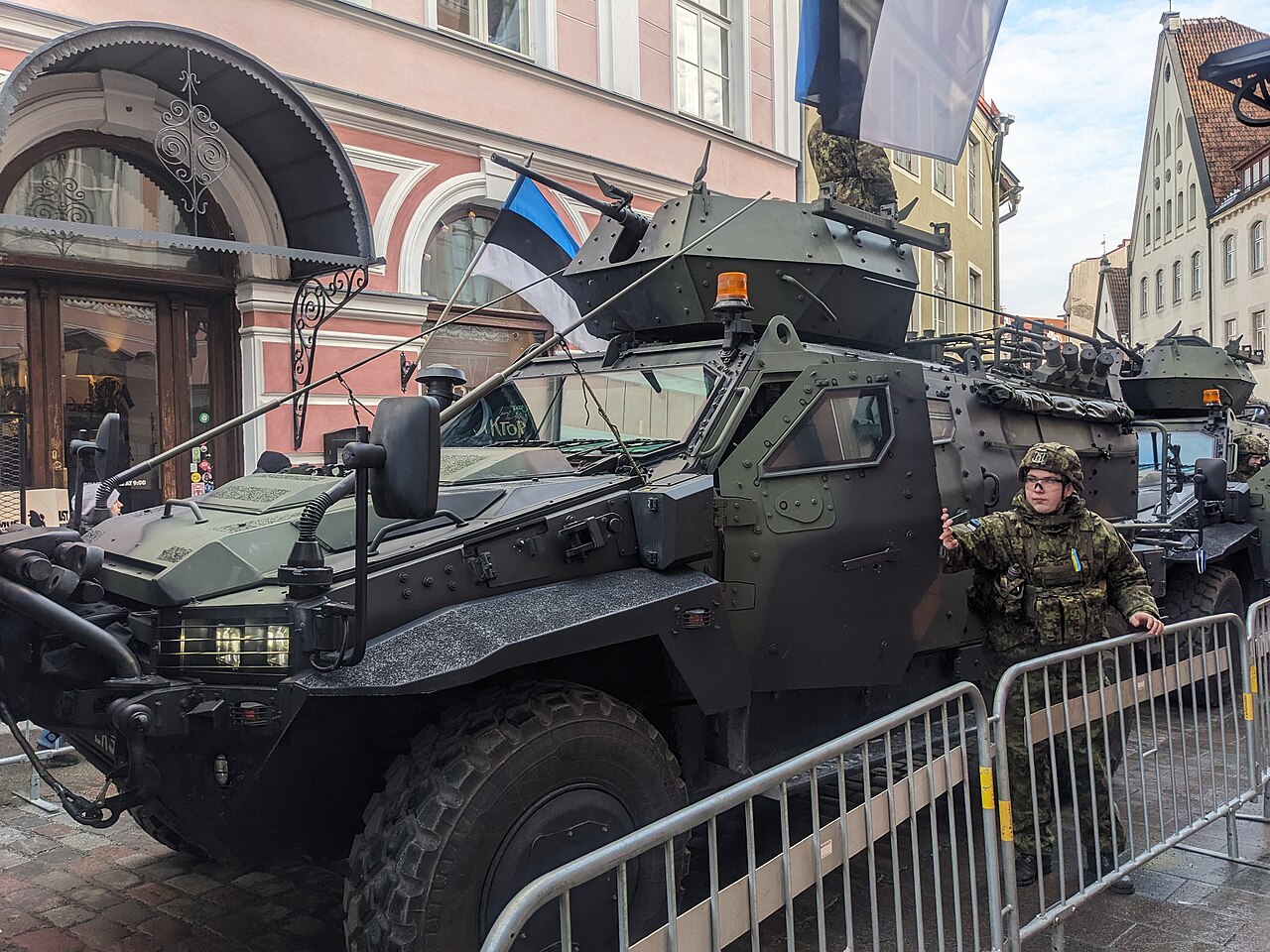
On 18 October 2023 the Estonian Centre for Defence Investments announced contracts worth about €200 million for roughly 230 wheeled armoured vehicles. Otokar’s ARMA 6×6 took the larger share, with 130 vehicles. Nurol’s part was 100 NMS 4×4 vehicles, valued by Janes at about $60 million. Janes also reported four further NMS vehicles for the Estonian Rescue Board.
The Estonian version is the extended wheelbase model, which Nurol called the Yörük EWB. It was built to Estonian requirements, with a 12.7 mm roof-mounted weapon station, mine and small-arms protection, and modifications that included anti-armour features. The Estonian investment agency said at signing that the first vehicles would arrive in 2024, and Nurol announced on 31 January 2025 that acceptance was complete and deliveries had finished. Nearly 50 vehicles of the Turkish batch were handed to the 2nd Infantry Brigade in March 2025.
The contract is also a useful measure of Nurol’s weight in NATO. Estonia became the second NATO and EU member to field the vehicle after Hungary, and the deal ran to about a year from signature to final delivery. Speed was the recurring argument in this sale. For a broader look at why European buyers have looked east for light armour, see our piece on why countries buy Turkish armoured vehicles.
Is Nurol Building Factories Abroad?
Yes, and this is the most telling part of the company’s current strategy. Two separate overseas projects are under way.
Hungary
Nurol, its Hungarian arm, the state-linked N7 holding and Rába Automotive signed a memorandum in 2023 to produce the Gidrán at Rába’s site in Győr. The partners said the project would employ more than 200 people and draw on a domestic supplier network. The Hungarian version uses an ASELSAN SARP remote weapon station. Hungary received its first ten vehicles in 2021 and, according to Army Recognition, 56 more in 2025, with the localisation share meant to rise over time. Our profile of ASELSAN covers the turret and sensor side of these builds.
United Kingdom
Nurol Makina UK opened a plant at Tachbrook Park in Leamington Spa, a site of about 7.9 acres that was expected to provide up to 150 skilled jobs within three years. At Defence Vehicle Dynamics in 2024 the company showed three UK-oriented vehicles, including a medium-weight 4×4 called Dragon for the Medium Protected Mobility requirement and an NMS Light of about 10 tonnes with five seats and a quoted top speed of 150 km/h. It has also signed a collaboration with NP Aerospace, and in 2023 it teamed with CANiK’s UK arm AEI Systems on the Venom LR and Trakon weapon systems. The company has said it intends to lift UK content above 50 percent through phased localisation.
Whether the British work turns into a large order is not settled. The Medium Protected Mobility programme is a competitive requirement, and production timing was described as a plan rather than a finished fact. Readers who follow this trend can compare it with our overview of Turkish defence factories abroad.
How Does Nurol Compare With Otokar, FNSS and the Rest?
Nurol does not compete with the eight-wheeled and tracked platforms of FNSS or the larger ARMA and COBRA lines of Otokar. Our profiles of FNSS and Otokar show companies with broader ranges and larger factories. Nurol’s niche is narrower. It stays in the light and medium tactical class, where buyers want a mine-protected vehicle quickly, with a commercial engine they can service at home.
That focus cuts both ways. It has let a company with a workforce reported at over 600 in a company interview (the figure is undated) win contracts in NATO countries. But it also ties results to a small number of export contracts, and several headline numbers, such as Uzbekistan’s 1,000-vehicle target, depend on the pace of local production rather than on firm deliveries.
The other risk is political. A big share of Nurol’s sales depends on governments that buy from Türkiye by choice, and export approvals and offsets can change. The same point runs through our look at which NATO members operate Turkish systems.
What to Watch Next
Three things will show whether the niche strategy holds. The first is the Hungarian line at Győr, where the share of local content and the pace of output will be visible in Hungarian procurement news. The second is the British plant and whether any UK protected-vehicle contract follows. The third is Estonia, where the extended options in the ten-year framework could bring more NMS vehicles if the first batch performs well in service.
If those three develop, Nurol will have moved from being a Turkish export supplier to a company that builds inside its customers’ borders. If they stall, it still has a long list of small and medium export orders and a well-known platform in the Ejder Yalçın. Either way, it is one of the clearer examples of a Turkish firm winning by picking a category and staying in it.