Türkiye Has Its Own Air-to-Air Missiles Now, but Not Yet in Numbers

For decades, every fighter in the Turkish Air Force has flown with American air-to-air missiles under its wings. The AIM-9 Sidewinder covers close range and the AIM-120 AMRAAM covers everything beyond visual range. Both come with US export controls attached. Since late 2025 that has started to change in a way that can be measured in test firings rather than slogans. Two missiles from TÜBİTAK SAGE, GÖKDOĞAN and BOZDOĞAN, have now hit targets from an F-16 and from an unmanned fighter, and in May 2026 they passed live-warhead trials.
This piece sets out what each Turkish air-to-air missile is, what has actually been proven, and what still stands between a successful test campaign and a weapon in regular squadron service.
| Item | GÖKDOĞAN | BOZDOĞAN |
|---|---|---|
| Developer | TÜBİTAK SAGE (GÖKTUĞ programme) | TÜBİTAK SAGE (GÖKTUĞ programme) |
| Class | Beyond-visual-range air-to-air missile (BVRAAM) | Within-visual-range air-to-air missile (WVRAAM) |
| Guidance | Active radio-frequency seeker, datalink for mid-course updates, lock-on after launch | Imaging infrared seeker, off-boresight, all-aspect engagement |
| Reported range | Over 65 km | Over 25 km |
| Propulsion | Solid-fuel rocket motor | Reduced-smoke solid-fuel motor with thrust vector control |
| Aircraft interface | MIL-STD-1553 / 1760, LAU-129 launcher compatible | MIL-STD-1553 / 1760, LAU-129 launcher compatible |
| Missile it would replace | AIM-120 AMRAAM | AIM-9 Sidewinder |
| Platforms named | F-16, KIZILELMA, KAAN, HÜRJET | F-16, KAAN, KIZILELMA |
Figures are as reported by TurDef, The Aviationist and other programme coverage. TÜBİTAK SAGE has not published a full public datasheet with weight, length or warhead mass.
Who Is Building Türkiye’s Air-to-Air Missiles?
The work sits with TÜBİTAK SAGE, the state research council’s defence-industry institute in Ankara. According to TurDef, the GÖKTUĞ contract was signed with the Ministry of National Defence in December 2012 and moved under the Presidency of Defence Industries (SSB) in November 2016. GÖKTUĞ was meant to yield two missiles for the F-16 first, then for Türkiye’s newer aircraft.
The split is conventional. BOZDOĞAN, the short-range missile, is the dogfight weapon. GÖKDOĞAN is the long-arm missile that an aircraft fires at a target it may never see with its own eyes, using its radar and a datalink to steer the missile toward the target before the missile’s own seeker takes over.
SAGE is a research institute rather than a factory. TurDef quoted SAGE manager Gürcan Okumuş as describing the production approach as boutique, one that “does not require a serial production line.” That framing matters when reading the order sizes below.
How Long Did the Test Campaign Take?
The programme was not quick. The timeline, as reported:
- 2018. First successful flight tests of GÖKDOĞAN.
- 14 April 2021. BOZDOĞAN is fired from an F-16 and destroys a TUSAŞ ŞİMŞEK target drone.
- December 2022. The Defence Industry Executive Committee (SSIK) approves both missiles for production, according to TurDef.
- January 2024. SSB chief Haluk Görgün says design verification is finished and the missiles are ready for acceptance tests. TÜBİTAK SAGE calls it “one last step.”
- 12 February 2025. Minister of Industry and Technology Mehmet Fatih Kacır announces a GÖKDOĞAN firing that hit a target aircraft directly.
- 19 October 2025. Both missiles are fired in succession from a single F-16, each hitting a pilotless target, a first for the pair.
- 30 November 2025. A KIZILELMA unmanned fighter is announced to have destroyed an aerial target with GÖKDOĞAN (details below).
- 28 May 2026. Kacır announces that both missiles have left the verification phase with firing tests using live warheads.
The initial order is small. TurDef reports that SAGE was contracted for 25 missiles of each type, plus 14 launchers, for the F-16 fleet. Treat that first batch as an operational evaluation lot more than a stockpile.
What Did the Warhead Tests in May 2026 Prove?
Earlier shots hit drones, but a hit is not a kill. A missile that strikes a target with an inert or instrumented warhead tells engineers about guidance. It says little about whether the fuze, the fragmentation pattern and the detonation sequence work together.
Kacır described the May firings as a “concrete demonstration” of Türkiye’s air deterrence. Defence Security Asia reported that the tests covered seeker performance, guidance precision and warhead behaviour, and SavunmaSanayiST wrote that both missiles carry pressure and fragmentation type warheads. No kill probabilities or range details were released, which is normal.
The announcement does not say the missiles are in full-rate production. It says the verification phase is over. Turkish outlets pair that with integration on the F-16 being complete and serial production as the next step. No delivery schedule has been published.
Why Did the KIZILELMA Shot Matter?
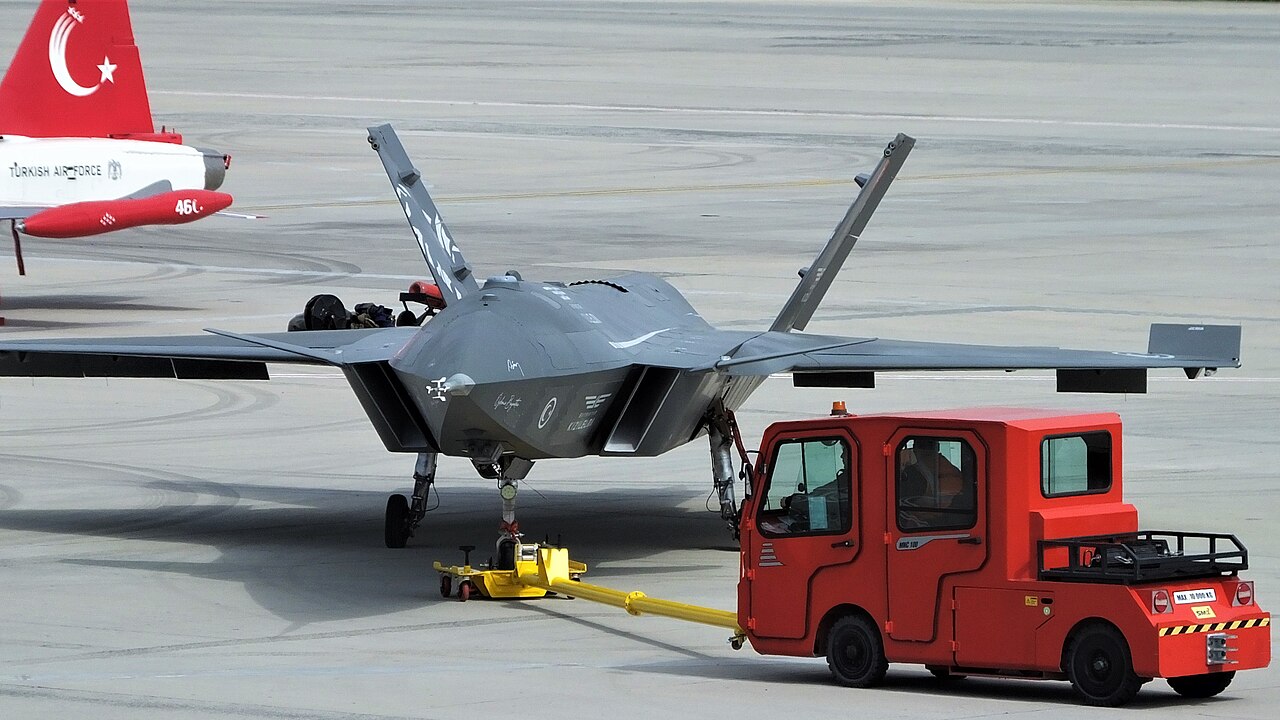
On 30 November 2025 Baykar announced that its Bayraktar KIZILELMA unmanned combat aircraft had destroyed a jet-powered target over the Black Sea off Sinop with a GÖKDOĞAN. The aircraft found the target with ASELSAN’s MURAD AESA radar, then launched the missile. The Aviationist reported that the prototype carried two GÖKDOĞAN rounds on external stations and fired one, and that the missile flew a loft profile before a head-on hit.
Baykar called it the first time an unmanned fighter had destroyed a jet-powered aerial target with a beyond-visual-range missile. Air Force Commander Gen. Ziya Cemal Kadıoğlu, who watched from an F-16, used similar wording. That is Baykar’s and the Air Force’s framing, not an independently audited record.
What the test shows more concretely is a complete Turkish kill chain. The radar, the aircraft and the missile were all domestic. The radar side of that chain is covered in our explainer on how Türkiye built its own AESA radars.
Which Aircraft Will Carry Them Next?
The F-16 comes first because it is the platform that exists in numbers. The missiles were developed for it and tested from it, and the AMRAAM and Sidewinder they would replace are already part of that jet’s mission system.
After that, the picture depends on timelines outside SAGE’s control:
- KAAN. Programme reporting says the fighter’s internal bays are intended for GÖKDOĞAN and BOZDOĞAN. That is a design intent, not a demonstrated internal launch. Current status and orders are in our KAAN programme guide.
- KIZILELMA. Already demonstrated with GÖKDOĞAN, as above.
- HÜRJET. In September 2026 the jet used the MURAD radar to lock onto a sister aircraft. Our report on the HÜRJET MURAD radar test notes that missile integration is the next air-to-air step.
- AKINCI and ANKA-III. Turkish trade press lists both as candidate carriers. For how AKINCI has already handled an air-to-air shot with another missile, see the AKINCI and SUNGUR test.
- JF-17 Thunder. Some English-language coverage names Pakistan’s and Azerbaijan’s JF-17s as potential users. No contract has been announced, so treat that as speculation.
How Does GÖKDOĞAN Compare With AMRAAM?
Turkish media routinely describes GÖKDOĞAN as an AMRAAM replacement, and the operational role is the same. The public numbers are not directly comparable, though. A reported 65 km range puts the missile in the class of the AIM-120 variants that air forces have flown for years, not among the long-range missiles such as MBDA’s Meteor or China’s PL-15. AMRAAM has been in service since the early 1990s and refined across several generations, while GÖKDOĞAN has only just finished verification.
Türkiye is working on the next step. Reports describe an extended-range GÖKDOĞAN-ER, quoted at over 180 km, but no official specification exists and flight trials are not confirmed. A separate ramjet-powered missile called GÖKHAN, with Roketsan and TAPSAN reported as developers and Meteor-like performance as the aim, is at an earlier stage. Both should be read as projects, not products.
There is also a ground-based spin-off. TurDef lists the GÖKSUR point-defence missile as an adapted variant of BOZDOĞAN. ASELSAN’s missile has moved into production, as we covered in GÖKSUR 100-N production, but company materials have not spelled out how much design it shares with BOZDOĞAN, so it stays a reported link.
What Still Has to Happen Before These Missiles Are a Standard Load?
Three things. First, serial production. SAGE proved it can build a first lot, but filling a fleet takes a manufacturing route and a multi-year order, and neither is public. Second, acceptance into the Air Force inventory with the paperwork and training that goes with it. Wikipedia says both missiles entered the inventory in July 2024, but official Turkish statements around that time still spoke of acceptance tests, so that date should be treated with caution. Third, exports. A missile built without US components could in principle be sold more freely than AMRAAM, but until a customer signs, that remains a possibility rather than an order book.
For the Turkish Air Force, the immediate value is narrower and more practical. The F-16 fleet would carry a missile whose software, upgrades and stockpile decisions are set in Ankara, and the same weapons would follow onto KAAN and KIZILELMA as those aircraft reach units.