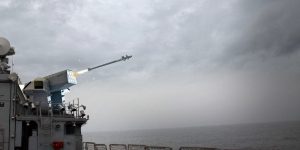
GÖKDENİZ CIWS Gives Turkish Warships a 35 mm Last Line of Defence

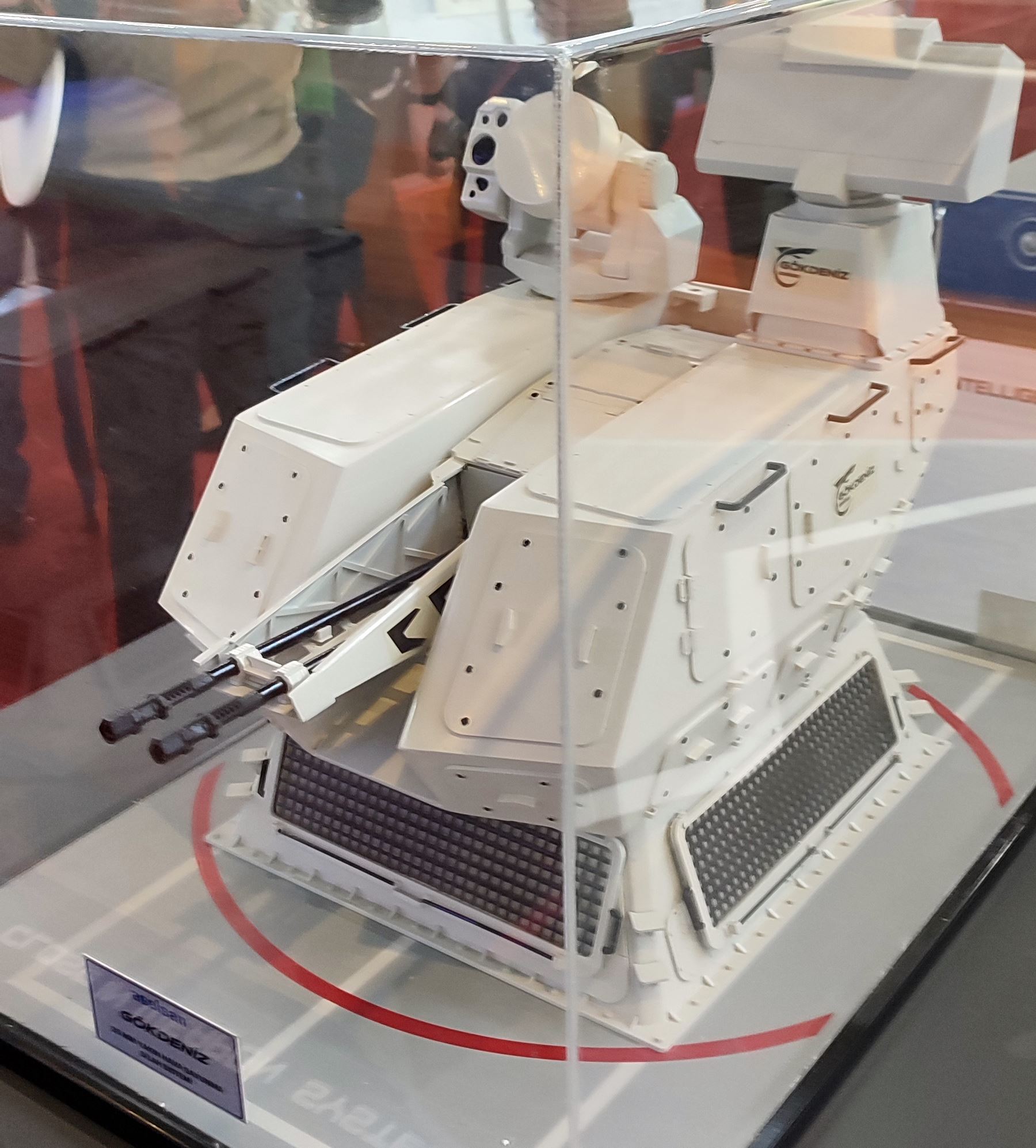
When an anti-ship missile gets past the decoys, the jammers and the area air defence missiles, a warship is left with whatever it can throw into the sky in a few seconds. On a growing number of Turkish-built ships, that last answer is ASELSAN’s GÖKDENİZ, a naval close-in weapon system (CIWS) that puts twin 35 mm cannon, its own radars and an electro-optical sensor on a single mount.
The gun is the sea-going cousin of the KORKUT land system, and it has already left Turkish yards on export hulls. Here is what is publicly known about it, and what still rests on company or secondary claims.
What Is GÖKDENİZ and Where Did It Come From?
GÖKDENİZ is a gun-based point-defence system developed by ASELSAN for surface ships. According to TurDef, the land version is the KORKUT air defence platform, while the marine version was first introduced as KORKUT-D and later renamed GÖKDENİZ. Janes reported on the system as a reveal at the IDEF 2019 exhibition.
The aim was a locally built last-ditch layer for ships that would otherwise depend on imported close-in guns. TurDef’s account says the main sub-components, including the 35 mm guns, the ATOM airburst ammunition, the radars, the electro-optical sensors, the motion control systems and the mission computers, were developed and produced domestically.
How Does the Gun System Work?
GÖKDENİZ packs the whole engagement chain into one installation. According to TurDef, the mount combines the 35 mm gun, a search radar, a tracking radar and electro-optical sensors on the same platform, so target detection, threat prioritisation, automatic tracking and engagement happen within a single system.
The cannon is a twin-barrel 35 mm Oerlikon-type design produced by the state-owned MKE. The combined rate of fire is 1,100 rounds per minute, and ASELSAN material cited in open references gives an effective range of around 4 km.
| Field | Detail |
|---|---|
| Developer and manufacturer | ASELSAN |
| Type | Gun-based naval close-in weapon system |
| Gun | Twin-barrel 35 mm, Oerlikon-type, produced by MKE |
| Rate of fire | 1,100 rounds per minute (combined) |
| Effective range | About 4 km, per ASELSAN material |
| Ammunition | 35×228 mm ATOM airburst and high-explosive incendiary rounds |
| Sensors | Search radar, tracking radar and electro-optical sensors on the mount |
| Ammunition feed | Automatic linkless feed that holds both round types |
| Land counterpart | KORKUT self-propelled air defence gun |
| Export customer | Turkmenistan (Turkmen-class corvette) |
The linkless feed lets the crew load airburst and high-explosive rounds at the same time and switch between them during an engagement. That matters because the same mount is meant to shoot at a missile one minute and a fast attack boat or drifting mine the next.
Why Does ATOM Airburst Ammunition Matter?
A 35 mm shell is small, and a sea-skimming missile is fast and narrow. Hitting it with a solid round takes an almost perfect firing solution. ASELSAN’s ATOM round sidesteps part of that problem.
ATOM is a programmable airburst shell. The fire control system takes muzzle velocity into account and sets the fuse so that the round detonates at a preset distance from the target, releasing a cloud of tungsten pellets. Any one pellet does little damage. Several hitting together can wreck wings, control surfaces and sensors, which is usually enough to make a missile or drone lose control. ASELSAN also states that the round resists electromagnetic jamming, a claim that has not been independently verified in public.
The same logic explains why the land-based relative has been in the news for counter-drone work. KORKUT’s signature round is the same ATOM, and our report on the KORKUT 35 live-fire demonstration shows how the concept is now being sold against small aerial targets.
What Threats Is It Built to Stop?
The primary job is defence against anti-ship missiles, along with drones and precision-guided munitions. ASELSAN’s material also lists conventional and rotary-wing aircraft, surface ships, small craft, coastal targets and floating mines. A gun mount cannot replace a missile battery, but it costs far less per shot than a guided interceptor and does not run out of rounds as quickly.
Turkish officials tested it against exactly that problem. In 2022, Presidency of Defence Industries head İsmail Demir announced on social media that GÖKDENİZ had destroyed a high-speed target in its last firing test from a ship, and said it would be ready for duty on the İstanbul frigate within the year. TurDef read his words as a test against subsonic anti-ship missiles, an interpretation rather than a confirmed detail.
Which Ships Carry GÖKDENİZ?
The first export customer was Turkmenistan. TurDef reports that Dearsan Shipyard built a ship for Turkmenistan and exported the CIWS with it, and open references say the system made its debut on the Turkmen-class corvette Deniz Han in 2021.
In Turkish service, the system is listed for the İstanbul-class (İstif-class) frigates, one mount per ship, and our overview of the MİLGEM I-class frigate programme covers the hull itself. Other vessels reported to carry or be planned for the system include:
- Pakistan Navy Babur-class corvettes, which are also MİLGEM derivatives;
- The Philippine Navy’s Miguel Malvar-class frigates, listed with a GÖKDENİZ variant;
- Ukraine’s Ada-class corvettes, including Hetman Ivan Mazepa, according to public references;
- Turkish Barbaros-class frigates under a mid-life upgrade that pairs one Phalanx with one GÖKDENİZ, as described in open sources.
Some of these entries rest on secondary references, and fit-out details can change between contract, launch and delivery. Treat the list as reported rather than confirmed by each navy.
What Is GÖKDENİZ-ER?
At IDEF 2021, Turkish companies also showed what Naval News described as indigenous replacements for the American RAM missile. One of them was GÖKDENİZ-ER, a missile-armed derivative. As reported then, it is designed to work independently of the ship’s own sensors, to carry 11 missiles, and to provide 360-degree coverage with an AESA radar and electro-optical sensors.
The same report described it as a rival to Roketsan’s LEVENT and as an alternative to SeaRAM Block 2, and said the choice of missile was still open. That is a development-stage picture from 2021. ASELSAN’s separate GÖKSUR 100-N point-defence missile has since moved toward production, as we covered in our GÖKSUR 100-N production report, but this article does not claim a formal link between that missile and GÖKDENİZ-ER.
How Does It Fit Into the Wider Air Defence Layers?
A close-in gun is the innermost ring. Outside it sit area air defence systems, the territory of larger ships such as the planned TF-2000 destroyer described in our TF-2000 programme piece. Between a long-range interceptor and a cannon there is usually a short-range missile in the RAM class, and GÖKDENİZ-ER is aimed at that inner band.
ASELSAN has also been showing naval remote weapon stations for the same ships, including the SMASH 300 gun covered in our report on its first firing tests. They are a different kind of weapon from a radar-directed CIWS, and they are not substitutes for each other.
For broader background on the maker, see the ASELSAN company profile. Public figures on GÖKDENİZ’s per-ship delivery counts, unit cost and live-fire statistics remain thin, and ASELSAN rarely discloses them. What is on the record is a domestically built gun, a matching airburst round and a growing list of hulls that carry it.