Inside GÖKBORA: Türkiye’s Ramjet-Powered Air-to-Air Missile

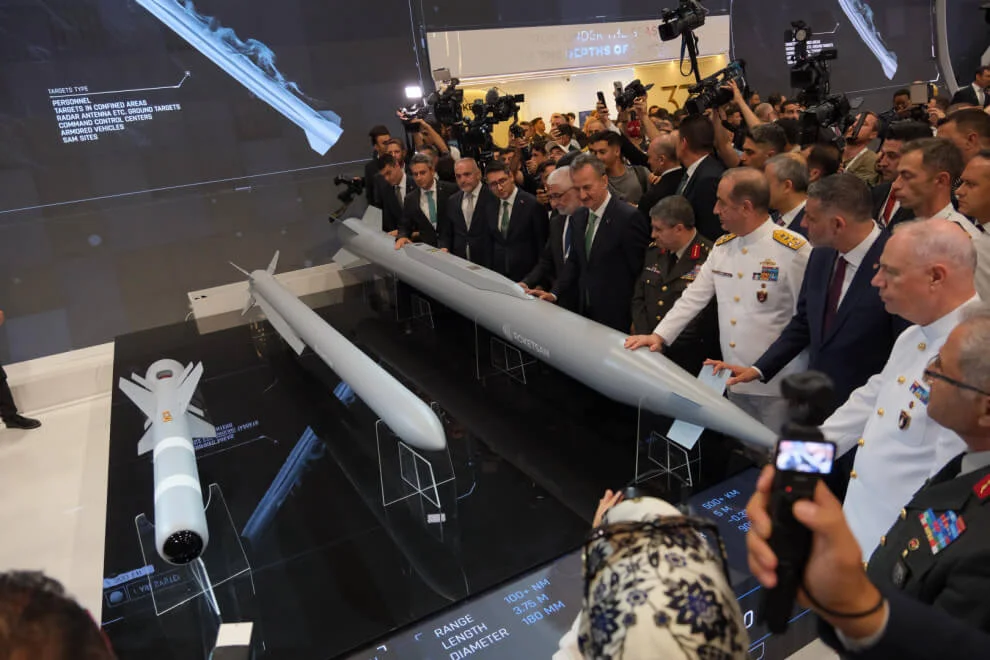
ROKETSAN General Manager Murat İkinci has again described GÖKBORA, the company’s ramjet-powered beyond-visual-range air-to-air missile, as the weapon that will give Türkiye its longest-range air-to-air shot — and the one meant to arm the KAAN fighter and Bayraktar KIZILELMA combat drone from inside their internal weapons bays. The renewed comments, reported this week by Turkish defence outlets, restate a programme that Roketsan has been building in public view for more than a year, and they come as KAAN’s own flight-test campaign edges closer to resuming.
GÖKBORA is not a new announcement. Roketsan unveiled it at IDEF 2025 in Istanbul in July 2025, alongside five other new systems, including the TAYFUN BLOK-4 ballistic missile. What has changed since then is the missile’s status: İkinci said in December 2025 that work on the missile’s solid-fuel ramjet motor had been completed, and in February 2026 he put the programme roughly two years from readiness, with a possible six-month slip. Neither Roketsan nor the Presidency of Defence Industries (SSB) has published a firing-test date.
What GÖKBORA Is
GÖKBORA is a beyond-visual-range air-to-air missile 3.75 metres long and 180 mm in diameter, with a publicly stated range in excess of 100 nautical miles — about 185 km, according to specifications Roketsan displayed on the missile’s unveiling panel at IDEF 2025. It is propelled by a solid-fuel ramjet, which Roketsan says is the first missile of its kind developed in Türkiye; a ramjet draws in air for combustion through the flight, so it keeps generating thrust in the missile’s cruise phase instead of coasting on momentum the way a conventional rocket motor does once its propellant burns out. That matters for a BVR missile because it preserves the kinetic energy an interceptor needs to run down a manoeuvring target at long range — the same operating principle behind the European MBDA Meteor, which several Turkish outlets have used as GÖKBORA’s benchmark.
Guidance is a two-stage design: inertial navigation with a datalink carries the missile through its midcourse flight, then an active electronically scanned array (AESA) radar seeker — reported under the designation AGRAS 3101/AA and developed jointly by ASELSAN and Roketsan under a contract signed alongside the IDEF 2025 unveiling — takes over for terminal guidance. That seeker effort sits alongside Türkiye’s wider push into domestically built AESA radar technology, and reports say ASELSAN and Roketsan are also working to integrate GÖKBORA with ASELSAN’s MURAD AESA radar family.
Built for the Internal Bay
The missile’s defining design constraint is that it has to fit inside an aircraft that is not supposed to be seen. KAAN and KIZILELMA are both designed around internal weapons bays to keep their radar signature low, and carrying a long missile externally on pylons defeats that purpose. İkinci has said GÖKBORA was shaped specifically to launch from those internal stations on both platforms. Beyond the two flagship programmes, Turkish reporting lists ANKA and Akıncı as intended carrier platforms, and names the Eurofighter Typhoon and TUSAŞ’s ANKA-III as integration targets further out. A folding-fin version intended for the F-16 has a qualification target of March 2031, according to a Ministry of National Defence planning document — a reminder that GÖKBORA’s rollout is expected to run across the rest of the decade, not arrive in one block.
That internal-carriage requirement is also why GÖKBORA matters commercially as much as technically. A fifth-generation fighter with no long-range missile that fits inside it is a stealth aircraft that has to break cover to fight at range. For the KAAN programme, whose export prospects rest partly on offering customers a complete, non-Western weapons package, a domestically produced, internally carried BVR missile closes a gap that foreign-sourced munitions — subject to the end-user and re-export restrictions that already complicate Turkish access to US-made AIM-120 AMRAAMs — cannot close as cleanly.
A Parallel, Rival Programme
GÖKBORA is not Türkiye’s only ramjet air-to-air missile. TÜBİTAK SAGE, the state research institute that also designed the SOM cruise missile family, has been developing GÖKHAN since 2021 under a separate national ramjet programme, and unveiled it alongside GÖKBORA at IDEF 2025. The two missiles share a mission but not a design: GÖKHAN uses a liquid-fuel ramjet rather than GÖKBORA’s solid-fuel motor, and its publicly released imagery shows a design without GÖKBORA’s folding rear fins, meaning it is being developed primarily for KAAN’s internal bay and F-16 external stations rather than Roketsan’s broader cross-platform plan. SSB has indicated it intends to run comparison trials once both missiles reach prototype maturity before settling on a production choice — so Türkiye may end up fielding one of two indigenous answers to the Meteor, or conceivably both, depending on how the competition plays out. Türkiye already fields shorter-range domestically built air-to-air weapons — Bozdoğan and Gökdoğan, Roketsan’s short- and medium-range missiles already in limited service — but neither approaches GÖKBORA’s claimed reach, and neither uses ramjet propulsion.
Why It Matters Beyond Türkiye
Long-range air-to-air missiles sit in a small club. Europe’s Meteor, the United States’ AIM-120D, China’s PL-15 and Russia’s R-37M currently define the BVR missile market that most NATO and non-aligned air forces draw from, and access to that club is tightly controlled by export licensing, not just engineering. A Turkish ramjet missile that reaches comparable range and fits inside a stealth aircraft’s bay would let Ankara offer KAAN customers a weapon loadout that does not depend on a third country’s export approval — a selling point Gulf and Southeast Asian buyers already weigh when they choose Turkish platforms over Western alternatives that come with stricter end-use conditions. It would also reduce the Turkish Air Force’s own reliance on AMRAAM stocks, a dependency that has mattered to Ankara’s planning since Washington’s periodic use of arms sales as diplomatic leverage.
None of that is confirmed yet. GÖKBORA has not flown, Roketsan has not disclosed a firing-test date, and İkinci’s own February 2026 estimate — roughly two years to readiness, with a possible six-month slip — points to a missile that will not be combat-ready before 2028 at the earliest, running in parallel with KAAN’s own slipping flight-test schedule. What is confirmed is that Roketsan has completed motor development, signed a seeker-development contract with ASELSAN, and is treating the missile as a cornerstone of how it plans to arm Türkiye’s next generation of combat aircraft.
Sources
- Roketsan, “ROKETSAN Made a Powerful Impact at IDEF 2025 with the Debut of Cutting-Edge Defense Systems,” 25 July 2025
- Anadolu Agency, via Haberler.com, interview with Murat İkinci at IDEF 2025, 26 July 2025
- Haberler.com, “ROKETSAN Genel Müdürü İkinci: GÖKBORA füzesinin motor çalışmaları nihayete ulaştı,” 4 December 2025
- Army Recognition, “IDEF 2025 — Roketsan Expands Türkiye’s Stealth Fighter Lethality With First Ramjet Air-to-Air Missile Gökbora”
- EDR Magazine, “IDEF 2025 — Gökbora versus Gökhan, the Turkish Ramjet Powered BVR Air-to-Air Missiles Duel”
- SSBülten, “Roketsan Says Gokbora Will Be Turkiye’s Longest-Range Air-to-Air Missile for Kaan Fighter Jet,” 28 October 2026