Turkish 8×8s vs Boxer and Patria AMV: Market Position


Turkish 8×8 armoured vehicles sit well below the Boxer and the Patria AMV on every measure of fleet scale, and the gap is not about armour or firepower. Otokar’s ARMA 8×8 and FNSS’s PARS family are credible, well-equipped platforms, but almost the entire Turkish-designed 8×8 population outside Türkiye comes from two licence-production programmes signed more than a decade ago — 257 vehicles in Malaysia and a first tranche reported at 400 in the United Arab Emirates. Boxer has passed 2,100 vehicles on order; the AMV family has more than 1,300 contracted. The 8×8 is the one land-systems segment where Türkiye’s export machine has not yet broken through, and the reason is structural.
DefenceTürkiye Data Box
Segment: Wheeled 8×8 armoured combat vehicles
Turkish platforms: Otokar ARMA 8×8 / ARMA II; FNSS PARS III, PARS IV and PARS ALPHA; BMC ALTUĞ
Main global competitors: Boxer (ARTEC), Patria AMV / AMVXP, VBCI (KNDS France), Piranha V (GDELS), Stryker (General Dynamics)
Documented foreign fleets of Turkish-designed 8×8s: Malaysia (257 AV-8 Gempita), UAE (Rabdan, first tranche reported at 400), Oman (PARS III, reported at 172 across 8×8 and 6×6)
Home programme status: Turkish Land Forces New Generation Armoured Vehicle order placed with FNSS for PARS ALPHA, initial batch reported at 25 vehicles
Export status: Offered openly; no publicly confirmed European 8×8 order to date
What counts as a Turkish 8×8
Three Turkish manufacturers field vehicles in this class. Otokar’s ARMA began as a modular 6×6 and 8×8 family and has since been updated as the ARMA II, shown with the company’s MIZRAK turret. FNSS offers the PARS line, which runs from the PARS III through to the current PARS ALPHA in both 6×6 and 8×8 form. BMC’s ALTUĞ is the newest entrant, generally shown with a 35 mm turret.
These are not light vehicles dressed up for a category they do not fit. A modern 8×8 of this type sits in the 25 to 35 tonne band, carries a crew plus a dismounted section, and is expected to accept anything from a remote weapon station to a 30 mm or 35 mm turret with anti-tank missiles. On that specification the Turkish entries are competitive. Envanter Medya maintains a detailed Turkish-language technical profile of the PARS ALPHA-based 8×8 New Generation Vehicle and its place in Turkish Land Forces planning for readers who want the subsystem-level detail.
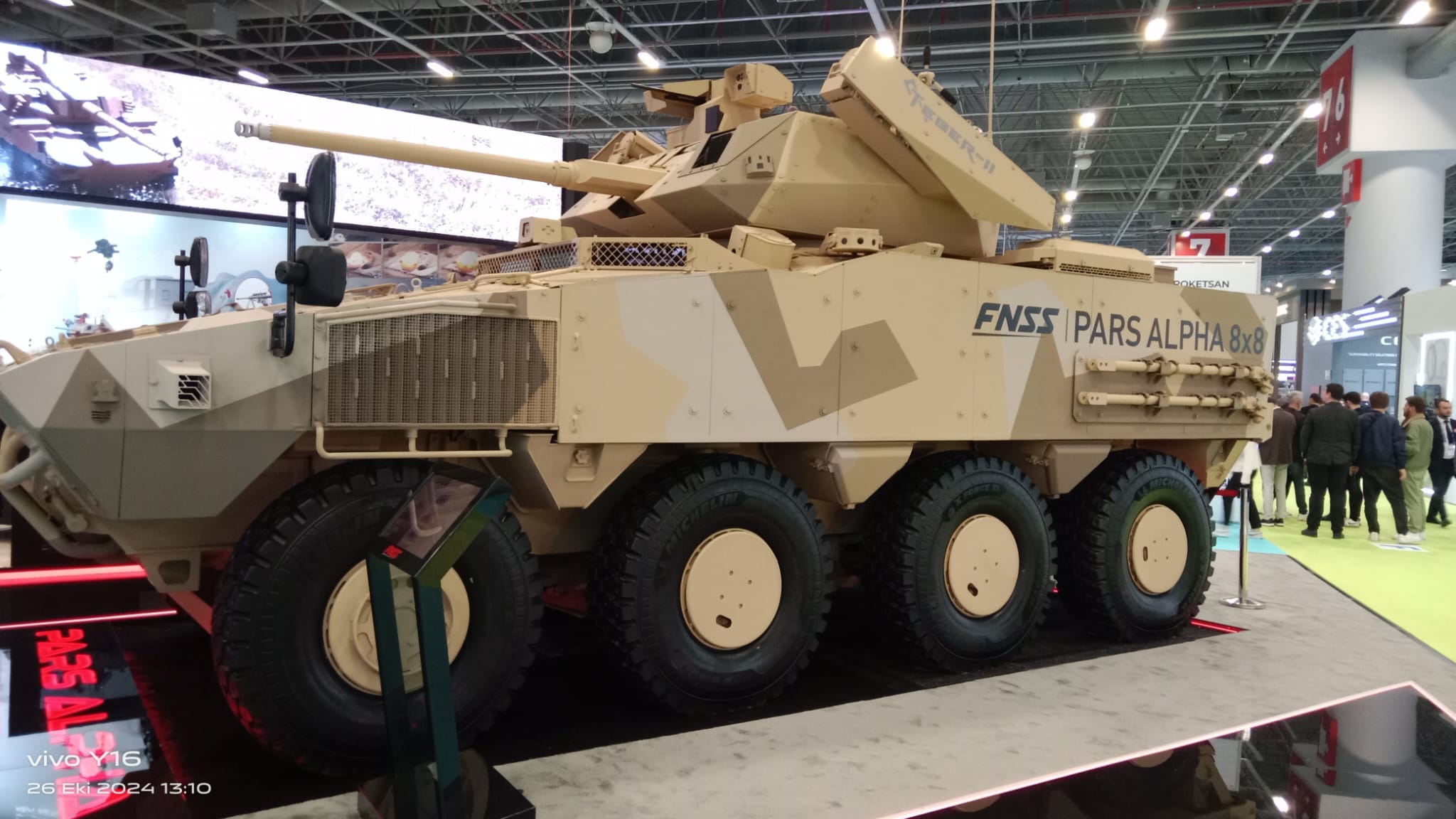
Where the Turkish platforms differ from their competitors is not in the vehicle. It is in how the vehicle reaches a foreign army.
The market they are trying to enter
The wheeled 8×8 is the most contested segment in land systems, because it is what most European and Commonwealth armies are buying instead of tracked infantry fighting vehicles. Two programmes dominate it.
Boxer is built by ARTEC, a joint venture of Rheinmetall and KNDS Deutschland, and — this is the part that matters commercially — most of its sales are managed through OCCAR, the European joint armaments organisation. The United Kingdom signed a £2.8 billion contract through OCCAR in November 2019 for an initial 523 vehicles, a fleet since grown to 623. The Netherlands ordered 200. Lithuania ordered a batch variously reported at 88 and 91 vehicles for about €385.6 million. Australia took 211 in the Combat Reconnaissance Vehicle role. Germany is reported to be preparing a far larger framework order expected to be concluded in December 2026.
Patria’s AMV took the other route. Finland’s Patria sold the design into a licence network rather than shipping vehicles: Rosomak S.A. in Poland, Japan Steel Works, Denel in South Africa as the Badger, and Đuro Đaković in Croatia. Poland alone fields the largest AMV fleet in the world. In December 2025 Patria and Rosomak extended that licence arrangement to 2034.
That second model should sound familiar, because it is the one Turkish industry is usually praised for inventing.
| Platform | Prime | Route to the customer | Documented foreign fleet scale | What the buyer is really buying |
|---|---|---|---|---|
| Boxer | ARTEC (Rheinmetall / KNDS Deutschland) | Multinational programme managed through OCCAR | More than 2,100 ordered across all versions | Shared development cost, a mission-module architecture and membership of a club that keeps growing |
| Patria AMV / AMVXP | Patria (Finland) | Licence production by the customer’s own industry | More than 1,300 contracted; licensees in Poland, Japan, South Africa and Croatia | A national production line and a licence now extended to 2034 |
| FNSS PARS | FNSS (Türkiye) | Licence co-production and technology transfer | 257 AV-8 Gempita in Malaysia; Oman order reported at 172 across 8×8 and 6×6 | A local assembly line, as Malaysia’s DEFTECH built at Pekan |
| Otokar ARMA 8×8 | Otokar (Türkiye) | Joint venture manufacture in the customer country | UAE Rabdan, first tranche reported at 400, built by Al Jasoor | A locally owned company rather than a licence — Tawazun holds the majority stake |
Compiled by DefenceTürkiye from manufacturer statements, contract reporting and customer announcements. Fleet figures are orders or contracts, not confirmed deliveries, and the Omani and Emirati totals are press-reported rather than officially disclosed.
Türkiye’s 8×8 export record is two deals, both old, both local build
Strip out the demonstrators and the offers, and the documented record comes down to two programmes.
Malaysia. In February 2011 the Malaysian government contracted DEFTECH to design, develop and manufacture 257 AV-8 Gempita vehicles in twelve configurations, derived from the PARS 8×8. FNSS signed a letter of offer and acceptance reported at USD 559 million covering the development work and technology transfer; sources differ on whether that signature fell in February or June of that year. DEFTECH was the principal assembler, building the vehicles at Pekan with FNSS providing technology transfer. Deliveries began in December 2014 and the full 257 are recorded as in service.
The United Arab Emirates. The Rabdan 8×8 is based on Otokar’s ARMA 8×8 and is produced by Al Jasoor, a joint venture in which Tawazun holds the majority stake alongside Otokar’s Emirati entity, at the Tawazun Industrial Park in Abu Dhabi. Reported contract values diverge sharply depending on the outlet — figures from roughly USD 544 million to USD 661 million and €625 million have all appeared — and the first tranche is generally reported at 400 vehicles. None of these figures has been confirmed by an official Emirati disclosure.
Both deals are more than a decade old. Both are structured so that the vehicle is built by the customer’s industry, not shipped from Sakarya or Ankara. And in neither case was the deciding factor a direct, off-the-shelf export sale of the kind that made the Bayraktar TB2 famous.
Why It Matters
For a foreign procurement office, the 8×8 segment is the clearest test of whether Turkish industry can compete at the top of the land-systems market rather than underneath it. Türkiye has won large wheeled-vehicle orders in Europe, but they are 4×4 and 6×6 fleets. The 8×8 is where the established primes are strongest, where unit prices are highest, and where the procurement structure — not the datasheet — decides the outcome.
Türkiye’s European breakthroughs are 4×4 and 6×6, not 8×8
This is the detail that most coverage of Turkish armoured vehicle exports glides past. The two European orders that genuinely changed the market’s read on Turkish industry were not 8×8 contracts.
Estonia signed in October 2023 for roughly 230 wheeled armoured vehicles worth about €200 million in total, splitting the work between Otokar’s ARMA 6×6 and Nurol Makina’s NMS 4×4. Otokar’s share was reported at about €130 million. Deliveries ran from late 2024 through 2025.
Romania’s much larger order — 1,059 Otokar COBRA II vehicles contracted in November 2024, with a substantial share to be built at Automecanica Medias — is a 4×4 programme. We set out how that deal was structured in our analysis of Türkiye’s defence relationship with Romania, and the wider pattern in Turkish defence exports to Europe.
So the honest summary is this: Türkiye has become a serious supplier of protected mobility to European armies at the lighter end, and has not yet converted that into an 8×8 order from any of them. The full operator picture is set out in our guide to which countries operate Turkish armoured vehicles.
The local-production argument does not work as well here
The standard explanation for Turkish export success is that Türkiye offers what Western primes resist: local assembly, technology transfer and a national production line. That argument is well evidenced across the 4×4 and 6×6 classes, and we have examined it at length in why countries buy Turkish armoured vehicles.
In the 8×8 segment it is much weaker, for a simple reason. Patria has been doing exactly the same thing for longer and at greater scale. Poland’s Rosomak line has been running since the early 2000s and the licence has now been extended to 2034. South Africa, Croatia and Japan all build or have built AMVs under licence. A ministry evaluating an 8×8 and asking “who will let us build it ourselves?” does not have to come to Ankara to get a yes.
Boxer answers the same question differently but just as effectively. Because it is run through OCCAR, joining the Boxer programme means joining a cost-sharing structure with guaranteed industrial workshare and a growing pool of operators to share support and upgrades with. That is a form of industrial participation a bilateral Turkish offer cannot replicate.
Fleet scale in the 8×8 segment
DefenceTürkiye chart. Figures are orders or contracts rather than confirmed deliveries and are not directly equivalent: the Boxer and AMV totals are programme-wide, while the Turkish figure combines Malaysia’s 257, the Emirati tranche reported at 400 and the Omani order reported at 172 across 8×8 and 6×6 configurations.
What changes the picture: a home fleet
There is one development that genuinely alters the outlook, and it is domestic rather than foreign.
The ARMA 8×8 has never had a large Turkish Army order behind it. That is unusual for a Turkish export success. The Bayraktar TB2, the Kirpi and the COBRA II all reached foreign customers after years of visible service at home, which is what gave buyers a combat record, a support ecosystem and a production line already running at volume.
The PARS ALPHA is the first Turkish 8×8 on track to get that. Under the Turkish Land Forces New Generation Armoured Vehicle requirement, the Presidency of Defence Industries placed an order with FNSS — reported in February 2025 at an initial 25 vehicles, covering PARS ALPHA 8×8 anti-armour and armoured recovery variants together with 6×6 command post vehicles. Reporting on the programme has pointed to a far larger eventual requirement, with figures above 2,000 vehicles discussed; that larger number is a stated ambition for the programme, not a contracted quantity, and should be read as such.
If even a fraction of it is funded, the export arithmetic changes. A Turkish 8×8 in meaningful domestic service would have the one thing ARMA never had when it was competing against Boxer: a reference fleet.
FNSS has also moved into Europe structurally. In June 2026 the company signed a framework agreement with CSG Defence at Eurosatory to establish Danube Defence Systems, headquartered in Trenčín, Slovakia. It is worth being precise about what that covers: the announced focus is the KARPAT medium tank, a tracked vehicle, with the parties indicating the cooperation could later extend to other armoured systems. It is not, on the public record, an 8×8 production arrangement.
Buyer View
Price. No Turkish 8×8 unit price is officially published. Independent estimates put a Boxer APC in the €4–5 million band and an IFV variant higher; Turkish vehicles are generally understood to sit below that, but a buyer should treat any specific Turkish figure circulating publicly as unverified.
Delivery. Turkish industry’s advantage on lead times is real and documented in our analysis of Turkish defence delivery times. In the 8×8 class specifically that advantage is less proven, because there is no recent large-volume 8×8 line running at rate.
Local production. Available and genuinely offered, with Malaysia and the UAE as worked precedents — but not a Turkish monopoly in this segment.
Interoperability. Türkiye is a NATO member and its vehicles are fielded by NATO states, as set out in our guide to NATO members operating Turkish defence systems. For EU-funded procurement, eligibility rules remain a separate and significant obstacle.
The limitations, stated plainly
Several things in this picture are weaker than Turkish industry’s public presentation of them.
The foreign fleet figures for Turkish 8×8s rest partly on press reporting rather than official disclosure. The Emirati tranche of 400 and the Omani figure of 172 are both widely reported and neither is confirmed by a customer government. Contract values for the Rabdan programme differ by more than USD 100 million across reputable outlets, which usually signals different scopes or currencies being compared rather than one correct number.
Several claimed ARMA 8×8 customers cannot be verified at all. A reported Kazakh order has never been officially confirmed, and Otokar’s substantial African and undisclosed-buyer export contracts do not identify either the customer or the vehicle split, so they cannot responsibly be counted as 8×8 sales.
On the other side, the comparison figures carry their own caveats. The Boxer and AMV totals are programme-wide orders across many variants and many years, and per-country AMV fleet numbers in open sources come largely from aggregators rather than defence ministries.
What comes next
Three things are worth watching. The first is whether the Turkish Land Forces NGAV programme converts its initial batch into a funded series order, because that is what would give a Turkish 8×8 a reference fleet. The second is whether the FNSS–CSG venture in Slovakia broadens beyond KARPAT into wheeled platforms, which would give Turkish industry a European industrial base in the segment. The third is Germany’s large framework order, expected to be concluded around the end of 2026 — not because Türkiye is competing for it, but because it will set the scale a challenger has to live with for the next decade.
FAQ
What are Türkiye’s 8×8 armoured vehicles?
The main Turkish 8×8 platforms are Otokar’s ARMA 8×8 and ARMA II, FNSS’s PARS family including the current PARS ALPHA, and BMC’s ALTUĞ. All are modular wheeled combat vehicles able to carry turrets up to 35 mm.
Which countries operate Turkish 8×8 armoured vehicles?
Malaysia operates 257 AV-8 Gempita vehicles derived from the FNSS PARS 8×8. The United Arab Emirates operates the Rabdan, based on the Otokar ARMA 8×8, with a first tranche reported at 400. Oman has been reported to operate PARS III vehicles across 8×8 and 6×6 configurations. Türkiye itself has begun inducting the PARS ALPHA.
How does the Otokar ARMA 8×8 compare with the Boxer?
They overlap in role but differ in market position. Boxer is a multinational programme with more than 2,100 vehicles ordered, a modular mission-pod architecture and procurement managed through OCCAR. The ARMA is a single-company product with a smaller installed base, offered with local production. A buyer is choosing between a large established ecosystem and a more flexible bilateral arrangement.
Is the PARS ALPHA in service with the Turkish army?
An order was placed under the Turkish Land Forces New Generation Armoured Vehicle requirement, reported in February 2025 as an initial batch of 25 vehicles across 8×8 and 6×6 variants. A much larger eventual requirement has been discussed publicly but is not a contracted quantity.
Why has Türkiye not sold an 8×8 to a European country?
Its European wins have been in lighter classes — ARMA 6×6 and NMS 4×4 for Estonia, COBRA II 4×4 for Romania. In the 8×8 class the incumbents already offer what Türkiye’s pitch is built on: Patria licenses local production, and Boxer offers workshare through a multinational programme structure.
Are Turkish 8×8s cheaper than Boxer or Patria AMV?
Probably, but no Turkish 8×8 unit price is officially published, so any direct comparison is an estimate. Published Boxer unit-cost estimates run from roughly €4 million for an APC configuration upwards.
What is the Rabdan 8×8?
An Emirati 8×8 infantry fighting vehicle based on the Otokar ARMA 8×8, produced by Al Jasoor, a joint venture majority-held by Tawazun, at the Tawazun Industrial Park in Abu Dhabi.
Sources
- FNSS Defence Systems — corporate statements on the CSG Defence framework agreement and Danube Defence Systems, June 2026
- Nurol Makina — NMS 4×4 and Otokar ARMA 6×6 delivered to the Estonian Armed Forces
- Breaking Defense — Estonia looks to Turkish firms for $211M armored vehicle buy
- Defense News — Turkish Otokar wins deal with UAE to build amphibious armored vehicles
- Army Technology — DefTech AV8 multi-role wheeled armoured vehicle programme
- Shephard Media — FNSS wins Turkish vehicle order, on the PARS ALPHA order and the programme’s stated scale
- TurDef — reporting of 24 February 2025 on the SSB award to FNSS for PARS ALPHA 8×8 and 6×6 vehicles
- Armada International / EDR Magazine — Patria and Rosomak S.A. agreement extending the 8×8 manufacturing licence to 2034
- Shephard Media — reporting on Boxer order growth and the OCCAR-managed contract structure
- Envanter Medya — Turkish-language technical profile of the PARS ALPHA-based 8×8 New Generation Vehicle and its companion page on the 35 mm turreted 8×8 configuration