Roketsan’s Azerbaijani Venture AZROKSAN Nears Production of 122mm Rockets

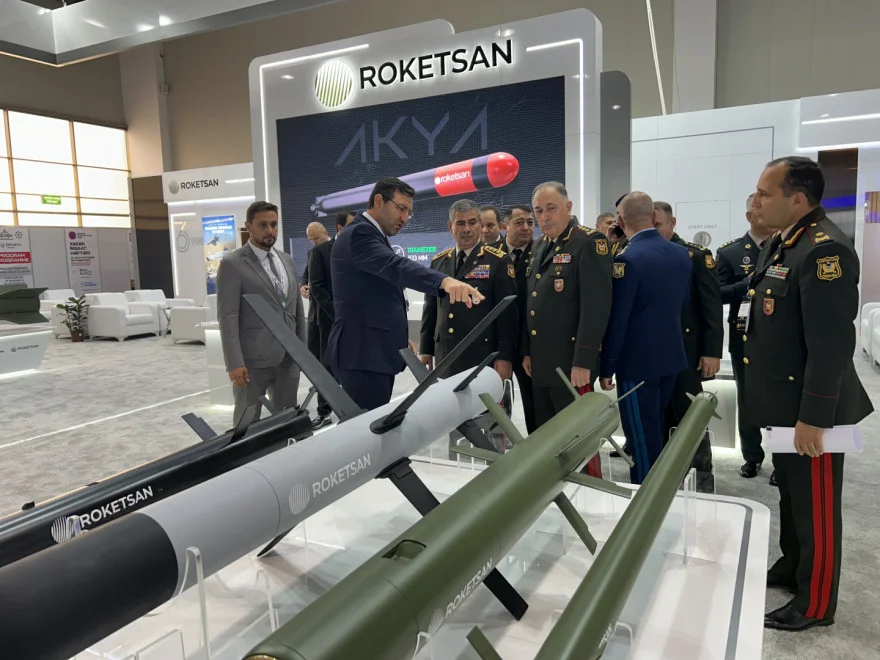
AZROKSAN, the Azerbaijani rocket-production joint venture between Roketsan and Azerbaijani state defence firm STP, says it will begin manufacturing as soon as its new production facility is complete, with a 122mm artillery rocket as its first product off the line. Roketsan General Manager Murat İkinci confirmed the plan on the sidelines of ADEX 2026 in Baku, the same week Roketsan separately signed its first export contract for the BARBAROS coastal defence system with Azerbaijan’s Ministry of Defence Industry.
“AZROKSAN will begin production as soon as the facility establishment process is completed, with 122mm rockets to be the first product manufactured,” İkinci said, adding that Roketsan intends to “expand the range of products supplied to the Azerbaijani Armed Forces in the future.” Neither Roketsan nor AZROKSAN has given a completion date for the facility or a target production rate.
From a 2024 Agreement to a Production Line
AZROKSAN was established through a joint production agreement Roketsan and STP signed at ADEX 2024, under which the venture was tasked with the production and design of the T-122 Sakarya rocket family and the TEBER laser-and-GPS guidance kit used to convert unguided rockets and bombs into precision weapons. The 122mm rocket now set to be AZROKSAN’s first product is the unguided baseline round in that family — the TR-122 and TRB-122 variants Roketsan has built for the Turkish Army since serial production began in 1997, with a range of up to roughly 40 km depending on variant.
The gap between the 2024 agreement and this week’s production announcement reflects how long localisation projects typically take to move from signed paperwork to an operating line: site selection, facility construction, equipment installation and workforce training all sit between a joint-venture agreement and a rocket actually leaving a Azerbaijani-built production line. ADEX 2026 appears to mark the point at which that groundwork is largely finished.
Guided Rockets to Follow
Beyond the unguided 122mm round, AZROKSAN’s mandate extends to the TEBER guidance kit family, which Roketsan and Azerbaijani partners have already integrated onto Azerbaijani Air Force Su-25 ground-attack aircraft under the LAÇIN Merhale-1 modernisation programme carried out with Turkish Aerospace. Local assembly of TEBER kits in Azerbaijan would let Baku arm existing unguided stockpiles with precision seekers domestically rather than importing complete guided rounds, a lower-cost route to a precision-strike capability that several Turkish customers have pursued in parallel with new-build purchases.
Reading the Localisation Trend
AZROKSAN is one of two Turkish localisation projects announced in Azerbaijan around ADEX 2026’s opening days — the other being a preliminary agreement between ASELSAN and Azerbaijani firm NOVASIS to build laser guidance kits, TOLUN munitions and KORKUT air defence components in Nakhchivan. Taken together with Roketsan’s new BARBAROS export contract and Turkish Aerospace’s agreement to deliver 14 HÜRKUŞ-II trainers, the week’s announcements — part of a package Türkiye’s Presidency of Defence Industries valued at more than $500 million and which DefenceTürkiye reported when they were signed — illustrate a shift SSB chief Haluk Görgün has described publicly: Turkish-Azerbaijani defence trade moving from straightforward arms sales toward joint manufacturing on Azerbaijani soil.
For Roketsan, a working AZROKSAN line would be a second active rocket-manufacturing footprint outside Türkiye, following export and licensing arrangements the company has pursued in other markets, and a template it has signalled interest in replicating with other products as the Baku relationship deepens. For Azerbaijan, domestic 122mm production would reduce reliance on imported artillery rockets for a weapon type its forces have used heavily, including in the 2020 Nagorno-Karabakh war and in Ukraine’s use of the same Soviet-calibre family.