How the Ejder Yalçın Won Customers From Qatar to Hungary

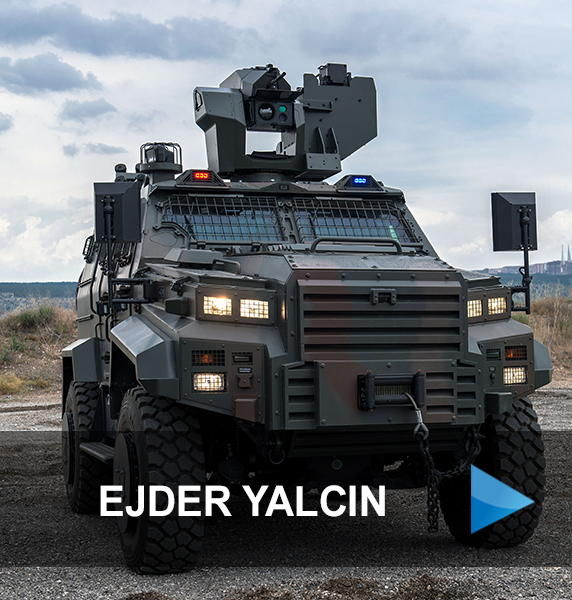
Few Turkish land vehicles have travelled as far as the Ejder Yalçın. The 14-tonne 4×4 from Nurol Makina has been ordered by buyers in North and West Africa, the Gulf, Central Asia, Southeast Asia and Central Europe, and it was the vehicle that first put the company on the export map. It also began as a fairly modest idea: a lighter, cheaper sibling to a six-wheeled armoured carrier that had already found a customer in Georgia.
What Is the Ejder Yalçın?
The Ejder Yalçın is a 4×4 tactical wheeled armoured vehicle built by Nurol Makina, the Ankara-based defence arm of Nurol Holding. It is a troop carrier first, designed around a V-shaped hull, floating floor plates and blast-attenuating seats to blunt mine and IED blasts. Reference data lists protection to STANAG 4569 Level 4 through a welded steel body, and the vehicle carries up to 11 people, including crew.
| Field | Detail |
|---|---|
| Manufacturer | Nurol Makina (Türkiye) |
| Type | 4×4 tactical wheeled armoured vehicle |
| Mass | About 14 tonnes |
| Dimensions | About 5.4 m long, 2.5 m wide, 2.3 m high |
| Crew and passengers | 2 + 9 |
| Payload | About 4 tonnes |
| Engine | Cummins diesel, about 375 hp (reported) |
| Top speed and range | About 120 km/h, about 700 km (reported) |
| Protection | STANAG 4569 Level 4 |
| Weapons | 7.62 mm or 12.7 mm machine gun, 40 mm grenade launcher or 25 mm gun on a remote station (options) |
| Series production | From May 2014 (reported) |
Figures such as speed, range and engine output come from compilations of manufacturer data, so treat them as nominal. Real performance depends on the armour package and weapon station fitted.
Where Did the Design Come From?
The story starts with the larger Ejder 6×6. Nurol began that project in 2006 with its own money, completed a prototype in the second half of 2007 and landed Georgia as its first customer, with an order reported at 72 armoured personnel carriers delivered by 2009. Tunisia later became a user of the 6×6 as well.
The 4×4 followed years later. According to reference compilations, design studies began in the last quarter of 2012, and a pre-prototype was shown at the IDEF fair in Istanbul in 2013. Series production is reported to have started in May 2014. The idea was straightforward. Many armies and police forces wanted mine-resistant protection but could not afford, or did not need, an 18-tonne six-wheeler. A 4×4 is also easier to ship, easier to maintain and more manoeuvrable in towns and narrow roads.
Before any foreign sale, Turkish domestic users took the first vehicles. Quwa reported in 2017 that Nurol had sold around 250 units to the armed forces and police for internal security and counterinsurgency work. Reference lists now credit the Turkish Land Forces, the Gendarmerie and the General Directorate of Security with several hundred vehicles in total, though the exact split varies by source.
How Did It Win Its First Export Customers?
The first export contract came in March 2017. Nurol announced that an undisclosed North African ministry of defence had ordered the Ejder Yalçın, with an integrated logistics package. Engin Aykol, then Nurol Makina’s general manager, called it the first export agreement for the vehicle. Reference lists show Tunisia as the first overseas operator, with about 71 vehicles credited to its army, a figure that has not been confirmed in a single official statement.
The second big win came a few months later. In October 2017, Nurol and Uzbekistan’s UzAuto signed a memorandum to co-produce 1,000 Ejder Yalçın vehicles. Quwa reported that 24 finished vehicles were included and that UzAuto would gain rights to re-export to third countries. The same report said Nurol beat Russian and Chinese rivals on price. Uzbekistan became the second foreign user, and the first with a local-production angle.
Then came Qatar. At DIMDEX in March 2018, Nurol announced a contract for 342 Ejder Yalçın vehicles with SARP-DUAL remote-controlled weapon stations, alongside 214 NMS 4×4 vehicles with Igla and anti-tank missile launchers. A repeat order for Joint Special Forces vehicles was routed through Barzan Holding, with deliveries planned in two batches in 2021 and 2022. Delivered numbers for Qatar have not been published.
Who Operates It Today?
The customer list is unusually broad for a vehicle that is not yet a decade and a half old. Open-source compilations, mainly Wikipedia’s operator table, credit the following, and the figures should be read as reported rather than audited.
- Türkiye: Land Forces, Gendarmerie and the security directorate, with several hundred in total.
- Qatar: 342 ordered for the Emiri Land Force.
- Uzbekistan: 24 in service and a 1,000-vehicle co-production framework.
- Tunisia: about 71 reported.
- Morocco: about 30 reported.
- Senegal: 25 for the National Gendarmerie, bought in 2018. Turkish media at the time reported that the Senegalese president’s motorcade used the vehicles.
- Chad: 20 or more, some with its UN contingent in Mali.
- Malaysia: 20 delivered as the Panthera 4×4 and deployed with its UNIFIL contingent in Lebanon.
- Niger: ordered in 2022. Niger’s presidency said in March 2022 that its president had inspected Ejder Yalçın vehicles with Aselsan Serdar weapon stations at Nurol’s plant near Ankara.
- Burkina Faso and Tanzania: listed as users, without confirmed numbers.
- Hungary: the Gidran variant, covered below.
The UN angle matters. Armoured vehicles that serve in peacekeeping missions in Mali or Lebanon get seen by officers from dozens of other armies, which makes them a low-cost demonstration. Several Sahel and Gulf orders appear to have followed that kind of exposure, though no buyer has said so publicly.
Why Did Hungary Pick a Turkish 4×4?
Hungary is the most notable NATO and EU customer. In December 2020 its defence ministry said that under the Zrínyi 2026 modernisation programme it would buy 300 4×4 armoured multi-purpose vehicles from Nurol. The Hungarian version is called Gidran. Two batches of 50 are reported to have arrived, from orders placed in 2020 and 2022. Calibre Defence reported in February 2025 that Hungary had ordered another 56 under a 2024 contract, taking the total to 106.
The industrial side is as important as the vehicles. In October 2023 Nurol Makina, its Hungarian entity, the state-linked N7 holding and the truck and axle maker Rába signed a memorandum on producing Gidran vehicles at Rába’s Győr facility. Reports put the framework at up to 600 4×4 vehicles including the Ejder Yalçın-based Gidran and Nurol’s NMS family, with more than 200 direct jobs. Nurol’s Emre Akın said the company would transfer as much production to Győr as possible in coming years.
That is the model Turkish builders now push everywhere: sell the first batch finished, then move assembly and components to the buyer. It is the same logic described in our look at Turkish defence factories abroad.
What About Malaysia, Uzbekistan and Local Production?
Malaysia followed a similar path. After the 20 Panthera vehicles went to Lebanon, Nurol Makina and Nadicorp Holdings signed a memorandum at DSA 2026 in April 2026. It sets a framework for local production of 4×4 armoured vehicles in Malaysia and for export to Asian markets, with the Ejder Yalçın (Panthera) and the NMS 4×4 named as the platforms. Details on volumes were not disclosed.
Uzbekistan’s 2017 memorandum was the earlier version of the same idea. Nurol made no public statement on how many of the planned 1,000 have been built locally, so that number remains a framework, not a delivery record.
How Does It Compare With Other Turkish 4x4s?
Turkey’s 4×4 market is crowded. Otokar’s COBRA II carries the country’s largest land-vehicle export deal, and Katmerciler’s HIZIR II targets the same mine-resistant tactical niche. Nurol’s own sister company FNSS covers heavier tracked and 8×8 vehicles, as covered in our FNSS profile.
What separates the Ejder Yalçın is the timing and the volume of foreign contracts it collected between 2017 and 2018, and the willingness to give buyers a local assembly line. Buyers often cite price and speed of delivery as reasons for choosing Turkish armour, a pattern we examined in why countries buy Turkish armoured vehicles.
The vehicle is also a platform, not one fixed configuration. Nurol markets versions for armoured combat, command and control, ambulance, CBRN reconnaissance, border security, air defence and mine and IED detection. Qatar’s order with Igla launchers shows how far that flexibility stretches.
What Are the Limits of the Public Record?
Quite a lot of the Ejder Yalçın story rests on secondary sources. Nurol does not publish a delivery ledger, several buyers never confirm their orders, and operator tables online sometimes mix the 6×6 and the 4×4. The Tunisian, Moroccan and Chadian numbers are the softest. Hungary and Malaysia are the best documented, thanks to ministry statements and press releases from Nurol itself.
The company’s wider positioning, including how the 4×4 line sits alongside the NMS, is covered in Nurol Makina’s bet on 4×4 armour. What the record already shows is a vehicle that sold first in Africa, scaled up in the Gulf and then crossed into NATO’s eastern flank, a sequence few Turkish land platforms have managed.