Six Centuries After the Imperial Arsenal, MKE Is Building Plants Abroad

Ask a Turkish artilleryman where his shells come from and the answer, more often than not, is Kırıkkale. The Mechanical and Chemical Industry Corporation, known as MKE, has supplied the Turkish Armed Forces with cannon, powder and cartridges under one name or another for longer than the Republic has existed. Now it is doing something new: setting up a wholly owned company in Cairo and offering partners in Poland, Hungary and Southeast Asia the chance to build with it rather than simply buy from it.
This profile covers what MKE is, what it makes, and why the past twelve months have been unusually busy for a firm that spent most of its history quietly filling orders from the Ministry of National Defence.
What Is MKE and Who Owns It?
| Item | Detail |
|---|---|
| Full name | Makine ve Kimya Endüstrisi Anonim Şirketi (MKE), English: Mechanical and Chemical Industry Corporation |
| Headquarters | Ankara |
| Roots | Imperial Armoury (Tophane-i Âmire), dated by MKE to 1453 |
| Modern institution | Founded in 1950 as a state economic enterprise; converted to a joint-stock company by Law No. 7330 in July 2021 |
| Ownership | State-owned, linked to the Ministry of National Defence |
| General manager | İlhami Keleş |
| Employees | About 4,000 (3,982 reported for 2024) |
| Main sites | Kırıkkale, Ankara, Çankırı, İzmit; new facilities under construction in Kırşehir and Samsun |
| Main products | Ammunition, propellants and explosives, rifles and machine guns, mortars, howitzers, bombs, rockets, CBRN protective equipment |
| Subsidiary | Zafer (Cairo, Egypt) |
| Website | mke.gov.tr |
The company describes itself as capable of fully integrated production, from chemicals and gunpowder to finished weapons systems. That claim is hard to check from outside, but the plant list supports the general idea: propellant, brass, shell bodies, fuzes and weapons are all made at sites in and around Ankara and Kırıkkale.
How Did a Fifteenth-Century Arsenal Become a Joint-Stock Company?
MKE dates its origin to the Imperial Armoury founded in 1453. Other histories place the Tophane-i Âmire somewhat later in the fifteenth century, so treat the exact year as tradition rather than archive. What is not in dispute is the line that follows: the armoury was reorganised as a separate ordnance office in 1832, folded into the Ministry of War in 1908, and became the General Directorate of Military Factories after the Republic was declared.
The decisive move came after 1921, when the Anatolian government built arms plants on land near Keskin. The town that grew around them is Kırıkkale, which still hosts the heaviest concentration of MKE plants. In 1950 the factories were regrouped as MKEK, a state economic enterprise, and they kept that status for seventy-one years.
In July 2021 Law No. 7330 turned the institution into a joint-stock company with initial capital of 1.2 billion lira, registered that same month. The stated aim was a faster, more commercial structure under state control. Ownership did not change. The Ministry of National Defence remains the shareholder, and the shift shows up mostly in how MKE signs deals abroad.
What Does MKE Actually Make?
The catalogue is wide, and MKE says it runs to over 1,000 items. The main blocks are these.
- Ammunition. The Ammunition Factory in Kırıkkale covers anti-aircraft rounds (25 mm and 35 mm), tank ammunition in 105 mm and 120 mm, 155 mm and 175 mm howitzer and gun rounds, mortar bombs and aircraft bombs, along with fuzes and hand grenades. The plant holds NATO AQAP 2110 certification, according to MKE.
- Energetic materials. Explosives, gunpowder and rocket propellant come from Kırıkkale and Ankara. A large energetic materials plant in Kırıkkale is part of the current expansion.
- Small arms. The MPT-76, Türkiye’s national 7.62 mm infantry rifle, reached the army in January 2017 with a first batch of about 500 rifles, followed by a 4,500-rifle shipment in 2018 under an initial order of 20,000. It is meant to replace the ageing G3. MKE also builds licensed MG3 machine guns and MP5 variants, plus sniper and anti-materiel rifles.
- Artillery. The T-155 Fırtına 155 mm self-propelled howitzer, derived from South Korea’s K9 under licence, is the best-known tracked piece. The newer BORAN is a light towed 105 mm gun. Mortars in 60 mm, 81 mm and 120 mm round out the range.
- Protection and other products. Gas masks, CBRN respirators, mine-clearing systems and the TOLGA counter-drone air defence system.
Türkiye’s private gunmakers work in a different niche, mostly commercial and police pistols and shotguns. MKE is the state supplier for military-calibre ammunition and heavy weapons, which is a separate business. For the private side of the small-arms market, see our profile of Sarsılmaz, the gunmaker exporting to 80 countries.
Why Did BORAN Become MKE’s Export Breakthrough?
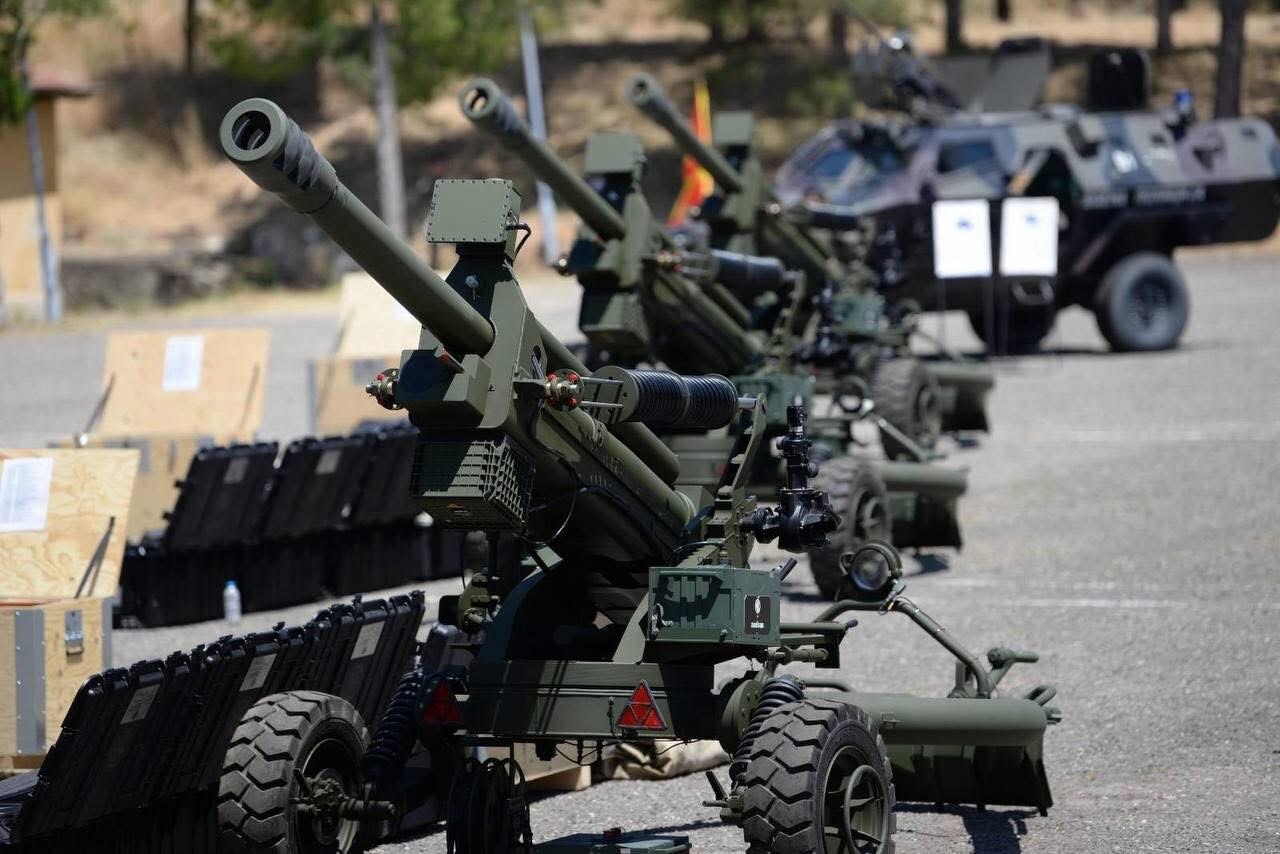
BORAN is a 105 mm towed howitzer of roughly 1,775 kg, with a reported range of 17 to 18 km and a sustained rate of six rounds a minute. Its GPS-assisted fire control is meant to cut the time to get a gun into action from the half hour typical of older towed pieces to under a minute. It is light enough for helicopter lift.
Bangladesh received the first guns in 2024, which MKE describes as the first howitzer export in the history of the Republic. North Macedonia followed: a battery of six was presented at the Mirče Acev barracks in Prilep on 18 July 2025, together with ASELSAN fire-control equipment. In 2026 Albania ordered six BORANs plus ammunition, making it the second NATO member in Europe to buy the gun, according to Armada International.
The next step is URAN, the same 105 mm gun on a 4×4 KİA light tactical vehicle. Factory manager Fatih Bulanık said in September 2026 that URAN needed only about a quarter of the testing BORAN went through and could finish qualification within a month. Details of that programme are in our report on URAN nearing qualification as BORAN exports grow.
The pattern matters beyond one howitzer. Each gun sold pulls 105 mm ammunition behind it, and ammunition is where MKE earns repeat business.
What Is Zafer, and Why Is MKE in Egypt?
Egypt is where MKE’s new model is most visible. Turkish-Egyptian defence ties were effectively frozen for much of the 2010s, then reopened. In February 2026, during President Erdoğan’s visit to Cairo, the two sides reportedly signed a package worth about $350 million: roughly $130 million for TOLGA air defence systems and roughly $220 million for Egyptian production lines for 155 mm and small-calibre ammunition.
On 3 September 2026, at the Balkan Shield expo in Sarajevo, MKE signed a memorandum of understanding with two Egyptian state factories, Heliopolis Chemical Industries (Military Factory 81) and Helwan Company for Engineering Industries (Military Factory 99). The agreement covers exchange of technical expertise and use of existing Egyptian capacity. It was the first document under the wider framework to name specific plants.
Days later, at the El Alamein International Airshow, Keleş told Anadolu Agency that MKE had set up a company called Zafer (“Victory”) in Cairo, with all shares held by MKE and incorporated under Egyptian law. It is the company’s first wholly owned subsidiary in Africa. Zafer will handle commercial activity and joint production of energetic materials, ammunition equipment and air defence and counter-drone solutions. Keleş also said MKE had completed its first TOLGA sale to Egypt.
“The ability to transfer technology has begun to take precedence over product exports,” Keleş said, as reported by Daily Sabah. That sentence sums up the strategy. Governments that buy ammunition increasingly want to make it at home, and MKE’s answer is to be the partner that helps them do so. More detail is in our report on Zafer, MKE’s first wholly owned company in Africa.
Keleş said the company is also exploring joint ventures in Canada and the United States and localisation partnerships in Malaysia and Indonesia. No terms have been published for any of them.
Can MKE Help Feed Europe’s Ammunition Demand?
Partly, and mostly through partnerships rather than direct sales. On 10 September 2026 MKE signed a memorandum with Poland’s PGZ for short-range air defence based on TOLGA, after a similar arrangement with Hungary’s HT Division earlier in the year. TOLGA links a Gökbörü AESA radar and electro-optical sensors to remote weapon stations with 35 mm, 20 mm and 12.7 mm guns firing airburst rounds. No value or timeline was disclosed. Our report: MKE and PGZ sign an air defence MoU for TOLGA.
The bigger obstacle is EU procurement law. The SAFE instrument requires a high share of EU or EEA content, reported at 65 per cent, and Türkiye has not concluded the security partnership that would loosen that. As of September 2026 there was no large, publicly announced EU-state contract for finished Turkish artillery ammunition. Private rival Arca Defense is working around this by building a plant in Estonia with a reported investment of 300 million euros. MKE’s route is joint production and equipment rather than factories inside the EU. The wider picture is in Can Türkiye supply Europe’s ammunition?
How Big Is the Expansion, and What Should Readers Question?
Numbers first. Keleş has said MKE’s turnover rose from $470 million in 2021 to about $1.2 billion in 2024, and exports from $40 million to $639 million over the same period. Defense News’ 2026 Top 100 list put MKE’s 2025 defence revenue at about $1.42 billion, up roughly 18 per cent, with 53 per cent coming from foreign customers and 47 per cent from domestic ones, according to press reports of the ranking. A $1.5 billion investment programme runs from 2023 to 2027. MKE says it added more than 350 machines and over 30 production lines in 2025.
The company also projects steep capacity growth by the end of 2026, including a 5,400 per cent rise for 155 mm howitzer ammunition and 1,900 per cent for rockets. Those are the company’s own targets, and in some lines they start from a low base.
Geography is changing too. Baykar and MKE have announced investments in Samsun, on the Black Sea coast. The argument is partly about spreading production beyond the Ankara-Istanbul corridor, and partly about finding land that meets safety rules for munitions plants. Officials quoted in the reports say construction, qualification and training could take years before output starts. See the Baykar and MKE Samsun investment for the details.
Three caveats are worth keeping in mind.
- Export reach is described inconsistently. MKE says it ships to 105 countries. Other sources cite 40, or more than 60. Definitions of “export” and the period covered probably explain some of the gap, but the company’s own figure should be read as a claim.
- Egypt is early. Zafer has been announced, not yet shown producing anything. The $350 million package figures come from reporting, and the MoU text is not public.
- Capacity is not output. New lines need qualified crews, propellant supply and customers who order on schedule. The Samsun and Kırşehir sites are still at the construction stage.
The next things to watch are straightforward: URAN’s qualification result, the first product to leave Zafer, and whether a European buyer ever places a direct order for MKE ammunition. Any of the three would say more about the company’s export model than the current capacity targets.