
What the Bayraktar TB3 Can Do From a Warship Deck

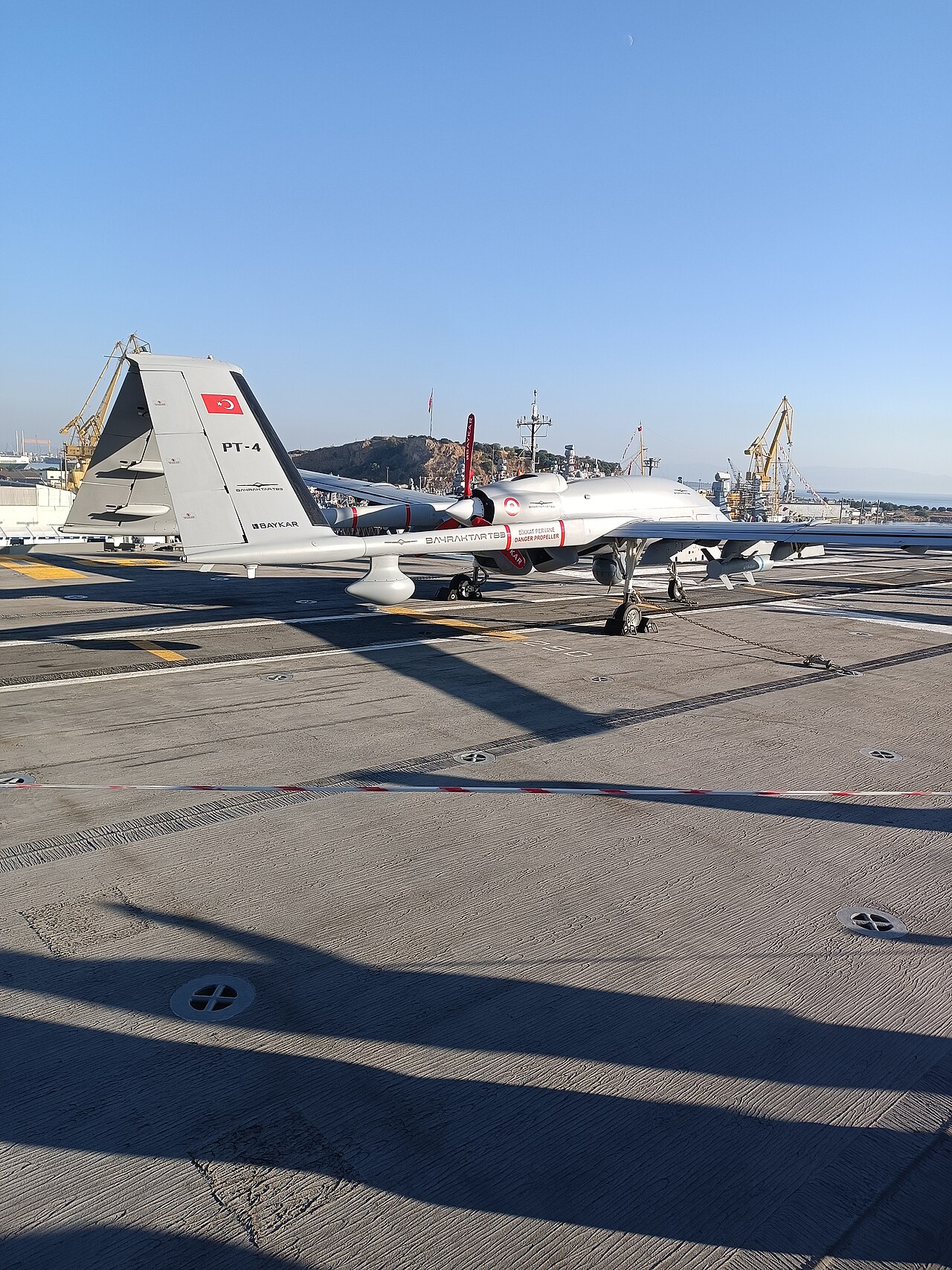
The Bayraktar TB3 is the drone Baykar built for a problem the TB2 could never solve: what do you do when there is no runway? It is a turboprop, carrier-capable armed unmanned aircraft with folding wings, reinforced landing gear and autonomous take-off and landing. Its home is the short, ski-jump deck of TCG Anadolu, although the aircraft has already flown from land bases, joined NATO drills and attracted export orders.
This guide covers where the TB3 came from, what Baykar says it can do, how its ship trials unfolded, who has bought it, and what is still unproven.
| Field | Detail |
|---|---|
| Manufacturer | Baykar |
| Type | Carrier-capable medium-altitude long-endurance armed UAV (UCAV) |
| First flight | 27 October 2023, Çorlu |
| Length / wingspan / height | 8.35 m / 14 m / 2.6 m |
| Maximum take-off weight | 1,600 kg (Baykar); earlier reports cited 1,450 kg |
| Payload | 280 kg |
| Engine | 170 hp turbodiesel (TEI PD-170) |
| Endurance | 24+ hours (Baykar) |
| Service ceiling | 25,000 ft (Baykar) |
| Key feature | Folding wings for short-deck ship operations |
| Operators | Turkish Naval Forces and Land Forces (reported); Indonesia and Italy (via Astore Levante) are announced future users |
Why Did Baykar Build a Ship-Based Version of the TB2?
Turkish naval planning changed when the amphibious assault ship TCG Anadolu entered the picture. The ship is derived from Spain’s Juan Carlos I design and has a bow ski-jump, but Türkiye’s hopes of putting F-35B fighters on it faded after the country was removed from the F-35 programme in 2019. Drones were the obvious answer, and they were the one aviation field where Türkiye already had depth.
The Bayraktar TB2 could not do the job. It needs a runway, it is relatively light, and it cannot fold into a hangar-deck lift. The TB3 keeps the TB2’s general concept of a twin-boom, propeller-driven drone, but almost everything underneath is new: a stronger airframe, landing gear built to survive a deck arrival, a larger payload and a wing that folds for storage.
Baykar’s own background helps explain how quickly it moved from the TB2 to larger aircraft. The Baykar company profile covers that background in more detail.
What Is the TB3 Made Of, and What Can It Carry?
On paper the TB3 is a mid-sized drone. It is 8.35 metres long with a 14 metre wingspan, and Baykar lists a maximum take-off weight of 1,600 kilograms and a payload of 280 kilograms. Earlier public reporting put the maximum take-off weight at 1,450 kilograms, and Baykar’s page notes the figure may vary on the naval version.
Power comes from a 170 hp turbodiesel, reported to be the domestically developed PD-170 from TUSAŞ Engine Industries (TEI), which was designed with maritime operation in mind. Baykar advertises more than 24 hours of endurance and a service ceiling of 25,000 feet. The aircraft flies autonomously through take-off, landing, cruise and taxi, and supports both line-of-sight and beyond-line-of-sight links.
Weapons are where the TB3 pulls ahead of its predecessor. Reported configurations use up to six underwing stations. Munitions publicly associated with the aircraft include Roketsan’s MAM-L and MAM-T smart munitions and the İHA-122 supersonic missile. Baykar’s own sensor options include laser-guided, INS/GPS-guided and infrared-guided munitions, electro-optical and infrared payloads, ELINT equipment and surveillance radar. An ASELSAN ASELFLIR-500 turret was reported in use during the 2026 NATO exercise described below.
How Did the Flight Tests Reach the Ship?
The test sequence was methodical, and it is worth laying out because it shows how Baykar de-risked a hard problem.
- 27 October 2023: Maiden flight at Baykar’s Çorlu facility, lasting about an hour.
- 1 June 2024: A take-off test from a mainland ramp built to imitate the Anadolu ski-jump, according to reports.
- 19 November 2024: The first landing and take-off from the deck of TCG Anadolu, announced by Selçuk Bayraktar.
- 25 March 2025: A TB3 launched from Dalaman and, with a TB2 designating the target by laser, hit a target more than 50 kilometres away with Roketsan’s İHA-122 supersonic missile, according to Turkish reports.
- May 2025: TB3s flying from Anadolu during the Denizkurdu exercise fired MAM-L munitions and scored direct hits.
The ship’s hardware was always going to lag the aircraft. Plans outlined in 2023 included dedicated control stations, satellite communication terminals, a deck-mounted roller launch aid, arrestor gear and safety nets. Early ship footage did not show most of these, which suggests the TB3 has so far relied on the ski-jump and its own short-field performance.
What Did the TB3 Do in NATO and Fleet Exercises?
In February 2026 the TB3 took part in NATO’s Steadfast Dart from Anadolu in Baltic conditions that included severe cold, snow and strong winds. Reports say it engaged surface targets with two MAM-L munitions, flew about 1,700 kilometres and returned to the ship, with some accounts describing an eight-hour sortie alongside Eurofighter Typhoons. Some of these details come from secondary reporting, so they should be read as reported rather than independently confirmed.
The most recent step came in September 2026. During a fleet exercise, a TB3 took off from Anadolu and released two sonobuoys from a Baykar-developed pod called the SAS POD, then processed acoustic data in real time while operating alongside a crewed maritime patrol aircraft. Reports describe it handling returns from both its own buoys and those dropped by the patrol aircraft. Our report on the sonobuoy test has the details.
Two buoys is a modest number. Still, putting anti-submarine sensing on a drone this small and flying it off a ship is unusual, and it widens the role beyond surface strike and reconnaissance.
How Does the TB3 Fit Into Anadolu’s Air Wing?
Anadolu is now a mixed-aircraft ship rather than a fixed-wing carrier in the classic sense. The TB3 provides endurance, persistent surveillance and light strike from the ski-jump. The new Bayraktar KALKAN vertical take-off drone, which made its first flight from the ship on 24 September 2026, adds a runway-free option. Helicopters and other assets fill remaining gaps.
Looking further out, the larger Bayraktar KIZILELMA jet-powered unmanned combat aircraft is the long-term candidate for a heavier, faster carrier-based role, and it is being developed on a separate track. The TB3 is the lower-cost, lower-risk step that has already proved it can operate from a deck.
Who Uses the TB3, and Who Has Ordered It?
Inside Türkiye, the Turkish Naval Forces are the primary user. The Land Forces Command also added TB3s to its inventory in September 2025, based on a defence ministry announcement reported in the Turkish press. That is a useful reminder that the aircraft does not need a ship to be useful: its endurance and payload are an upgrade over the TB2 for land-based units too.
Abroad, the picture has moved quickly.
- Indonesia: In February 2025, during President Erdoğan’s visit to Jakarta, Baykar and the Indonesian company Republikorp signed an agreement for a joint venture to localise production, assembly and maintenance. The reported volumes were 60 TB3 and nine AKINCI aircraft.
- Italy: Leonardo and Baykar formed the LBA Systems joint venture. Its first product, the Astore Levante, is based on the TB3 and carries Leonardo mission equipment, including the LEOSS-T electro-optical turret, Osprey AESA radar options and the ULISSES acoustic system for anti-submarine work. It was shown at Farnborough in July 2026. The Italian Navy chief said in March that the service plans to operate the TB3 family from the carrier Cavour, and the first batch is reported to be in production for delivery to an Italian customer before the end of 2026.
- Spain: The Juan Carlos I, the Anadolu’s design parent, has been mentioned as a possible operating ship, but no contract has been announced.
The Italian deal stands out because it puts a Turkish-designed aircraft on a NATO carrier alongside F-35B fighters. It also gives Baykar a European production and sensor partner at a time when buyers increasingly ask for local content.
Why Does a Small Drone on a Big Deck Matter?
The appeal is mostly about cost and persistence. A crewed fighter needs a pilot, a large logistics chain and a hangar slot; a TB3 needs a small ground control team and can stay aloft for many hours. A navy can keep an aircraft overhead, watching a sea lane or tracking a contact, for far longer than a helicopter allows.
There is also a training angle. The TB3 lets crews learn deck routines, flight-deck control and manned-unmanned teaming on a platform cheap enough to risk. Those lessons carry over to heavier aircraft later, which is one reason the programme draws attention beyond the drone itself.
What Remains Unproven?
Several questions are still open, and the public record does not answer them.
First, the TB3 has not been shown operating from a ship with arrestor gear, a catapult-style launch aid or a full set of deck-handling tools. Its reliance on a ski-jump limits which ships can host it and how heavily it can be loaded for take-off.
Second, official performance figures come from the manufacturer. Independent verification of endurance, ceiling and take-off weights in naval conditions is thin. The gap between the 1,450 kg and 1,600 kg figures is one example.
Third, the ASW role has been shown at a small scale. Two sonobuoys and real-time processing is a proof of concept, not a fielded anti-submarine capability, and the Turkish Navy has not announced a standing ASW configuration.
Finally, the export story is still mostly agreements and plans. Indonesia and Italy are the concrete cases, and deliveries to foreign customers will be the real test of whether the aircraft matches its brochure.
For now the TB3 has done what it was built to do. It has left a ship deck, fired weapons, joined a NATO exercise and begun to collect foreign customers, all in less than three years after its first flight.


