How Türkiye Turned the Drone Threat Into an Export Product Line

Since June, Turkish companies have repeatedly put counter-drone hardware in front of foreign delegations. ASELSAN ran a two-day live drone-defence demonstration in Ankara for officials from 20 countries. On 26 September its KORKUT 140/35 gun engaged drones while on the move at the Karapınar range in Konya, with delegations from 12 countries watching, according to Turkish and trade media. In between, STM put an interceptor drone through field tests.
Behind the demonstrations sits a real order. In December 2025, ASELSAN signed a $410 million export contract with Poland’s Armament Agency for electronic warfare systems that Polish officials tied to counter-UAS missions. The broader question for anyone tracking counter drone systems from Türkiye is whether this is a one-off or the start of a product category. The evidence so far points to the second.
Why did counter-drone become a product line of its own?
Small drones changed the economics of air defence. A first-person-view (FPV) quadcopter or a Shahed-type loitering munition costs a few hundred to a few tens of thousands of dollars. Shooting one down with a guided missile worth many times more is a losing trade, and militaries from Eastern Europe to the Gulf have been shopping for cheaper answers.
The answer has not been a single weapon. Jammers work on radio-controlled drones but not on drones steered by a fibre-optic cable. Guns are cheap per shot but short-ranged. Lasers need clear line of sight and a few seconds on target. Buyers want a stack of layers fed by one set of sensors, and that is how Turkish firms now sell it.
The domestic driver is Steel Dome (Çelik Kubbe), the national layered air defence architecture approved by the Defence Industry Executive Committee in August 2024. Its lowest tier is where the counter-drone systems sit. Steel Dome gives the Turkish Armed Forces a home customer, and exhibitions abroad show the same equipment to everyone else.
What is inside ASELSAN’s drone-defence package?
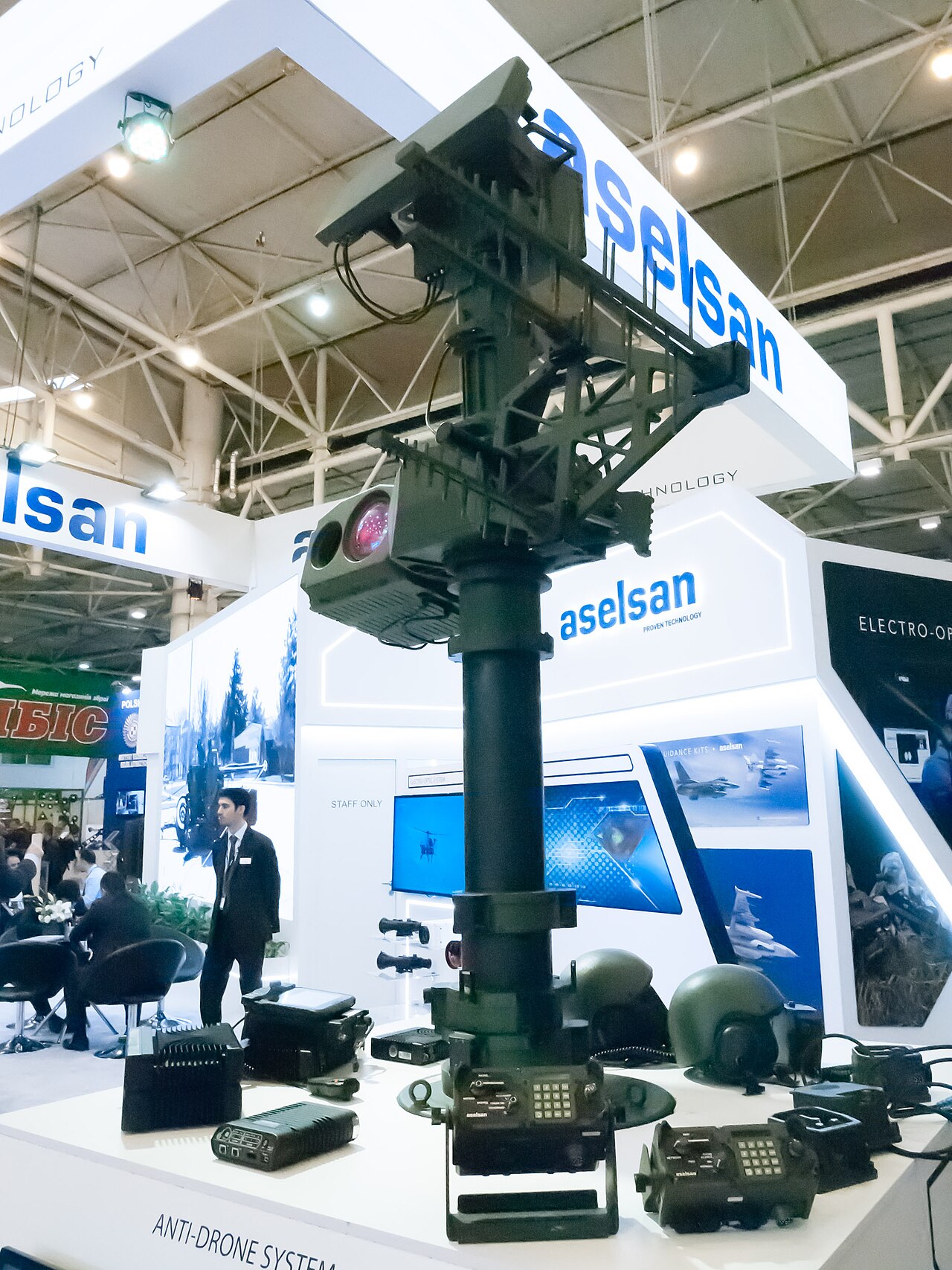
ASELSAN’s integrated offering is called DRONDEF (also written DRONEDEF). Unveiled at SAHA EXPO 2026 and shown again at Eurosatory in June, it bundles sensors, jammers, guns, a laser, a microwave weapon and interceptor drones under a single command centre. ASELSAN gives the system a detection range of up to 10 km, and says it can run inside Steel Dome or on its own.
| Component | Role | What has been published |
|---|---|---|
| İHTAR | Detection and soft kill (jamming) | AESA radar, image processing and programmable FPV jamming; a new version shown in May 2026 swaps a rotating radar for four fixed AESA panels |
| GÖKBERK | Laser hard kill | 5 kW and 10 kW versions; ASELSAN reported it destroying FPV drones in tests in March 2025 |
| EJDERHA/AD | High-power microwave | Disables drone electronics with pulses; effective against fibre-optic-guided drones according to TURDEF |
| KORKUT 25 SB | Airburst gun | 25 mm ATOM airburst rounds, roughly 1,000 m range, mobile or towed |
| ŞAHİN LITE / DUAL | Grenade launcher and machine gun | 40 mm ATOM airburst grenades; the Dual adds a 12.7 mm gun firing pellet ammunition |
| GÖKALP | Interceptor drones | Towed or mobile launcher, radar-guided E1 and E2 interceptors |
| MİĞFER | Last-ditch defence | Two 12-gauge shotguns aimed through VR goggles |
The Ankara demonstration in June showed why the layers matter. According to ASELSAN, two fibre-optic drones approached in a swarm and were handed to the EJDERHA microwave weapon. Two radio-controlled drones from different directions were jammed by İHTAR. A third fibre-optic drone was destroyed by the GÖKBERK laser. Each effector took the threat it was best suited to, and the company is selling that hand-off as much as any individual box.
The newer İHTAR matters for another reason. TURDEF, which reported on the May 2026 version, counted six jammer antennas against three on the original İHTAR 100. The magazine suggested this could improve coverage against frequency-hopping links, though ASELSAN has not said so.
Where do guns and missiles fit in?
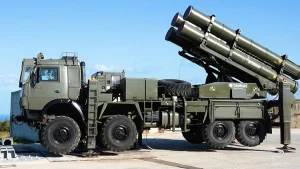
The heavier end of the drone-defence spectrum belongs to gun systems and, increasingly, hybrids. The KORKUT 140/35 carries twin 35 mm cannon firing ATOM airburst ammunition, which detonates at a programmed point to throw fragments across a small drone’s path. Reporting on the Konya trial put the engagement range at roughly 4 km. The demonstrated version sits on an Otokar ARMA II 8×8 wheeled vehicle.
ASELSAN’s GÜRZ goes one step further by putting a 35 mm gun and short-range missiles on the same truck. The company said it carried out the system’s first live-fire test at the Sinop Test Center on 5 September, engaging an aerial target with a GÖKSUR missile. ASELSAN’s general manager, Ahmet Akyol, said the plan is to bring GÜRZ into the Turkish Armed Forces inventory in 2027. Engagement range and target type have not been published.
ASELSAN also took its counter-drone and electronic warfare lineup to MSPO 2026 in Kielce, Poland’s main defence show, and the venue sits in the home market of its largest European counter-drone customer.
Who else in Türkiye builds counter-drone systems?
ASELSAN has company at home, and several competitors have picked noticeably different approaches.
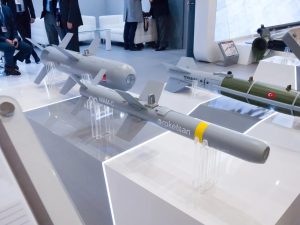
Roketsan builds the ALKA directed-energy system, which pairs electronic jamming with a laser. According to Koray Dayanç, Roketsan’s weapons systems and integration director, development began around 2018-2019 and ALKA won an SSB competition against ASELSAN and TÜBİTAK BİLGEM. The laser has grown from 2.5 kW to 5 kW and then 10 kW, and Roketsan says a drone can be neutralised in one to five seconds depending on its structure. Roketsan also says ALKA has been protecting units against swarm kamikaze-drone attacks since its first deliveries, a claim that cannot be checked independently.
MKE is pushing TOLGA, a short-range system with an AESA radar, electro-optical sensors and remote weapon stations in 35 mm, 20 mm and 12.7 mm calibres. Its first international sale, of the twin 20 mm variant, went to Qatar, and in September it signed an MoU with Poland’s PGZ covering short-range air defence and non-kinetic countermeasures. MKE has a similar partnership with Hungary’s HT Division. None of these are large production contracts yet, but they show the model: build locally with a partner, and sell the core weapon station.
STM has taken the interceptor-drone route. Field tests of TUNGA-X, reported by Anadolu Agency on 12 September, covered drone-killing and site guarding missions. STM lists the aircraft at 4 kg with a 750-gram fragmentation warhead and proximity fuze. It is flown by an FPV pilot for now, with autonomous engagement planned for later in 2026, according to STM.
Turaç, an ammunition maker, went for cost. Its Drone Kalkanı turret, unveiled in September, uses two Derya MAX semi-automatic shotguns and Turaç’s own anti-drone cartridges, with a sensor package that tracks targets at 600-800 metres and an effective shotgun range of about 150 metres, according to the company. ASELSAN’s MİĞFER uses the same basic idea at arm’s length, which says something about where the cheapest layer of the stack is heading.
Who is actually buying Turkish counter-drone systems?
Orders are thinner than attendance. The clearest contract is Poland’s. ASELSAN said it won the $410 million deal after a competitive tender against international rivals. Polish officials described the system as an automated reconnaissance and jamming system for counter-UAS work and the first step in a wider programme of counter-drone air defence, which could open room for follow-on buys. Neither side has published a delivery schedule.
Qatar’s TOLGA purchase is the second concrete sale. After that, the list turns into delegations, memorandums and partnerships. Twelve, eighteen and twenty countries sat through recent ASELSAN demonstrations, but attendance is not an order book.
ASELSAN has an angle that most counter-drone vendors lack. By its own description it is the primary electronic warfare supplier to the Turkish Armed Forces, and jamming, direction finding and radar sit at the core of a counter-drone sensor chain. It is notable that the Polish contract was awarded on the electronic side, not for a missile or a gun.
What could slow the sector down?
Three things are worth watching.
First, independent data is scarce. Most performance figures, from engagement ranges to kill times, come from the companies themselves. The public demonstrations are run by the vendors, on scenarios the vendors designed. Buyers will want trials on their own ground against their own threats.
Second, Europe has its own candidates. Gun-missile hybrids such as Germany’s Skyranger aim at the same customers, and European suppliers come with established logistics in NATO armies. Turkish pricing, which none of the companies has disclosed, will have to do much of the work.
Third, the domestic schedule still runs ahead of the export one. GÜRZ does not enter Turkish service until 2027 on current plans, and a procurement of Steel Dome’s scale, including the $6.5 billion in contracts signed in November 2025 for air defence in general, will compete for the same factory capacity as export orders.
The next data points will be the delivery schedule for the Polish contract, any follow-on under Poland’s counter-drone programme, and whether the delegations that watched the demonstrations this autumn turn into signatures.