Bayraktar TB3 Drops Sonobuoys From TCG Anadolu in ASW Test

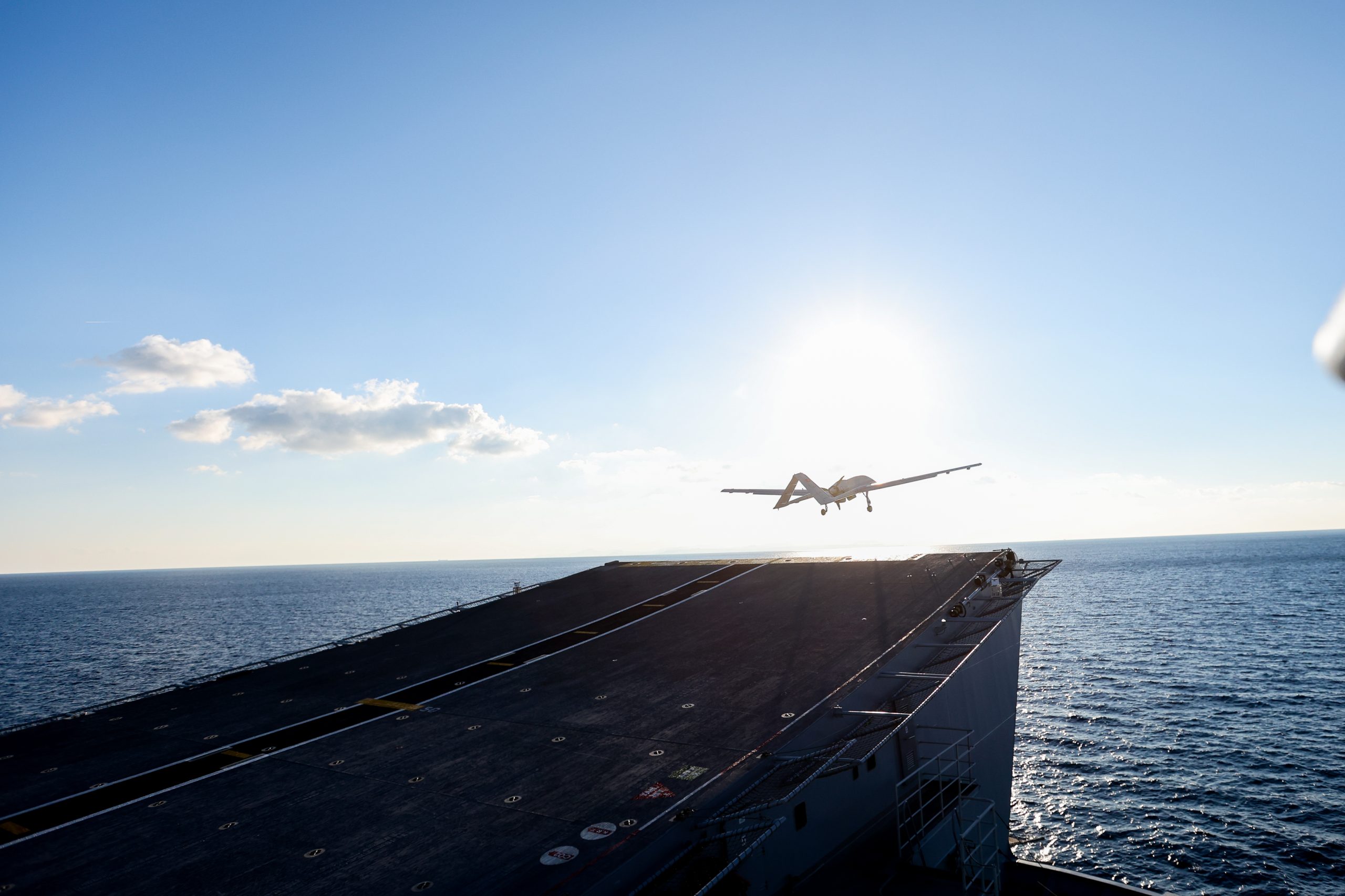
A Bayraktar TB3 flew off the deck of TCG Anadolu on September 22 and dropped two sonobuoys into the Eastern Mediterranean, giving Baykar’s carrier-capable drone a submarine-hunting role that only one other unmanned aircraft in the world has publicly demonstrated.
The test took place during Denizkurdu-I/2026, the Turkish Naval Forces Command’s six-day fleet exercise running September 20-25 across the Black Sea, the Aegean and the Eastern Mediterranean. Baykar said the TB3 released the sonobuoys using its indigenously developed Sonobuoy Dispenser System, known by its Turkish acronym SAS POD, which is mounted under the aircraft’s wing.
What the Test Actually Showed
The headline event was the drop itself, but the more significant part was what happened afterward. According to Baykar, the TB3 did not simply release the sonobuoys and fly away — it processed the acoustic data they generated in real time using an onboard sonobuoy processing unit, and fed that data into the exercise’s command picture. The aircraft also worked alongside a crewed maritime patrol aircraft during the same mission, receiving and processing signals from sonobuoys the manned aircraft had dropped as well as its own.
That combination — launch, acoustic processing and coordination with a manned platform in a single sortie — is what separates a symbolic weapons-bay demonstration from an operationally relevant anti-submarine warfare (ASW) capability. Submarine hunting has traditionally been the preserve of crewed maritime patrol aircraft and helicopters precisely because processing sonar returns and localizing a contact under real acoustic conditions is a demanding, continuous task. Automating that chain on an unmanned platform is a harder engineering problem than adding a hardpoint for a missile.
A Short List of Platforms
Naval News, which first reported the technical detail of the test, noted that outside General Atomics’ MQ-9B SeaGuardian, the TB3 is only the second known unmanned platform to have demonstrated live sonobuoy drops with integrated acoustic telemetry processing. The SeaGuardian has been building out this capability since 2025, when General Atomics and the US Navy began testing an expanded sonobuoy-dispensing system that can carry up to 80 buoys across four underwing pods, and it dropped the first Multi-static Active Coherent buoys from an uncrewed aircraft in December 2025.
The TB3’s test was far more modest in scale — two buoys from a single pod — but it establishes the same underlying capability on a much smaller airframe that already operates from a Turkish amphibious assault ship rather than a runway. For Baykar, that is arguably the more relevant comparison: no other short-takeoff UCAV in service anywhere has shown it can do this from a ship.
TCG Anadolu’s Expanding Role
TCG Anadolu was designed and laid down as a landing helicopter dock before the Turkish Navy reconfigured it to operate TB3s, becoming what is now routinely described as the world’s first drone carrier built around fixed-wing UCAVs rather than helicopters. Since entering service, the ship has hosted a widening list of weapons tests from its deck, including ATMACA anti-ship missile launches, AKYA heavyweight torpedo firings and MAM-L/MAM-T precision strikes from TB3s during the June 2026 Denizkurdu-2 exercise in the Gulf of Antalya. The sonobuoy test adds a sensor mission to that list rather than a strike one, filling a genuine gap: TCG Anadolu’s air wing has so far been built almost entirely around strike and reconnaissance, not undersea search.
Denizkurdu-I/2026 itself is a domestic Turkish exercise rather than a NATO drill, involving roughly 100 ships, 50 aircraft and 14,000 personnel from the Naval Forces, Army, Air Force and Coast Guard commands. It is scheduled to culminate on September 24 with a Distinguished Observer Day aboard TCG Anadolu, when foreign military attachés and journalists are typically invited to watch live demonstrations — an occasion Baykar and the Navy have used in the past to showcase exactly this kind of new capability.
Why It Matters Beyond Türkiye
ASW is one of the few mission sets where uncrewed systems have made limited inroads so far, and it is also one of the more lucrative niches in the export market: several NATO members already operate Turkish-made systems, and Gulf and Asia-Pacific customers of Turkish naval drones have shown interest in anti-submarine tools as regional undersea activity — from Russian submarines in the Black Sea to Chinese submarines in the Indo-Pacific — has increased. A TB3 variant or successor with a credible, exportable ASW fit would compete in a market currently dominated by manned P-8 Poseidons and MQ-9B SeaGuardians, both considerably larger and more expensive platforms. The TB3 itself remains a much smaller, less expensive complement to Baykar’s larger AKINCI and the older Bayraktar TB2, both built for strike and reconnaissance rather than undersea search.
Baykar has not said whether the SAS POD will be offered as a standard TB3 mission kit for export customers, and no contract or customer has been announced for an ASW-configured TB3. The September 22 flight was a single test within a national exercise, not a qualification or acceptance trial, and Baykar’s own statement was limited to describing what the aircraft did rather than announcing an operational or export milestone.