FNSS Unveils İ-ZAHA: An Unmanned Vehicle for the First Wave

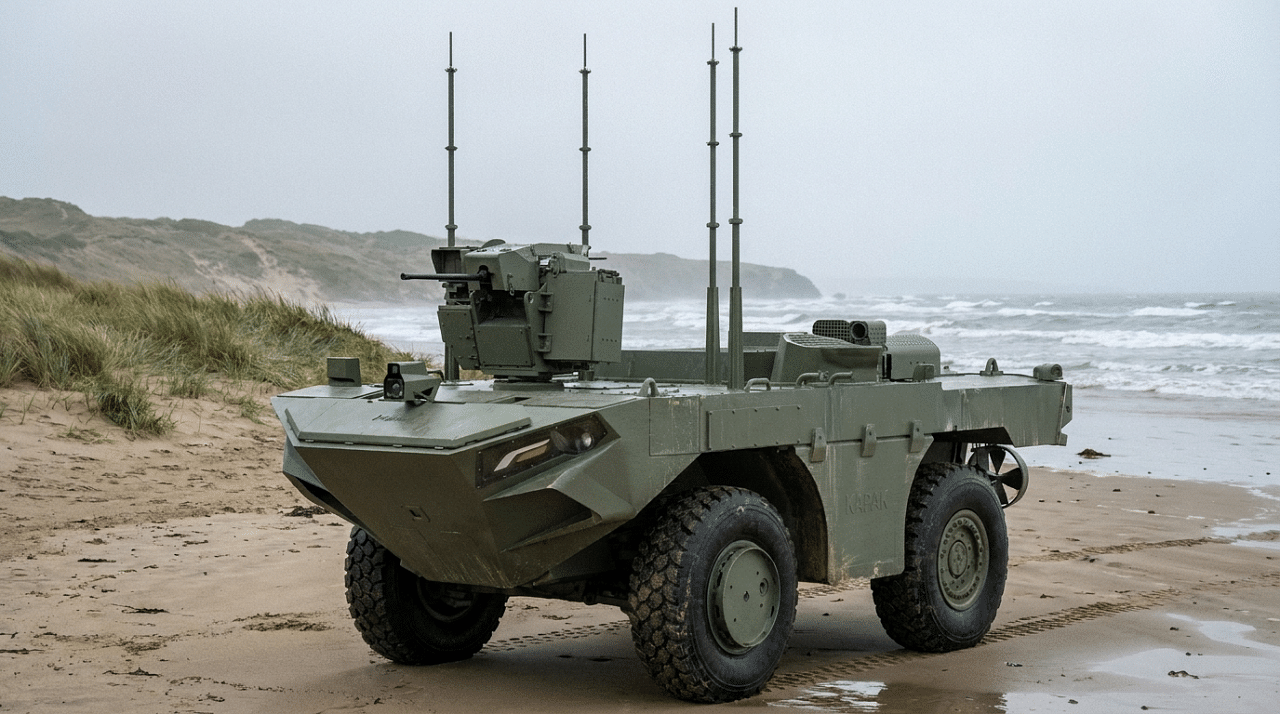
FNSS has built an unmanned version of the vehicle it hopes will one day lead the first wave of a Turkish amphibious assault, ahead of the marines rather than alongside them. The Ankara-based armoured vehicle maker unveiled İ-ZAHA — marketed internationally as U-MAV, the Multi-Purpose Modular Unmanned Amphibious Vehicle — at TEKNOFEST Mavi Vatan 2026, held at the Gölcük Naval Shipyard Command in Kocaeli from 20 to 23 August. It is designed to run in front of FNSS’s existing crewed ZAHA Marine Assault Vehicle, taking on the highest-risk minutes of a landing so that a human crew does not have to.
Why the first wave is the problem
Amphibious doctrine has a well-known weak point: the first vehicles onto a beach are the ones a defender can see coming and has had the most time to range in on. Navies that operate marine forces have spent decades trying to reduce that exposure with faster landing craft, better armour and longer-range fire support, but the vehicles themselves have still carried crews into the most dangerous phase of the operation. FNSS’s answer is to take the crew out of that phase entirely and put an unmanned platform there instead — one built to scout, clear obstacles, jam or fight as needed, and only then let the manned wave come ashore behind it.
FNSS CEO and board member Selim Baybaş framed the vehicle as a direct extension of the company’s manned programme rather than a separate product line. “FNSS continues to grow its work and its R&D investment in unmanned and autonomous vehicle technologies,” Baybaş said at the unveiling. “U-MAV brings together our engineering capability, the field success of the Marine Assault Vehicle and our continuing R&D effort in a new-generation, heavy-class unmanned amphibious vehicle. Very few companies worldwide can build an unmanned amphibious vehicle of this size and capability.”
What İ-ZAHA can do
İ-ZAHA is an 8-tonne platform driven by a combined 300-horsepower powerpack, giving it a power-to-weight ratio of roughly 37.5 hp per tonne. FNSS states it can make the sea-to-shore transition without interruption, reaching around 7 knots in the water and up to 70 km/h once ashore. Navigation relies on a combined GNSS/INS system intended to keep the vehicle operating in GPS-denied or degraded environments, and it can be run autonomously, by remote control, or in a hybrid of the two — operating as part of a manned-unmanned team alongside crewed ZAHA vehicles rather than as a fully independent system.
The vehicle is built around a common platform with swappable mission modules that FNSS says can be changed in the field in around 40 minutes, giving it ten declared mission configurations: fire support, mine clearance, combat engineering, electronic warfare, reconnaissance, deception, counter-drone, navigation and obstacle marking, logistics support, and casualty evacuation. An onboard mission computer runs AI-enabled image processing for automatic target detection and threat scoring, transmitting compact detection data back to a command post rather than a continuous high-bandwidth video feed — a design choice aimed at keeping the vehicle usable over the kind of contested, bandwidth-limited communications link an amphibious force would actually have offshore. Line-of-sight control range is rated at around 3 km, extendable through a UAV relay.
One structural feature stands out: İ-ZAHA carries Nurol Teknoloji’s “Armor Integrity” monitoring system, which tracks the location, direction and severity of impacts on the hull along with accumulated damage over time. FNSS says it is the first unmanned vehicle to carry the system, giving commanders a live readout of how much punishment the platform has absorbed rather than having to guess. For air transport, FNSS lists compatibility with the CH-47F Chinook, Mi-26, C-130 Hercules, A400M, C-17 Globemaster III, C-5 Galaxy, An-124 and Il-76 — a deliberately wide list aimed at NATO and non-NATO operators alike.
Where it fits in Türkiye’s amphibious build-out
İ-ZAHA does not exist in isolation. The manned ZAHA is already in service with the Turkish Naval Forces’ Amphibious Marine Brigade, with a second 27-vehicle contract signed with the Presidency of Defence Industries in May 2026 on top of the first. Both vehicle types are designed to operate from Türkiye’s TCG Anadolu, the amphibious assault ship that has become as well known for launching Bayraktar TB3 and Kızılelma drones as for landing marines. Pairing an unmanned first wave with a manned second wave, launched from a ship that already doubles as a drone carrier, points toward an amphibious concept built around layers of unmanned systems screening for the humans who follow — a pattern that shows up elsewhere in Turkish procurement, from the drones Türkiye now exports in large numbers to the armoured vehicle exports FNSS has separately built through its European partnerships.
FNSS has not named a customer or announced an order for İ-ZAHA; at this stage it is a company-funded unveiling rather than a contracted programme, and the Turkish Naval Forces Command is the plainly intended first customer given the vehicle’s design lineage from ZAHA. FNSS is pitching it more broadly, though — the company’s marketing points explicitly at NATO allies that operate amphibious forces and share the same first-wave casualty problem. Whether any of them place an order will depend on trials Türkiye has not yet disclosed a timeline for. What FNSS has demonstrated so far is a working platform with a clear mission logic, built by a company that already has a rare qualification: an operating production line for a heavy amphibious assault vehicle, manned or not.
Sources: FNSS (product specifications and CEO statement); Naval News, Breaking Defense, Defence Turkey and Jane’s coverage of the İ-ZAHA/U-MAV unveiling at TEKNOFEST Mavi Vatan 2026, 20–23 August 2026.