MKE and Azerbaijan’s MIRAS Unveil BMP-1 TURAN Upgrade

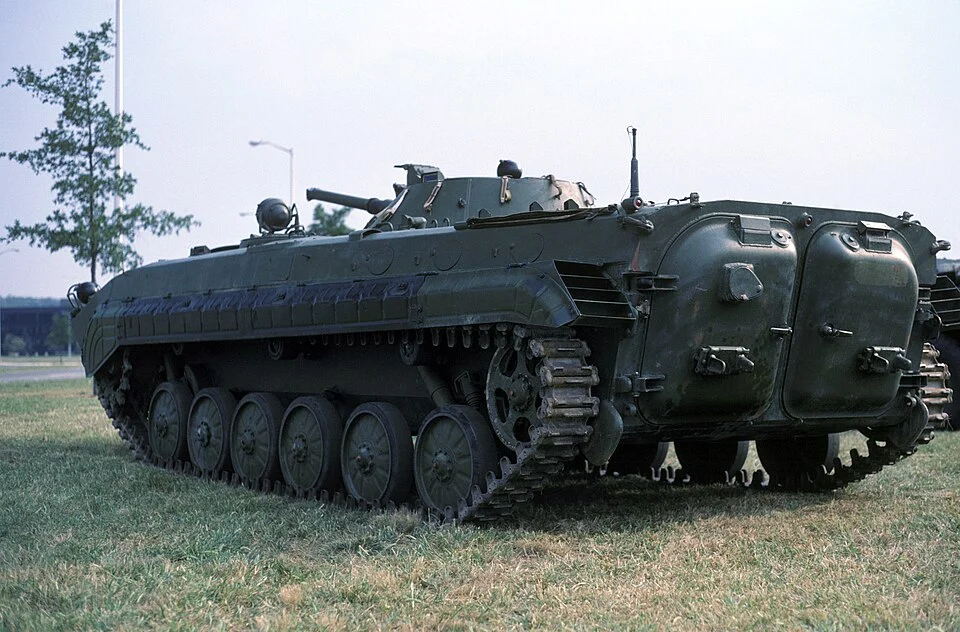
Turkey’s state-owned MKE and Azerbaijan’s MIRAS Military Industrial Company put a modernized BMP-1 infantry fighting vehicle on public display for the first time at ADEX 2026 in Baku on September 30, branding it the BMP-1T “TURAN.” The vehicle replaces the Soviet original’s worn 73mm smoothbore gun with a 30mm automatic cannon and gives Azerbaijan’s aging BMP-1 fleet a modern turret, sensors and fire control without the cost of buying new hulls.
The unveiling turns a memorandum of understanding signed earlier at SAHA 2026 in Istanbul into hardware. It is a modest line item next to the headline contracts Türkiye and Azerbaijan signed in the same week — the roughly $500 million package covering ROKETSAN’s BARBAROS coastal defense system, 14 Turkish Aerospace HÜRKUŞ-2 trainers and a planned ASELSAN production facility in Nakhchivan — but it points at something those bigger deals don’t: how Türkiye plans to sell into a market that still runs mostly Soviet armor.
A new turret for an old hull
Azerbaijan’s Army, like most post-Soviet militaries, still fields BMP-1s built decades before the Nagorno-Karabakh wars that reshaped its armed forces. The TURAN modernization keeps the original hull and drivetrain and rebuilds everything above it. The 73mm gun and its dated sighting system are gone, replaced by a dual-feed 30mm automatic cannon in a new turret with continuous 360-degree traverse and a wider elevation range than the original mount allowed. Electro-optical and thermal imaging, automatic target tracking and improved stabilization are built in, aimed squarely at letting the vehicle fight at night and while moving — something the original BMP-1 was never designed to do well.
MKE says the package also folds in counter-drone protection drawn from its own TOLGA short-range air defense system, a detail that matters more in 2026 than it would have a decade ago: Azerbaijan, like every army watching Ukraine, has had to think hard about what a loitering munition or FPV drone does to an infantry fighting vehicle that can’t see or shoot at it. Neither MKE nor MIRAS has published a vehicle count, a per-unit cost or a production timeline, and nothing disclosed so far amounts to a signed production contract — the ADEX display is a capability unveiling built on an existing cooperation agreement, not confirmation of a firm order.
MKE’s Azerbaijani foothold
The modernization is being carried out through MKA — Makine Kimya Azerbaijan — the Azerbaijani subsidiary MKE set up in 2025 specifically to manage local operations and joint projects of this kind, working alongside MIRAS, the state company that already builds and assembles military equipment inside Azerbaijan. The memorandum signed at SAHA 2026 and realized at ADEX covers more than the BMP-1 fleet: the two companies describe it as a framework for joint development of weapons, ammunition and other vehicle-integrated systems, plus maintenance and refurbishment work carried out on Azerbaijani soil rather than shipped back to Turkey.
That local-subsidiary model is becoming MKE’s preferred route into harder markets, mirroring what FNSS has done with armored vehicle licensing abroad and what Otokar has built with its own overseas production lines. For a Soviet-legacy vehicle fleet that a NATO-standard replacement would be prohibitively expensive to swap out wholesale, a turret-and-sensor upgrade built locally is a far easier sale than a new vehicle purchase — and keeps the relationship, and the follow-on parts and ammunition business, with Türkiye rather than a Russian or Chinese competitor.
Part of a bigger Baku push
The TURAN unveiling landed in the same week Turkish officials called their largest-ever delegation to an Azerbaijani defense show, with ASELSAN, Baykar and Turkish Aerospace all signing separate agreements alongside MKE’s. Azerbaijani and Turkish officials have been explicit that the ADEX 2026 agreements go beyond equipment sales to cover local production, R&D, training and technology development — language that fits a bilateral relationship both governments already describe as “one nation, two states,” and one that has steadily moved from arms sales toward joint manufacturing since the 2020 Nagorno-Karabakh war.
For MKE, a company better known internationally for ammunition and towed artillery than for armored vehicles, the TURAN program is a chance to build a track record in vehicle modernization — a segment dominated elsewhere by FNSS, Otokar and BMC — using a customer that already trusts Turkish equipment and has the Soviet-legacy fleet size to make the business worthwhile. Whether it turns into a production contract, and how many of Azerbaijan’s BMP-1s eventually get the upgrade, is the detail to watch next.
Sources: Joint Forces and Trend.az reporting from ADEX 2026, Baku, September 30, 2026.