How Turkish Drones Swapped Canadian Cameras for ASELSAN Optics

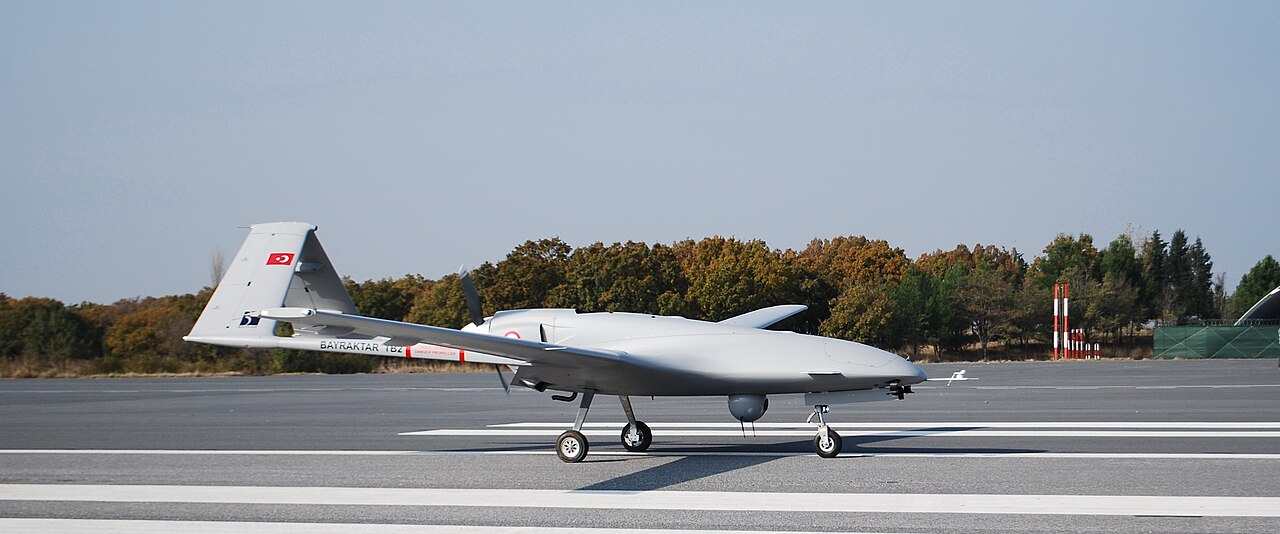
A modern combat drone is, at bottom, a flying camera with a weapon attached. The airframe gets it to the target area, but the electro-optical and infrared (EO/IR) turret under the nose is what finds, identifies and tracks the target, and what lets a laser-guided munition hit it. For years the turret on Türkiye’s best-known drones was not Turkish at all. That changed in 2020, and the change now runs through almost every unmanned and manned platform the country is building.
What Is an EO/IR Sensor, and Why Does a Drone Depend on It?
An EO/IR turret is a gyro-stabilised ball, or gimbal, that carries several sensors behind a common window. A typical set includes a daylight television camera, a thermal imager that works in the mid-wave infrared band, often a short-wave infrared channel for haze and low light, a laser rangefinder and a laser designator. Stabilisation matters as much as the optics. A drone vibrating at altitude and banking in turns cannot hold a vehicle in the frame unless the gimbal cancels that motion.
The laser is the link to the weapon. The designator paints the target so a laser-guided munition can follow the reflected energy, while the rangefinder feeds the fire-control solution. Take the turret away and a drone can still fly, but it loses most of its value as a strike platform.
How Did a Canadian Embargo Push Türkiye Into Building Its Own?
Early Bayraktar TB2 and ANKA aircraft flew with the Canadian-made WESCAM MX-15D turret. In October 2020, during the fighting between Azerbaijan and Armenia, Canada suspended its arms export permits to Türkiye, citing reports that Canadian technology was being used in the conflict. Ankara rejected the premise and said the defence industry would continue regardless of embargo decisions.
ASELSAN already had a replacement in development. In November 2020 the Common Aperture Targeting System, known as CATS, was shown firing a test shot from a TB2, with a Roketsan MAM-L smart micro-munition hitting the target, according to Anadolu Agency. Baykar’s later statements say CATS has been exported to 10 countries. Reports on TB2s delivered in the following years describe Turkish-built optics in place of the Canadian ones, unless the buyer chose otherwise.
The episode is now a textbook case in Turkish procurement circles. A single export licence had put a key sensor at risk, and the response was to localise it rather than wait. The broader pattern is covered in our piece on Türkiye’s drive for defence production independence.
What Do the ASELFLIR Turrets Offer?
CATS was the first step. ASELSAN has since built a family under the ASELFLIR name, sized for different aircraft. The company’s own product pages and later reports give a sense of the range.
| System | Intended platforms | Reported details |
|---|---|---|
| CATS | TB2, ANKA and other tactical UAVs | Common-aperture EO/IR turret, first shown with MAM-L firing in 2020 |
| ASELFLIR-300T | Fixed-wing and rotary-wing aircraft | High-resolution infrared camera, day TV and spotter TV, laser rangefinder/designator up to 20 km, 360 degree continuous azimuth, four-axis stabilisation (ASELSAN) |
| ASELFLIR-500 | AKINCI, TB3, helicopters, light attack aircraft | Mid-wave infrared camera at 1280×1024, day TV and SWIR channels; laser range reported at around 35 km |
| ASELFLIR-600 | Heavier high-altitude UCAVs such as AKINCI and AKSUNGUR | Full-HD TV, HD MWIR and SWIR, laser designator reported at 35 km; serial production reported planned for 2026 |
| ASELFLIR-410N | Naval and unmanned surface vessels | Trials reported for unmanned boats such as MARLIN |
The ASELFLIR-300T is the older design and the one ASELSAN documents in most detail, with a field of regard covering a full circle and three selectable fields of view on the infrared camera. The ASELFLIR-500 is the step up, a larger gimbal built around a single large aperture. Some published figures, including its weight of roughly 54 kg, come from secondary sources and should be treated as reported rather than confirmed by the manufacturer.
At Farnborough in July 2026, ASELSAN presented the 410, 510 and 600 families as a payload range for UAV classes from tactical to heavy, according to Breaking Defense. The company listed AKINCI, ANKA, ANKA III, TB2, AKSUNGUR and KIZILELMA among the platforms it supports.
Which Turkish Drones Carry Which Sensor?
Why does the gimbal size matter? A larger aperture collects more light and resolves detail at longer slant range, which lets a heavy drone stay farther from air defences while still identifying what it sees. The cost is weight and drag. A turret suited to a 1,000 kg-class aircraft would swamp a small tactical drone, which is why ASELSAN sells several sizes instead of one universal ball.
The Bayraktar TB2 is the aircraft most closely tied to the CATS story. After the Canadian turret became unavailable, Baykar shifted production to the Turkish unit, and ASELSAN has since shown additional pods on the TB2, including ANTIDOT and FULMAR pods in a demonstration before foreign delegations.
The heavier Bayraktar AKINCI uses ASELSAN optics as well. Baykar announced in February 2024 that an AKINCI fitted with the ASELFLIR-500 had hit a moving maritime target, working with MAM-T and MAM-L munitions. The company described the turret as an advance on the earlier CATS. The smaller Bayraktar TB3, which operates from ship decks, is reported to carry the ASELFLIR-500 too.
A fighter-sized drone needs something different, because a protruding ball would wreck a low radar signature. That is the logic behind TOYGUN, an electro-optical targeting system built into the airframe, and KARAT, a passive infrared search and track sensor. ASELSAN’s 2023 activity report describes TOYGUN-100 for unmanned fighters such as KIZILELMA and ANKA-3, and TOYGUN-200 for the KAAN, with a 1280×1024 infrared camera and a laser designator reported at 35 km. KARAT comes in two sizes and uses a 640×512 detector.
KARAT got a public test in April 2026. Defence Blog reported that the sensor on a Bayraktar KIZILELMA picked up a passenger airliner at 110 km. A passive sensor emits nothing, so the target has no warning it is being watched, which is the point of the design. The larger KARAT-200 is planned for the KAAN fighter and the ANKA-III.
How Does This Fit ASELSAN’s Wider Business?
Integration is the quiet half of the job. A turret has to talk to the flight computer, the datalink and the weapon stations, and its video has to reach the ground operator with little delay. Having ASELSAN and Baykar in the same domestic supply chain shortens the loop between a field complaint and a software or hardware fix, something that is hard to do with a foreign supplier bound by export rules.
Electro-optics sits beside radar, electronic warfare and communications in a company that has become Türkiye’s largest defence electronics house. The ASELSAN company profile covers its structure and product lines. Optronics is a good business for the firm for a simple reason. Every unmanned aircraft Türkiye sells abroad needs a turret, and each turret is a recurring sale with spares, upgrades and training attached.
There is also a less visible market in seekers. ASELSAN’s 2023 report referred to imaging infrared seekers for anti-tank and air-to-surface missiles, among them the KİLİT-13K, which was being prepared for mass production. The same detector and stabilisation know-how feeds both the turret and the missile nose.
Foreign buyers are part of the picture too. Sensor sovereignty is now a selling point, because a customer that buys a Turkish drone with a Turkish turret deals with one government on export approvals rather than two. Contract terms are rarely published, so how much weight buyers give the argument is hard to measure from outside.
What Are the Limits of the Turkish Sensor Story?
Independent performance data is thin. Detection and recognition ranges depend on atmosphere, target signature and the operator’s settings, and manufacturers rarely publish them in a form that lets outsiders compare a CATS against a WESCAM or a Western pod. Most figures above come from ASELSAN, Baykar or Turkish media, which is worth keeping in mind when reading any claim that one turret beats another.
What can be said with confidence is narrower. Türkiye had one major foreign sensor supplier for its flagship drones, lost access to it in 2020, and had a domestic replacement flying within weeks. Five years on, there is a graded family of turrets from tactical drones to heavy UCAVs, plus embedded sensors for its stealth programmes. The next tests to watch are the series delivery of the ASELFLIR-600 and the TOYGUN and KARAT units on KIZILELMA and KAAN.