How KARGU Put Turkish Loitering Munitions on the Export Map

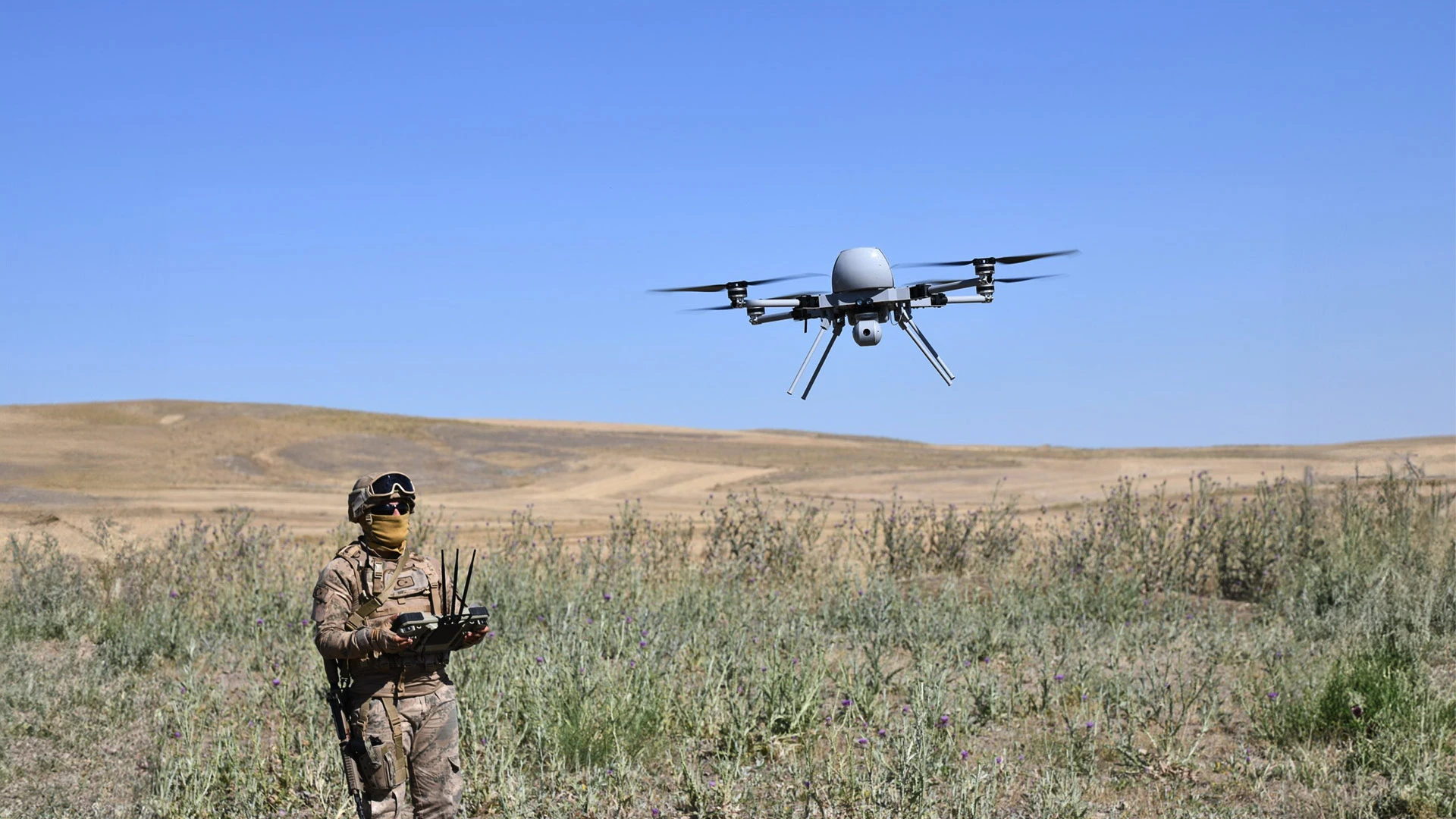
Few Turkish weapons have travelled further in the public imagination than a quadcopter that folds into a backpack. The KARGU drone, built by Ankara-based engineering house STM, is a small rotary-wing loitering munition: it flies to a target area, watches, and dives onto what its operator selects. It is also the system at the centre of the most argued-over paragraph in recent arms-control reporting, a line in a 2021 UN document about Libya. Behind the headlines sits a fairly ordinary product with an unusually successful sales record.
This article separates what STM itself publishes about KARGU from what has been reported by others, because on this system the two often drift apart.
What Is the KARGU Drone?
STM describes KARGU as a portable, rotary-wing attack drone that gives ground troops tactical reconnaissance and a precision-strike option. The complete system has two parts, the drone and a mobile ground control station, and one soldier can operate it. The name is Turkish for a watchtower, and the platform was reportedly conceived first as an airborne sentry before it was armed.
The company calls it “combat proven” and says it is reusable: an operator can abort a mission and bring the aircraft home, which separates a loitering munition of this type from a one-way missile. A camera with electro-optical and infrared channels lets it work day and night.
| Field | Detail |
|---|---|
| Manufacturer | STM Savunma Teknolojileri Mühendislik ve Ticaret A.Ş. (Ankara, Türkiye) |
| Type | Quadrotor loitering munition with ground control station |
| Role | Tactical ISR and precision strike against static or moving targets |
| Take-off weight | 7.7 kg including payload (STM) |
| Dimensions | 707 x 707 x 409 mm unfolded, propellers excluded; 471 x 463 x 210 mm folded (STM) |
| Endurance | 30 minutes with payload (STM) |
| Range | 10 km with external antenna, 6.5 km with onboard antenna (STM) |
| Cruise speed | 20 m/s (STM) |
| Maximum altitude | 3,000 m MSL (STM) |
| Sensors | EO/IR camera with 10x optical zoom |
| Warheads | Anti-personnel and armour-piercing options, swappable on the same airframe |
| Operators | Turkish Armed Forces, Azerbaijan (reported), other foreign customers (STM says more than 15 countries) |
How Does KARGU Work in the Field?
The drone is folded, carried, unpacked and launched. STM says preparation takes under a minute, and the aircraft takes off and lands vertically, so it needs no runway, catapult or recovery gear. The operator launches it toward a target area, flies or lets it navigate on its own flight-control system, and watches the video feed on a ruggedised touchscreen. STM rates the ground unit for about two hours of operation and to MIL-STD-810G environmental standards.
The strike itself is the important point. STM states that the precision-strike phase is performed by the operator, in line with a man-in-the-loop principle. The drone tracks and dives, but a person picks the target and commits the attack. That claim matters for what follows, because it is the company’s answer to the Libya controversy.
The numbers describe a short-legged system by design. A 10 km radius and half an hour in the air suit an infantry company or a special-operations team, not a theatre commander. The appeal is cost and simplicity: a weapon that a squad can carry and use against a dug-in position, a vehicle or a mortar crew that would otherwise demand an artillery call or a larger drone such as the Bayraktar TB2.
What Happened in Libya, and What Does the UN Report Say?
In March 2021 the UN Security Council’s Panel of Experts on Libya delivered its annual report. One passage covered the 2020 fighting around Tripoli and said that logistics convoys and retreating forces loyal to Khalifa Haftar were “hunted down and remotely engaged” by unmanned combat aircraft or lethal autonomous weapon systems, and named the STM Kargu-2 among them. The panel added that such systems were programmed to attack without requiring a data link between operator and munition, which it described as a true “fire, forget and find” capability. It assessed that forces affiliated with the Government of National Accord had likely received Kargu-2 units.
Headlines turned this into “the first autonomous drone kill.” The report did not say that. It did not establish that anyone was killed by a machine acting without a human decision, and it gave no technical evidence of how the drones were controlled in that engagement. Reading it carefully, it raises a question rather than answers one.
STM’s response, as reported by the trade press at the time, was that KARGU keeps a human in the loop during attacks. The company’s own marketing supports that reading: its promotional material shows an operator choosing targets. It is fair to say the UN panel and the manufacturer describe different things, and nobody outside the conflict has published an independent reconstruction. The episode nonetheless gave KARGU a place in every debate about autonomous weapons since.
Does KARGU Really Fly in Swarms?
STM markets a swarm capability, and it is now listed on the product page. According to the company, KARGU units run on proprietary swarm-intelligence software and use deep-learning computer vision for detection, classification and tracking. Distributed control and inter-drone communication let the units form and hold a formation, avoid collisions, split into sub-groups by task or payload, and scan an area cooperatively. Drones can be added to or removed from the group in real time.
That is a description of software, not of a fielded tactic. STM published swarm-flight videos as early as 2019, and Forbes reported in 2020 that the Turkish military was to receive 500 KARGU drones, with swarm use described as a goal. Whether any customer has used the swarm mode in combat has not been publicly confirmed. Treat the swarm as a demonstrated engineering capability with unverified operational use.
Who Operates KARGU?
The Turkish Armed Forces are the launch customer, and the drone has been associated with Turkish operations in Syria and Libya. Azerbaijan is the other user the record keeps returning to. KARGU systems were reportedly seen there in autumn 2020, around the Nagorno-Karabakh fighting, with a figure of at least 27 circulating in open-source reporting. Baku has not formally confirmed that number, so it stays an estimate.
The export story is told mostly by STM. The company says its first KARGU export came in 2021. In May 2025 it announced more than 10 countries were using the anti-personnel version and completed its first export of KARGU with an armour-piercing warhead. By September 2026 it was saying the drone was in service in more than 15 countries across four continents, and putting KARGU on its stands at MSPO in Poland, Africa Aerospace and Defence in South Africa and ADEX in Azerbaijan. Customer names are almost never disclosed, which is why counts like these are company statements and not independently audited figures. Our report on STM’s three-continent exhibition run covers that tour in detail.
The pattern fits the wider reasons buyers give for choosing Turkish unmanned systems: low unit price, real use in conflicts and quick delivery, as laid out in why countries buy Turkish drones. KARGU is the cheap, man-portable end of that offer, where the TB2 is the medium-altitude end.
What Is STM Adding to KARGU Now?
Three upgrades stand out on the company’s current page.
- Armour-piercing warheads. These give the drone a chance against fortified targets and light armour, beyond the anti-personnel role it was first known for.
- A GNSS-independent attack pod. A new pod and software let KARGU perform dive attacks where satellite navigation is jammed. Given how heavily GPS is jammed in current conflicts, this is arguably the most commercially significant item on the list.
- An RF seeker payload. STM says development is under way on a passive, wideband seeker that detects radio emitters, lets the operator steer toward a chosen source and strike it. The company names enemy electronic-warfare assets, air-defence systems and FPV-drone controllers as targets. It remains a development activity, not a delivered capability.
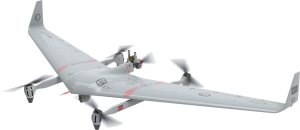
KARGU also now sits inside a family. The ALPAGU is a fixed-wing loitering munition, TOGAN a small reconnaissance multicopter, and KARGUFPV a kamikaze FPV variant, while the TUNGA-X is an interceptor drone designed to shoot down other small UAVs, recently put through field trials described in our piece on TUNGA-X and TOGAN. STM has also shown the longer-range KUZGUN kamikaze drone, which it credits with a range beyond 1,000 km, though that claim is the company’s own.
The market KARGU helped create is no longer STM’s alone. Other Turkish firms now field comparable munitions, among them Baykar’s SİVRİSİNEK, which has been reportedly spotted in Azerbaijani service, and a wider group covered in our guide to who builds Türkiye’s drones besides Baykar. For the company behind it, the broader picture is in the STM company profile.
What to watch is less the airframe than the electronics. Jam-resistant navigation, seekers that home on emitters and swarm software are where the next KARGU will differ from the one flown in 2020, and STM’s first armour-piercing export shows customers are already paying for those changes.