Where Turkish Military Satellite Communication Stands After Türksat 6A

A drone flying a patrol hundreds of kilometres from its ground station, a frigate on a long deployment, an armoured vehicle moving along a road with no fibre or radio relay in sight. All of them depend on the same thing: a satellite link that keeps working when someone is trying to break it. Turkish military satellite communication has moved from an import-dependent capability to a layered, largely domestic one over the past few years, though the picture is uneven. Some pieces are proven and fielded, others are still at the demonstration stage.
What Does Turkish Military Satellite Communication Actually Consist Of?
It helps to split the subject into three parts, because different companies and different programmes own each of them.
- Space segment. The satellites themselves, in this case mainly Türksat 6A and its X-band military payload.
- Terminals. Antennas and modems mounted on vehicles, ships, aircraft and drones, or installed in fixed ground stations.
- Protection. Anti-jam and secure waveforms that keep the link usable when an adversary tries to interfere with it.
Turkish industry now has a named player in each layer. ASELSAN built payloads and a fielded vehicle terminal, TÜBİTAK Uzay and Turkish Aerospace led satellite development, and CTech, a Turkish Aerospace subsidiary, works on terminals and jam-resistant modems.
| Layer | Main Turkish player | Example |
|---|---|---|
| Satellite | TÜBİTAK Uzay, Turkish Aerospace, ASELSAN | Türksat 6A (Ku-band and X-band payloads) |
| Land terminal | ASELSAN | TUMSIS X-band mobile terminal on the Cobra II |
| Airborne, naval and UAV terminals | CTech | Ku-band and Ka-band on-the-move terminals, AquaARX |
| Anti-jam modem | CTech | SecureARX |
Why Did Türksat 6A Matter for the Armed Forces?
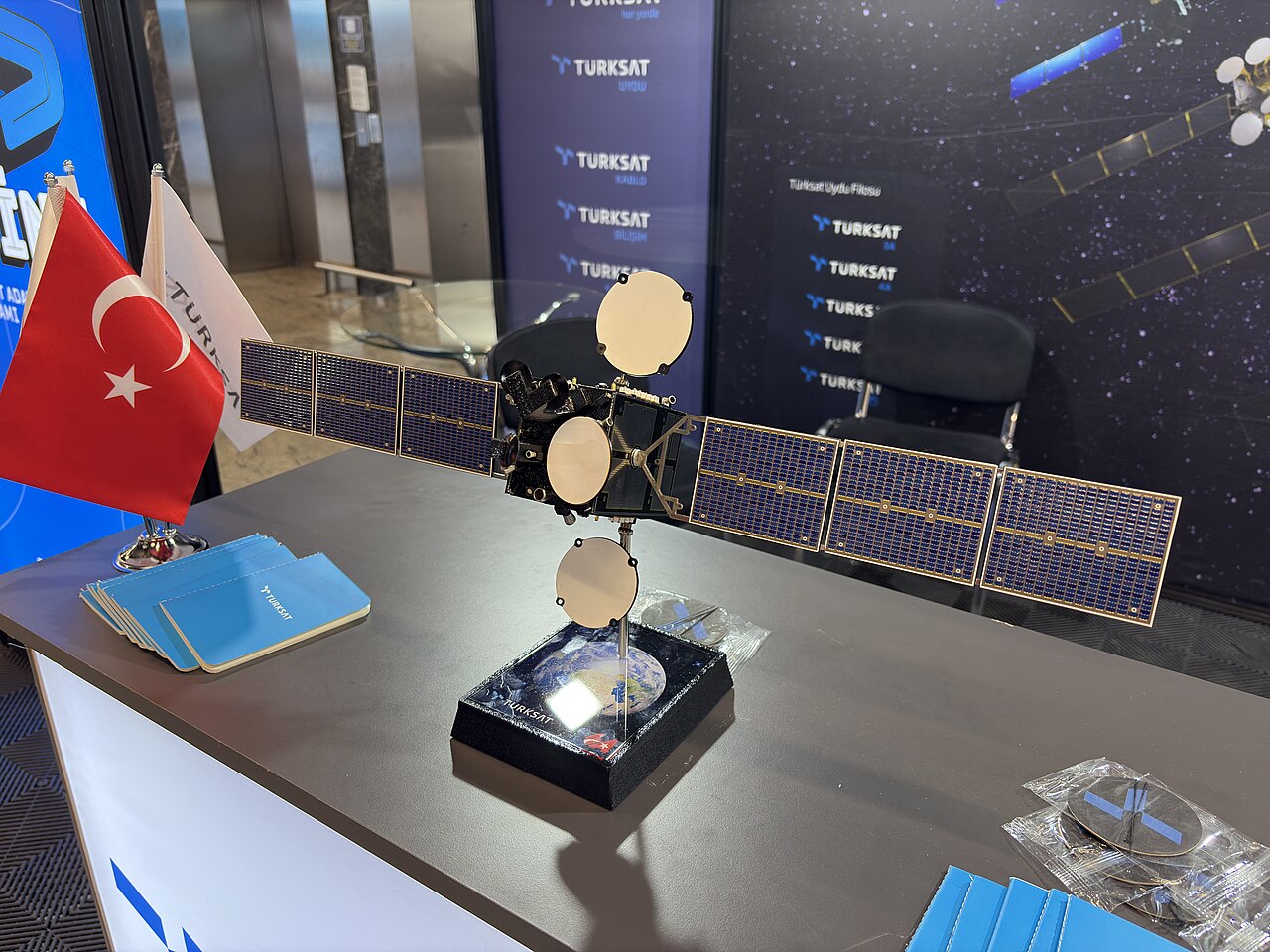
Türksat 6A was launched on 8 July 2024 on a SpaceX Falcon 9 from Cape Canaveral and sits in geostationary orbit at 42 degrees East. Publicly available specifications list 16 active Ku-band transponders plus four spares, and two active X-band transponders plus one spare. The design life is 15 years. It was formally put into service at a ceremony in Ankara in April 2025, after in-orbit testing.
The Ku-band capacity serves commercial broadcasting and broadband. The X-band payload is the part that concerns the military. X-band is a frequency range long favoured for government and military satellite links, and it is less affected by heavy rain than the higher bands that carry consumer broadband. Reporting on the launch said the X-band payload is intended for Turkish Armed Forces use, and open sources describe its coverage as limited to Türkiye, which fits a service meant for national forces rather than for sale to third parties.
Officials put domestic content at about 81 percent of subsystems and software. According to Breaking Defense, ASELSAN supplied both the Ku-band and X-band communication payloads. TÜBİTAK Uzay led the satellite work with Turkish Aerospace, and CTech is credited with contributions. Türksat’s count of active Turkish satellites in orbit rose to nine with this launch, a point covered in the site’s report on the Türksat 6A milestone.
What a satellite in geostationary orbit cannot do is move. It covers a fixed footprint, and any jamming aimed at its uplink or at a terminal’s receiver hits a predictable target. That is where the other two layers come in.
What Is a Satcom-on-the-Move Terminal, and Who Builds Them?
A satellite is useless to a moving platform unless its antenna can keep pointing at it while the vehicle bounces, turns or banks. These are the so-called on-the-move terminals, and they are where Turkish programmes have produced the most visible hardware.
ASELSAN’s TUMSIS is the clearest fielded example. Acceptance activities for the X-band mobile satellite terminal, integrated on the Cobra II armoured vehicle, were completed on 19 November 2021. The antenna automatically points at the selected satellite and supports IP-based voice, data, video and teleconference traffic while the vehicle is moving.
CTech covers a different set of platforms. According to the company’s product material, its broadband terminals include the DEV-KU-18, an 18-inch Ku-band unit, and the DEV-KA-12, a 12-inch Ka-band unit quoted at data rates of up to 40 Mb/s. The same material lists installations or proposals for the ANKA-S and Aksungur UAVs, the ATAK II helicopter, Hürkuş aircraft and Kılıç-class fast attack boats, and notes trials of a 12-inch Ku-band terminal on BMC’s Vuran 4×4 armoured vehicle. Its satellite products are also pitched for Bayraktar TB2 and Karayel UAVs, a reminder that many Turkish unmanned systems rely on beyond-line-of-sight links once they leave radio range. The user base for these drones is now international, which widens the demand for such links.
CTech is headquartered at Teknopark Istanbul in Pendik, with a branch in Ankara. The parent company is covered in the Turkish Aerospace (TUSAŞ) company profile, and ASELSAN’s broader portfolio is in the ASELSAN company profile.
How Do Jam-Resistant Satellite Links Work?
Commercial satellite terminals assume a cooperative environment. Military ones do not. Against a jammer, a receiver can be overwhelmed with noise on the downlink, or the uplink can be swamped so that the satellite cannot hear the legitimate user.
Anti-jam modems generally fight this by spreading or hopping the signal across a wide band, applying strong error correction and encryption, and in some designs steering antenna nulls toward the interference source. The exact waveform of any given Turkish system is not public, and CTech’s published material describes SecureARX only as a secure and jamming-resistant satellite communication system for fixed and mobile land, sea and air use.
What can be verified is the NATO side. CTech announced that the NATO Communications and Information Agency (NCIA) awarded it a contract on 21 October 2024 for the SATCOM Ground Segment Electronic Protective Measure Systems (EPMS), following a competition under the alliance’s satellite transmission services capability package. SecureARX is to be integrated into NATO ground systems as fixed and portable stations and platforms. In June 2026, the company reported that the modem had completed interoperability validation with NATO and allied systems at the CWIX exercise organised by Allied Command Transformation. CTech General Manager Dr. Cüneyd Fırat said the result showed how far its technologies, built to international standards, had come.
The company then took SecureARX and the SkyARX terminal to the MSPO 2026 show in Poland, as covered in the site’s MSPO report.
Can Satcom Hold Together a Swarm?
The newest question is not one terminal but dozens of small platforms. CTech has shown a communications concept for unmanned surface vessel swarms that pairs its AquaARX satellite terminal with the UfukLink Mini Pro line-of-sight radio. One boat carries both, links to a command centre over satellite, and relays orders to the rest of the swarm over the local radio network. The design means only one vessel needs a satellite antenna, which cuts cost and reduces the number of emitters an adversary can detect.
This was presented as a concept, not a fielded system. The hybrid link for Turkish USV swarms is worth a read for the architecture. The pattern is likely to repeat in drones and ground robots: a satellite trunk to the rear, a local mesh in the forward area.
What Is Still Missing From the Picture?
Three gaps stand out, based on what is publicly documented.
First, Türksat 6A is a single geostationary asset. Open sources give no detail on how many military terminals can use its two X-band transponders at once, or how the forces switch to alternative capacity if the satellite is degraded. Second, there is little public information about fielded quantities of jam-resistant terminals inside the Turkish Armed Forces, as opposed to the NATO contract. Third, geostationary links suffer from latency and from the physics of high-latitude and low-elevation use, which is one reason many armed forces are looking at low Earth orbit constellations as a complement. Türkiye has not announced a dedicated military constellation of that kind in the sources reviewed for this article.
Observation satellites such as İMECE are a separate track. They collect imagery rather than carry traffic, though they still need ground links to deliver it, as the site noted in its update on İMECE data flow.
For now, the domestic chain is easy to describe. Payloads from ASELSAN, a satellite developed by TÜBİTAK Uzay with Turkish Aerospace, terminals from ASELSAN and CTech, and a modem that NATO has chosen for ground protection. What remains is scale: more terminals on more platforms, and capacity that does not depend on a single satellite.